
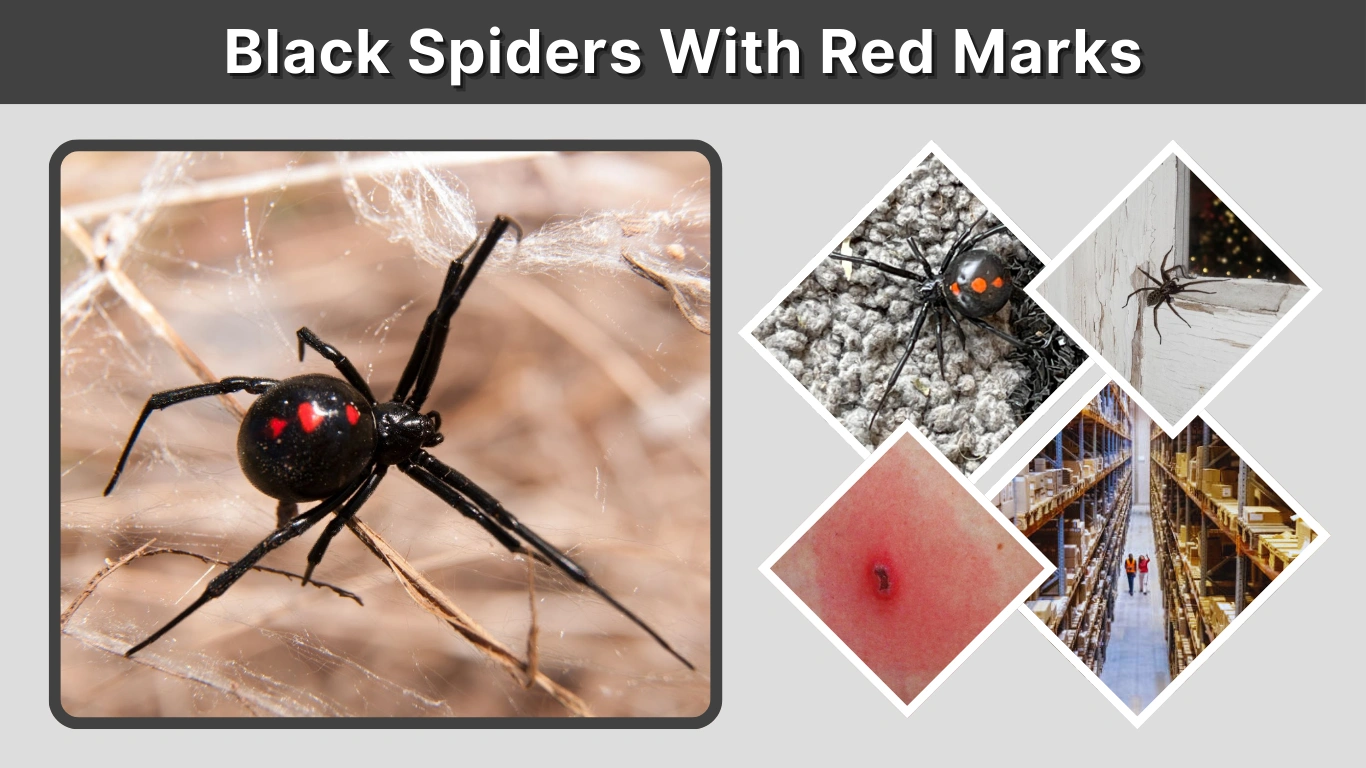
Black spiders with red markings—whether dots, stripes, crosses, diamonds, or heart-shaped patches—are among the most frequently searched spiders in North America. These markings appear on harmless jumping spiders as well as medically significant species like the black widow. Because these spiders appear in many shapes, sizes, and states, identifying them correctly helps you judge risk, understand behavior, and know whether your sighting was dangerous or simply surprising.
Identification
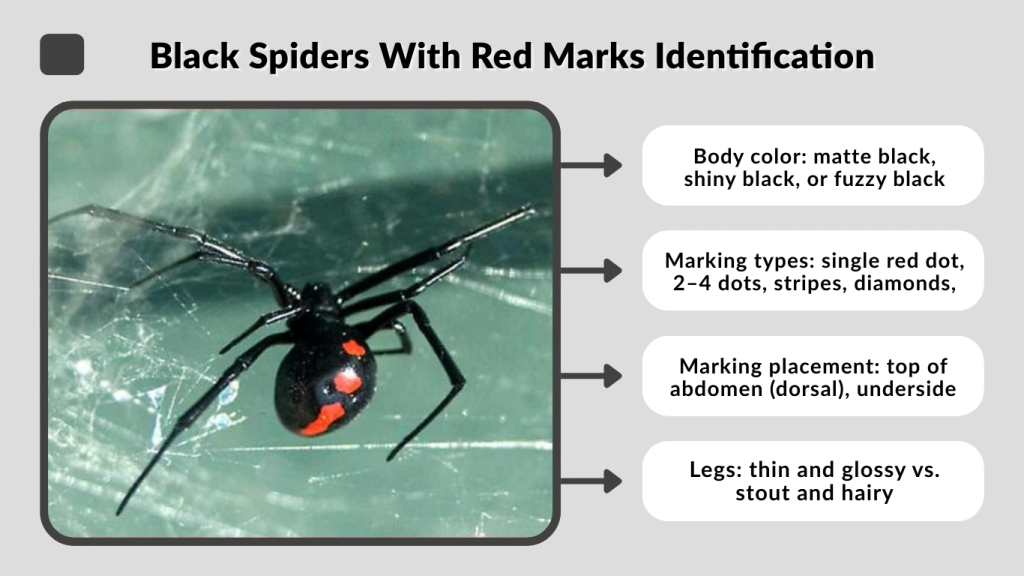
Many common species share the “black spider with red on back” appearance. You can use the features below to narrow identification quickly:
- Body color: matte black, shiny black, or fuzzy black
- Marking types: single red dot, 2–4 dots, stripes, diamonds, triangles, crosses, hourglass shapes, or irregular blotches
- Marking placement: top of abdomen (dorsal), underside (ventral), or both
- Body type: round widow-like abdomen, compact fuzzy jumping spider shape, slender ground-spider profile
- Legs: thin and glossy vs. stout and hairy
- Behavior: jumping, fast-running, web-building, hanging upside-down, hiding in crevices
- Web type: chaotic tangle webs, sheet webs, orb webs, or no web at all
- Location: indoors (corners, windows, garages), outdoors (woodpiles, sheds, stone walls, patio furniture)
- Region: certain states have distinctive species more likely than others
These quick identifiers help you determine whether you’re looking at a widow, jumper, or a harmless garden species.
Common Species Of Black Spider With Red On Back”
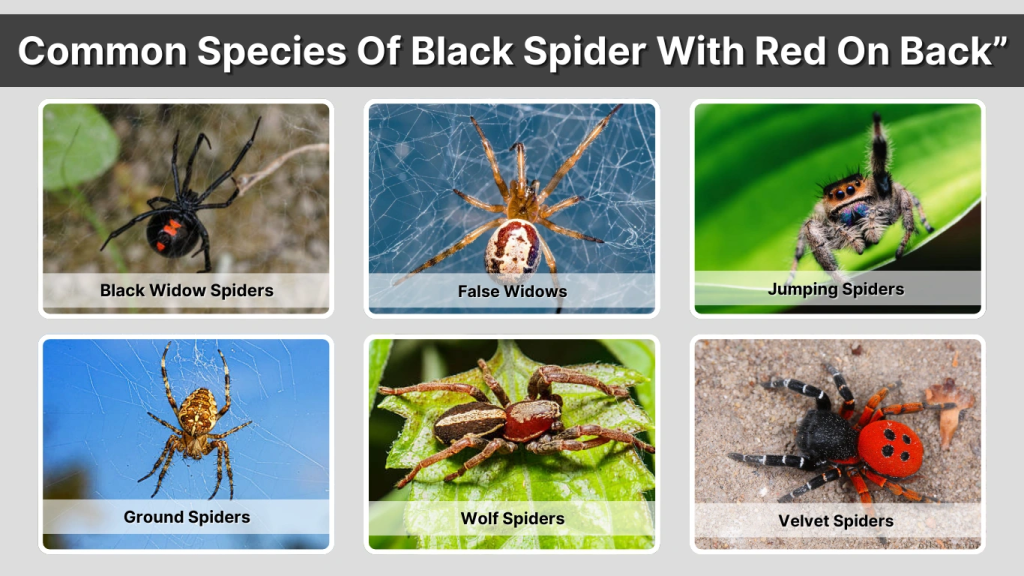
Black Widow Spiders (Latrodectus spp.)
The most famous—and medically significant—spider described as a black spider with red markings is the black widow. Although many people imagine a bright red hourglass on the underside of the abdomen, widows—especially juveniles—can have red dots, red stripes, or patchy red markings on the top of their abdomen as well. This is why many sightings of “black spider with red dots on back” turn out to be early-stage widows.
Widows have a smooth, shiny, globe-shaped abdomen, long thin legs, and typically hang upside down in tangled, sticky webs. They are widely distributed across the United States, including Texas, Florida, California, North Carolina, Arkansas, Oklahoma, Missouri, and Michigan. Outdoors, they live in woodpiles, foundation cracks, patio furniture, barns, and sheds. Indoors, they hide in corners, garages, basements, and storage areas.
Widow bites are uncommon, but when they occur they can cause muscle pain, cramping, nausea, sweating, and elevated heart rate. Prompt medical evaluation is recommended. Their distinctive shine and spherical abdomen make them easier to identify compared to fuzzy or matte spiders.
False Widows (Steatoda spp.)
Often confused with black widows, false widows can also match descriptions like “black spider with red spot,” “black with red and white markings,” or “black spider with red lines on back.” These spiders typically have a dark brown to black abdomen with subtle reddish, purplish, or red-orange patterns.
Key differences include:
- Less shiny than true widows
- Smaller, more oval abdomen
- Typically mild bites that cause only local irritation
- Webs similar to widows but often closer to ground level or low corners
False widows live indoors and outdoors across the U.S. and are common in regions such as California, Florida, Texas, and the Carolinas. Many sightings described as “not black widow” are misidentified false widows.
Jumping Spiders (Phidippus Species)
Most queries referencing “fuzzy,” “hairy,” “black fuzzy spider,” “jumping spider with red dot,” or “bold jumper with a red spot on back” point toward jumping spiders, especially Phidippus species.
Common features include:
- Fuzzy, stout bodies
- Large forward-facing eyes
- Fast, jerky movements and impressive jumping ability
- Harmless temperament
The Bold Jumping Spider (Phidippus audax) often has red or orange spots, especially in juveniles, before these turn white in adults. Other species may show red bands, red triangles, or even red patches that could be mistaken for more dangerous spiders. Unlike widows, jumpers do not build messy webs; they roam to hunt prey and create small silk sleeping sacs.
Because of their size, behavior, and fuzzy appearance, they are often a match for small, red-spotted spiders seen indoors or on outdoor walls.
Ground Spiders, Wolf Spiders, and Relatives
Some black or dark brown ground-dwelling spiders have reddish stripes or small red patches on their abdomen or carapace. These species may appear in gardens, leaf litter, garages, and under stones.
These spiders:
- Do not build aerial webs
- Are active hunters
- Are harmless to humans
- Sometimes appear shiny but not glossy like widows
Sightings of “black spider with a red line on back” or “with two red stripes” often align with these species, especially when the spider is fast-moving or seen on the ground rather than suspended in a web.
Velvet Spiders & Ant-Mimic Spiders
Rare in most U.S. states but still possible, these species can match descriptions like “tiny black spider with red dot,” especially when the spider is extremely small. Velvet spiders are furry and compact, while ant-mimics are slender with long legs and often appear smooth.
Though visually striking, they are harmless.
Range & Locations (State-by-State Guide)
Spiders with red markings occur across the United States, but different regions have different likely species. Knowing your state helps narrow the possibilities.
Texas
Texas has high overlap of all major types: black widows (very common), false widows, wolf spiders with red stripes, and numerous jumping spiders. Most “black spider with red dot in Texas” searches refer to widows or juvenile jumpers.
Florida
Black widows, red widow species, jumping spiders, and ant-mimic spiders occur statewide. Dorsal red markings are especially common on juveniles.
California
Western black widows dominate urban and coastal regions. Jumpers with red spots are also frequent in dry inland areas. Many “not black widow” sightings turn out to be false widows.
Michigan & Northern States
False widows and jumping spiders are more common than true widows, although widows occur in southern Michigan structures. Small fuzzy spiders with red dots here are almost always jumpers.
Colorado & High-Elevation States
Jumping spiders, ground spiders, and orb-weavers with red bands are most common. Widows are present but less frequently encountered outdoors.
North Carolina, Oklahoma, Arkansas, Missouri
These warm states host stable black widow populations. Many regional sightings describing single red dots, multiple dots, stripes, or patches match juvenile widows or false widows.
Geographic range plays a crucial role: while many species share black bodies and red markings, each state has its typical suspects.
Habitat & Behavior
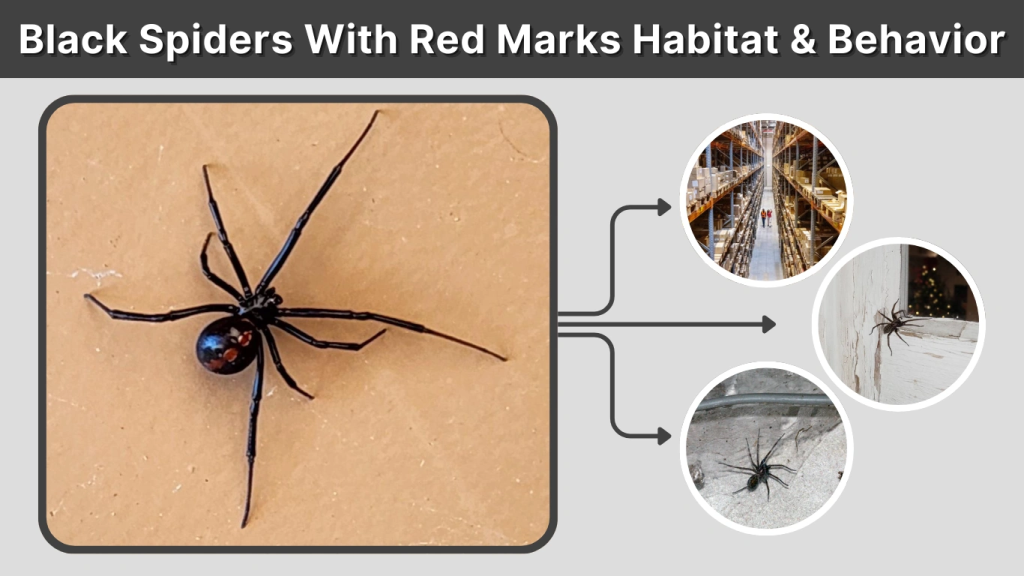
Understanding habitat and behavior helps refine identification further.
Indoors:
- Corners of ceilings and floors
- Garage tool shelves
- Behind toilets, appliances, and storage containers
- Window frames and closets
Indoor sightings that involve messy tangle webs strongly suggest widow or false widow species.
Outdoors:
- Woodpiles, stones, mulch, and brick foundations
- Patio furniture and grills
- Fences, sheds, mailboxes, and outdoor lights
- Garden plants, walls, and railings
Outdoor sightings in open areas or plants typically indicate jumping spiders or orb-weavers.
Behavior:
- Jumpers move in bursts, look around frequently, and leap between surfaces.
- Widows remain still, hanging upside down within a web.
- False widows hide in crevices but may venture short distances.
- Ground spiders sprint across flat surfaces, often in garages or patios.
Behavior is one of the strongest day-to-day clues for separating harmless jumpers from medically important widows.
Venom & Danger
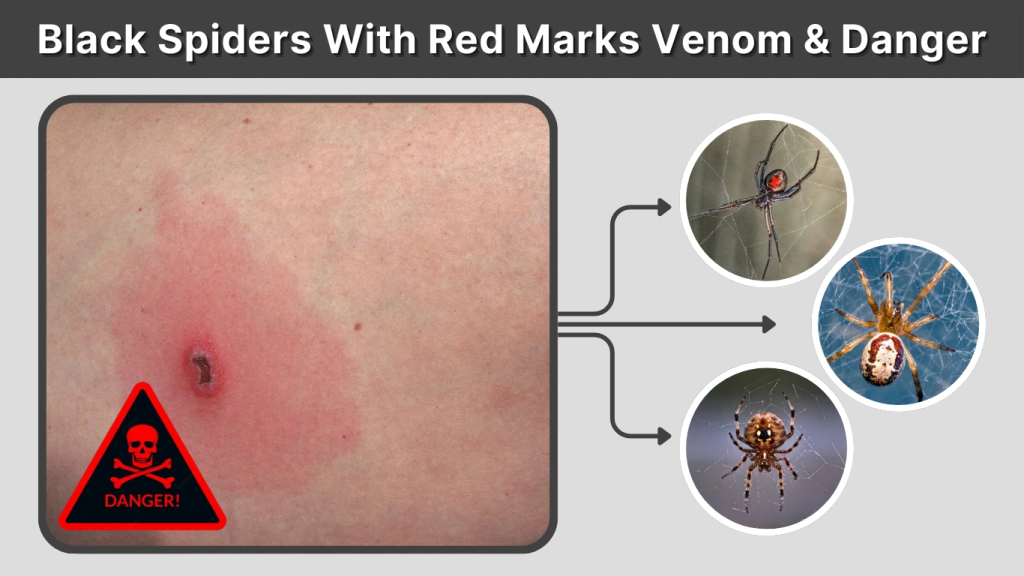
Not all red-marked spiders are dangerous, but a few require caution.
Black Widows:
- Potent neurotoxic venom
- Symptoms: severe muscle pain, cramping, sweating, nausea, increased heart rate
- Medical care recommended for children, elderly adults, and those experiencing strong symptoms
False Widows:
- Mild venom
- Local redness and swelling
- Not medically significant for most people
Jumping Spiders, Orb-Weavers, Ground Spiders:
- Harmless
- Bites extremely rare and very mild
The presence of red markings alone does not indicate danger. Body shape, behavior, and web type help determine threat level far more accurately.
Not a Black Widow?
Many people specifically search for “black spider with red on back not black widow.” This happens because juvenile widows often have dorsal red markings, leading to confusion. Key differences:
- Widows: red hourglass on underside; shiny black sphere-like abdomen
- False widows: oval abdomen; subtle red/white patterns; mild venom
- Jumpers: fuzzy, compact body; visible big eyes; no widow-style web
- Orb-weavers: patterned abdomen, often with red but also white or yellow
If the spider is fuzzy, active during the day, or jumping—it’s not a widow.
VS Comparison Tables
Black Widow vs. Red-Backed Jumping Spider
| Feature | Black Widow | Jumping Spider |
| Body Type | Shiny, round abdomen | Fuzzy, compact body |
| Markings | Hourglass or red dots | Red spots, stripes |
| Behavior | Hangs in messy webs | Jumps, hunts actively |
| Danger | Medically significant | Harmless |
Red Marking Types Table
| Red Mark Type | Likely Species |
| One red dot | Juvenile widow, jumping spider |
| Two red dots | Widow juvenile, orb-weaver |
| Three–four dots | Widow juvenile, patterned garden spider |
| Red stripe | Ground spider, jumper, widow juvenile |
| Red cross | Orb-weaver pattern |
| Red diamond | Orb-weaver or widow juvenile |
| Red triangle | Widow juvenile, jumper pattern |
| Red heart | Orb-weaver or patterned jumper |
| Red line(s) | Ground spider, false widow |
These variations cover nearly all known “black with red” spider appearances.
FAQs
What is the black spider with a single red dot on its back?
A single red dot usually indicates a juvenile black widow or a jumping spider. Juvenile widows often display dorsal red spots before developing the classic underside hourglass. Jumping spiders, especially Phidippus species, also show bright red patches but are harmless and fuzzy, making body texture a key difference.
Are black spiders with red stripes dangerous?
Not usually. Red stripes on the top of the abdomen commonly belong to jumping spiders, ground spiders, or orb-weavers, all of which are harmless. Black widows rarely have a true dorsal “stripe,” and when they do, it’s typically on juveniles, which still pose some risk if handled.
How do I tell if it’s a black widow or a jumper?
Look for behavior and texture. Widows have smooth, shiny, round abdomens and stay inside messy webs. Jumpers are fuzzy, active, and leap across surfaces. Jumpers also have large front-facing eyes and move during the day, unlike widows, which hide or wait in webs.
Why do some black widows have dots instead of hourglasses?
Juvenile widows possess dorsal red spots, stripes, or patterns as a natural developmental stage. The iconic red hourglass appears on the underside later in life. Because juveniles look so different from adults, many people mistake them for other species or assume they’re harmless.
What should I do if I find one inside my house?
If it’s clearly a jumping spider or harmless orb-weaver, gently relocate it outdoors. If it resembles a widow—shiny black, small messy web, red markings—avoid handling and use a container to remove it. For high-risk areas like garages or sheds, reducing clutter and sealing cracks can prevent re-entry.