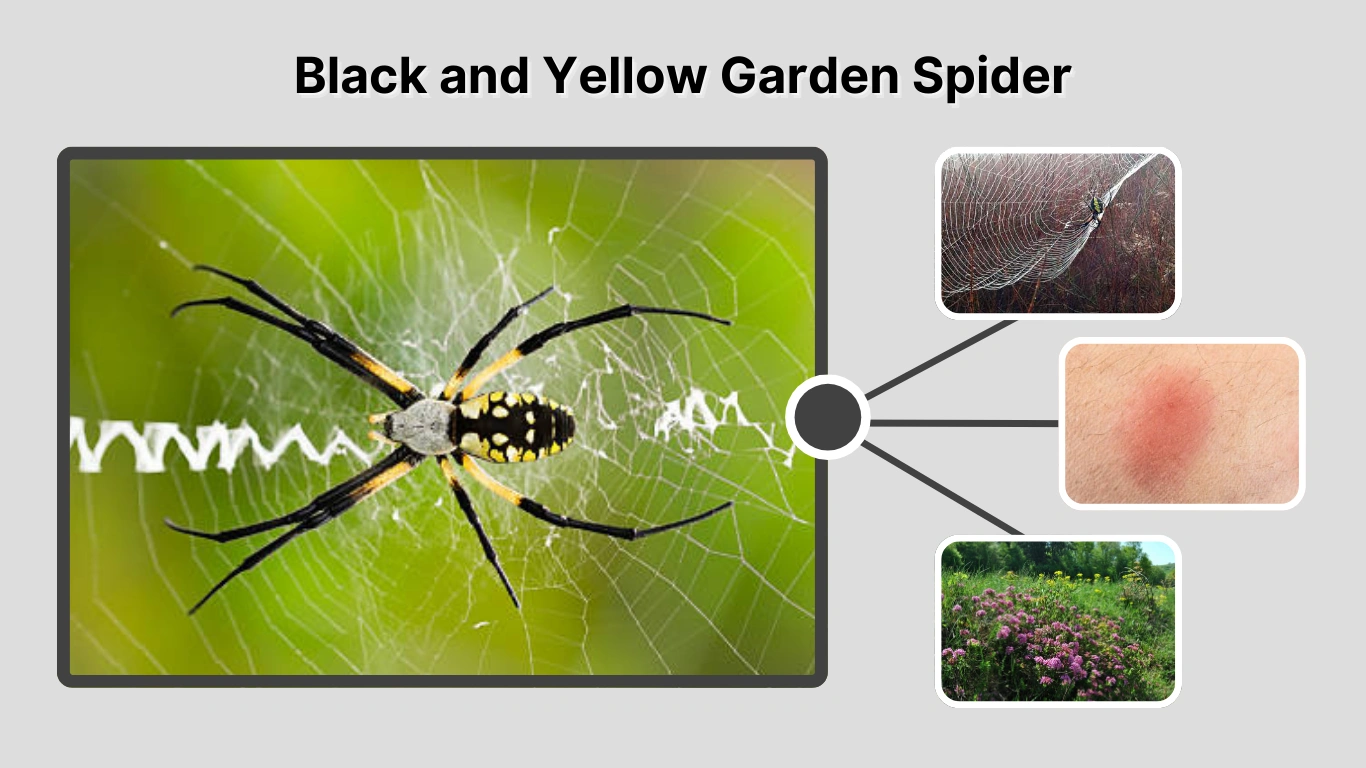
The black and yellow garden spider (Argiope aurantia) is one of the most eye-catching orb-weavers found across North America. Its bold coloration, large web, and distinctive zigzag stabilimentum make it a familiar sight in gardens, fields, and sunny edges of forests. Despite its dramatic appearance, this species is mostly harmless and provides valuable pest-control benefits. This article explores its identification traits, size, venom, behavior, habitat, range, diet, and male–female differences.
Identification
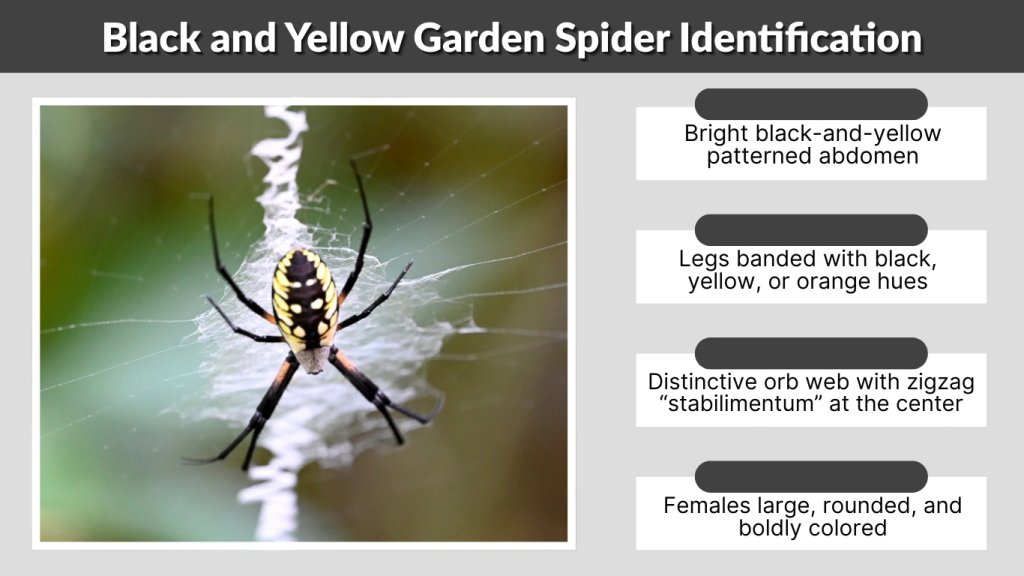
- Bright black-and-yellow patterned abdomen with symmetrical markings
- Legs banded with black, yellow, or orange hues
- Distinctive orb web with zigzag “stabilimentum” at the center
- Females large, rounded, and boldly colored
- Males much smaller, thinner, and duller
- Egg sacs are papery, brownish, and shaped like teardrops
- Juveniles have lighter markings and smaller webs
Size
The black and yellow garden spider is notable for its impressive size. Adult females, the ones most commonly seen in gardens, reach 0.75–1.1 inches in body length, with a leg span up to 3 inches. Their long, banded legs and large webs often make them appear even bigger, giving rise to descriptions such as “huge” or “giant.”
Males are dramatically smaller, typically only 0.20–0.35 inches long, and often go unnoticed because they hide at the edges of the female’s web. Seasonal factors also influence size—spiders encountered in late summer and early fall are generally the largest.
Venom, Bite & Danger Level
Many people ask whether the black and yellow garden spider is poisonous or dangerous. The short answer: they are venomous (like all spiders) but not medically dangerous to humans.
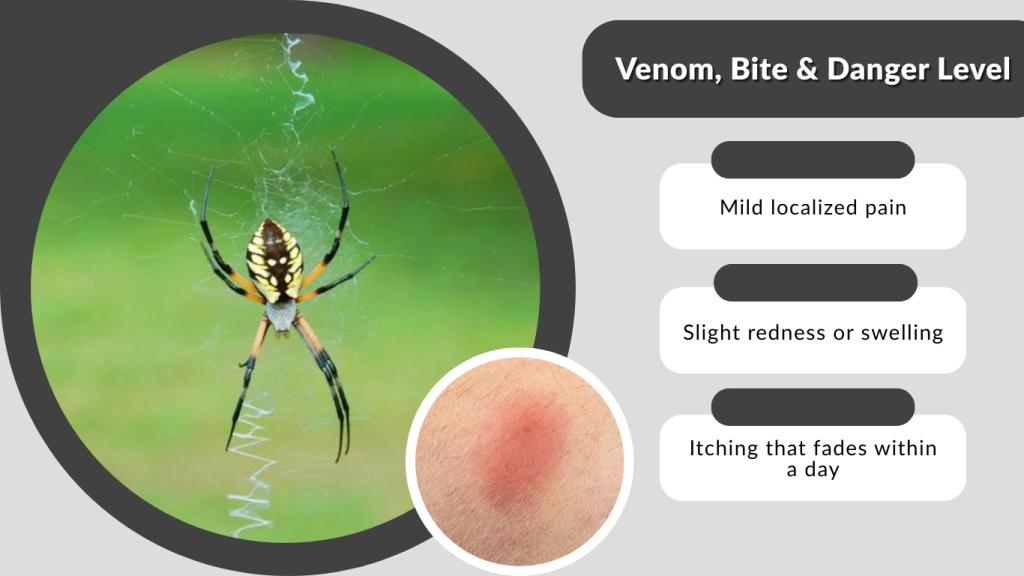
Their venom is designed to subdue insect prey, not mammals. A defensive bite is rare and typically only occurs if the spider is grabbed or pressed against skin. When it does happen, symptoms are usually:
- Mild localized pain
- Slight redness or swelling
- Itching that fades within a day
Most bites are compared to a bee sting or even milder. These spiders are not poisonous to dogs, though a bite on a sensitive area may cause minor irritation. Severe allergic reactions are extremely uncommon.
Behavior
Black and yellow garden spiders are diurnal hunters and rely heavily on their large orb webs to catch insects. Their web is rebuilt or repaired daily, especially after storms. The zigzag stabilimentum in the center, one of the spider’s trademarks, reflects UV light and helps attract prey.
They are generally shy and retreat when approached. When threatened, they may vibrate rapidly in place—a behavior called “web bouncing”—to confuse predators.
Males lead a more cautious life, often constructing tiny webs near a female’s larger web. When ready to mate, they approach carefully to avoid being mistaken for prey. Females may lay several egg sacs late in the season, which they guard from vibrations and disturbances.
Habitat
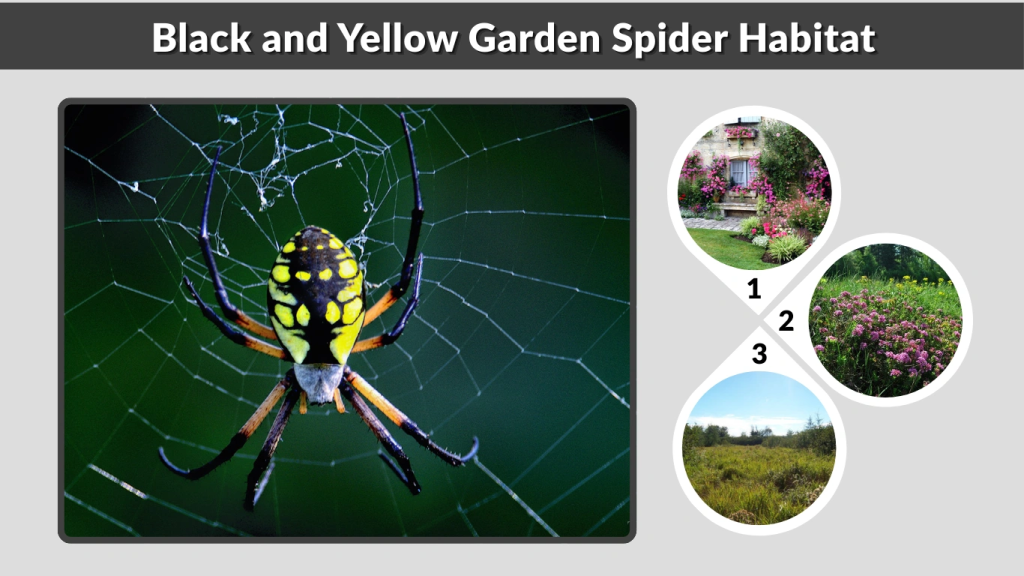
This species favors sunny, open locations where flying insects are abundant. Common habitats include:
- Home gardens
- Shrubby edges
- Meadows and tall grass
- Cornfields and agricultural plots
- Building eaves, fences, and outdoor structures
They anchor their webs between sturdy supports, often between tall plants or man-made objects. Their visibility in gardens makes them a familiar seasonal visitor, especially from midsummer to early fall.
Range
The black and yellow garden spider is widespread across the United States, with strong populations in states such as:
- Texas
- Ohio
- Minnesota
- Wisconsin
It is also found throughout southern Canada, including Ontario. Occasional reports from the UK or South Africa usually involve misidentification or accidental introduction rather than established populations. They are sometimes confused with banana spiders or joro spiders, which have different ranges and body shapes.
Diet
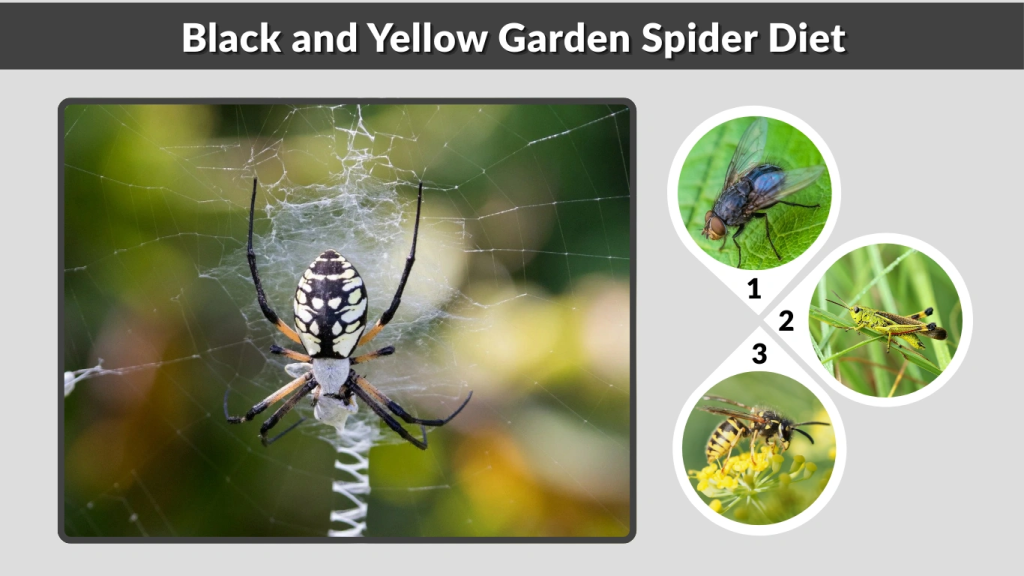
Black and yellow garden spiders are efficient predators that help control insect populations. Their diet includes:
- Flies
- Grasshoppers
- Bees and wasps
- Mosquitoes
- Moths and butterflies
They detect prey through web vibrations and rapidly immobilize it with silk before feeding. Their role in gardens is overwhelmingly beneficial, reducing pests and balancing local ecosystems.
Egg Sac & Reproduction
Female black and yellow garden spiders create one to four papery, brown egg sacs during late summer or early fall. Each sac may contain 300–1,000 eggs, protected within several silk layers. The female typically suspends these sacs off to the side of her web, often attached to tall grasses, shrubs, or garden structures.
Inside the sac, the spiderlings overwinter safely through cold months. In early spring, the juveniles emerge, dispersing by ballooning, where tiny spiders ride the wind on silken strands. Females become visibly “pregnant” (swollen abdomen) during the egg-laying season.
Male vs Female
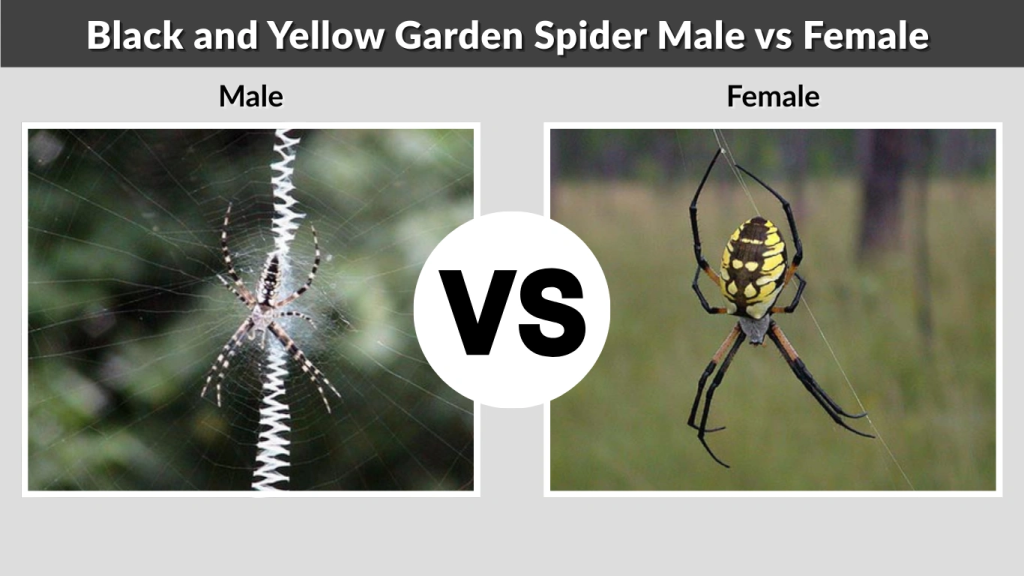
| Feature | Female Black & Yellow Garden Spider | Male Black & Yellow Garden Spider |
| Size | 0.75–1.1 inches | 0.20–0.35 inches |
| Coloration | Bright black & yellow | Duller brownish or faint yellow |
| Web presence | Builds full orb web | Builds tiny web near female’s |
| Aggression/behavior | Defensive but calm | Avoids confrontation |
| Lifespan | Full season | Short lifespan after mating |
| Visibility | Commonly seen | Rarely noticed |
Lifespan
Most black and yellow garden spiders live one warm season. Eggs hatch in fall, spiderlings overwinter, and growth continues the following spring. Adults become most visible in late summer, when females reach full size for mating and egg production.
Males live only briefly after mating. Females may survive into early winter but typically die after the first hard frost. Egg sacs, however, endure the cold and ensure the next generation survives.
Web
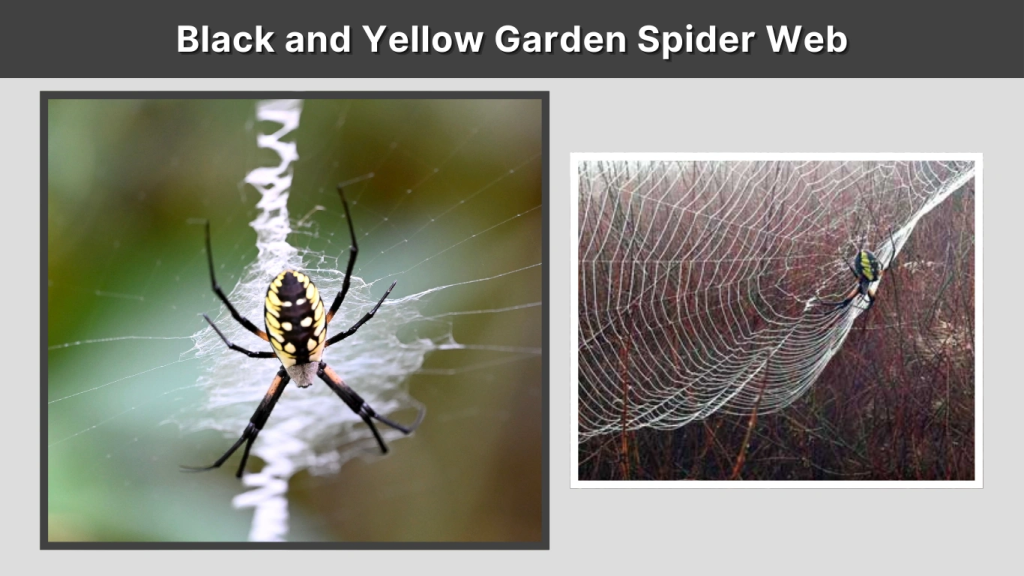
Their orb webs are large, intricate structures spanning up to 2 feet wide. The centerpiece is the iconic zigzag stabilimentum, thought to attract prey, strengthen the web, or camouflage the spider. Each morning, the web may be repaired or completely rebuilt.
Unlike banana spiders (golden silk orb-weavers) with gold-tinted webs, the black and yellow garden spider’s silk is bright white. Compared to the Joro spider, its web is smaller and closer to the ground.
Regional Variations
Texas
Populations in Texas grow especially large due to long warm seasons. Webs often appear on ranch fences, gardens, and sheds.
Ohio, Minnesota, Wisconsin
Midwestern individuals appear from midsummer to the first frost, often creating webs in tall grasses and between garden rows.
Ontario
Canadian populations are slightly smaller on average and appear later in the year due to cooler spring temperatures.
UK & South Africa
Sightings are usually imported individuals, not established colonies. They are often confused with local orb-weaving species.
Comparison Table:
Black and Yellow Garden Spider vs Banana Spider
| Topic | Black & Yellow Garden Spider | Banana Spider (Golden Orb-Weaver) |
| Size | Smaller | Much larger |
| Web | White with stabilimentum | Large gold-tinted webs |
| Venom | Mild | Mild |
| Range | North America | Tropical/subtropical worldwide |
Facts
- They help control agricultural pests, reducing insect populations naturally.
- The stabilimentum may deter birds from flying through the web.
- Females can consume and rebuild their webs daily.
- Their silk is extremely strong relative to size.
- They prefer warm, sunny areas with stable anchor points.
FAQs
Are black and yellow garden spiders poisonous?
Black and yellow garden spiders are not poisonous to humans or pets. They are technically venomous, like all spiders, but their venom is extremely mild and meant only for subduing insects. A bite is unlikely and rarely causes more than brief redness, slight swelling, or mild irritation.
Are black and yellow garden spiders dangerous to humans?
No, they pose almost no danger to humans. These spiders are shy and prefer escaping rather than biting. Even when handled roughly, their bite is harmless and comparable to a light bee sting. They don’t chase, attack, or display aggressive behavior, making them safe garden companions.
Do black and yellow garden spiders bite people?
They can bite, but only when accidentally pressed or grabbed. Bites are uncommon because the spider usually tries to flee or vibrate its web to scare off predators. If a bite occurs, symptoms remain mild and short-lived, with minor pain or redness that fades quickly without medical treatment.
Are black and yellow garden spiders harmful to dogs?
These spiders are not harmful to dogs. Their venom is too weak to cause significant effects beyond temporary irritation at the bite site. Dogs are unlikely to be bitten unless they stick their nose directly into the web. Even then, symptoms are minor and resolve naturally without veterinary care.
How big does a black and yellow garden spider get?
Females grow quite large, reaching up to about one inch in body length with a leg span of nearly three inches. Their bright patterns and long legs often make them appear enormous. Males are much smaller and slender, usually unnoticed. Seasonal growth peaks in late summer and early fall.