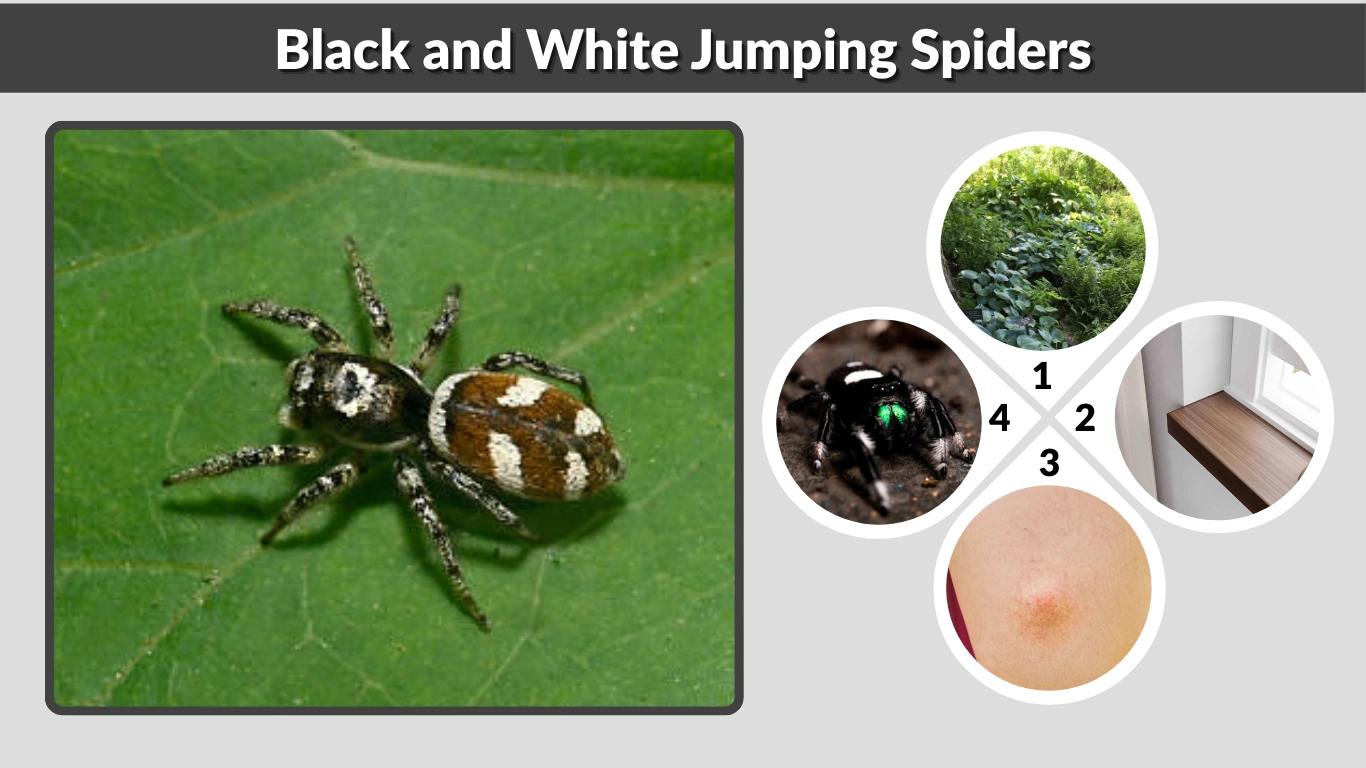
Black and white jumping spiders are among the most visually striking members of the spider world. Recognized for their bold stripes, spots, fuzzy bodies, and sometimes metallic green or blue fangs, these spiders appear across North America, Europe, Australia, and other regions. They’re common in homes, gardens, and forests and are known not only for their beauty but also for their intelligence and harmless nature. This guide covers species identification, regional sightings, venom safety, behavior, and essential tips for recognizing them indoors and outdoors.
Overview of Black and White Jumping Spiders
Black and white jumping spiders belong mainly to the Salticidae family, known for superior vision and dynamic leaping abilities. These spiders feature a high-contrast pattern that makes them easy to spot, whether they are striped, polka-dotted, or boldly banded. Many belong to the genera Phidippus, Salticus, or Pelegrina, each containing species with unique markings and behavior styles.
Despite their intimidating appearance and bright metallic fangs, black and white jumping spiders are not dangerous to humans. Their venom is designed for small insects and poses little medical risk. These spiders are curious, often watching humans closely, but rarely bite unless trapped or threatened.
Species Identification
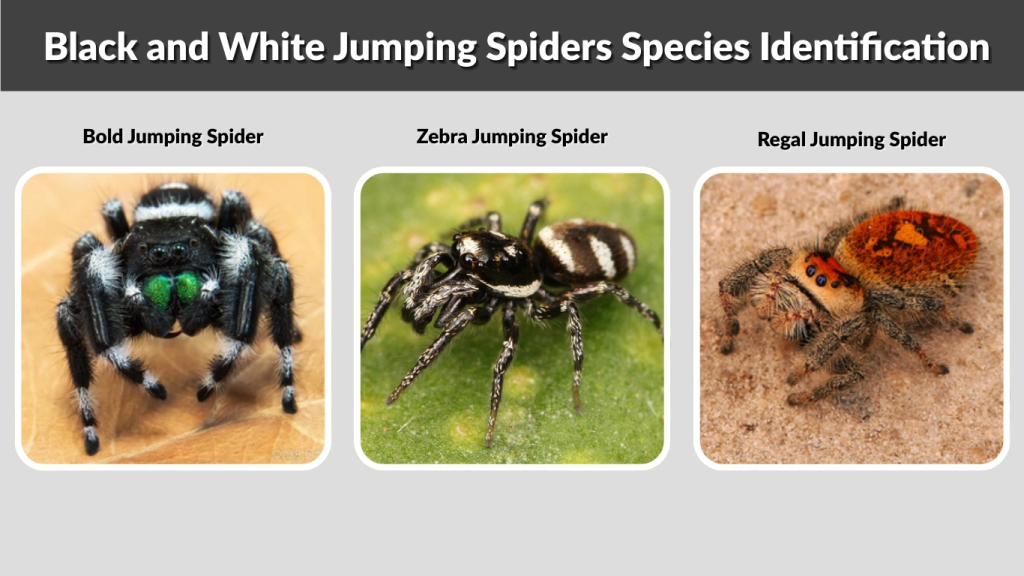
Identifying black and white jumping spiders involves observing color patterns, body size, fang color, and regional distribution. Many species share similar markings, making it essential to understand their distinctions.
Daring/Bold Jumping Spider (Phidippus audax)
One of the most widespread species, the daring or bold jumping spider, is famous for its shiny black body with white or orange spots and metallic green or blue chelicerae. You might encounter this species in many parts of the U.S.—Texas, Colorado, Oklahoma, Ohio, Oregon, Pennsylvania, Virginia, Washington, Wisconsin, Michigan, Minnesota, Missouri, Indiana, Idaho, Utah, Maine, Maryland, Massachusetts, Louisiana, Arizona, and more. It’s equally common indoors and outdoors and is one of the easiest spiders to recognize.
Zebra Jumping Spider (Salticus scenicus)
The zebra jumping spider sports bold white stripes across its black body, giving it its zebra-like name. This species is widespread across the UK, Europe, Colorado, Ontario, Alberta, and other cooler regions. Small, fast, and precise in movement, zebra jumpers frequently appear on walls and window frames.
Regal Jumping Spider (Phidippus regius)
Known for its elegant markings, the regal jumping spider is especially common in Florida and southern states. Females typically show black bodies with contrasting white patterns, while males are often darker. Their striking green or blue metallic fangs make them stand out, and they are among the largest jumping spiders in North America.
Other Variants and Regional Types
Many less common black and white jumpers appear worldwide. Australia hosts several Salticidae species with bold monochrome coloring. South Africa offers unique spotted and striped variations. Costa Rica features tropical black-and-white jumpers of various sizes. You may also encounter spiders with gold-white-black patterns, red-white-black markings, or even unique “tiny butt spots,” which sometimes appear in juvenile Phidippus species.
Key Physical Features
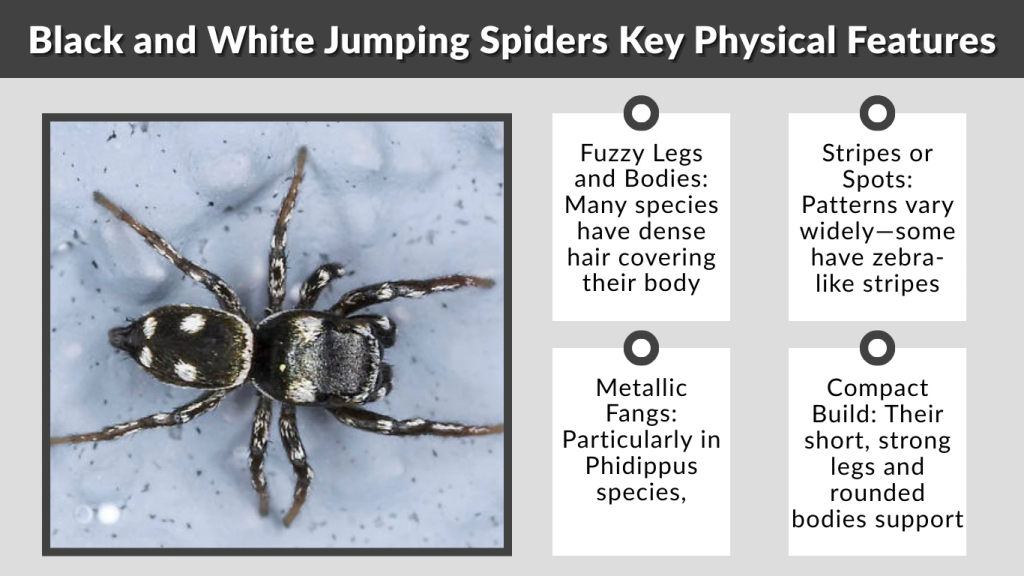
Black and white jumping spiders share several recognizable traits:
- Fuzzy Legs and Bodies: Many species have dense hair covering their body, aiding balance and sensory perception.
- Stripes or Spots: Patterns vary widely—some have zebra-like stripes, others polka dots, and some simple white patches.
- Metallic Fangs: Particularly in Phidippus species, chelicerae may shine green, blue, or even iridescent metallic shades.
- Compact Build: Their short, strong legs and rounded bodies support agile jumping and accurate landing.
The combination of these features makes them easy to identify, even from a distance.
Behavior and Adaptations
Black and white jumping spiders are known for their exceptional vision, curious nature, and impressive jumping mechanics. They rely on hydraulic pressure in their legs to leap many times their body length—sometimes up to six times farther. Unlike web-building spiders, they actively stalk prey using their front-facing eyes, which provide near-stereoscopic depth perception.
Their coloration serves purposes in camouflage, courtship, and predator deterrence. Many species raise their front legs or display their metallic fangs when threatened, creating a striking visual warning.
Habitat and Regions
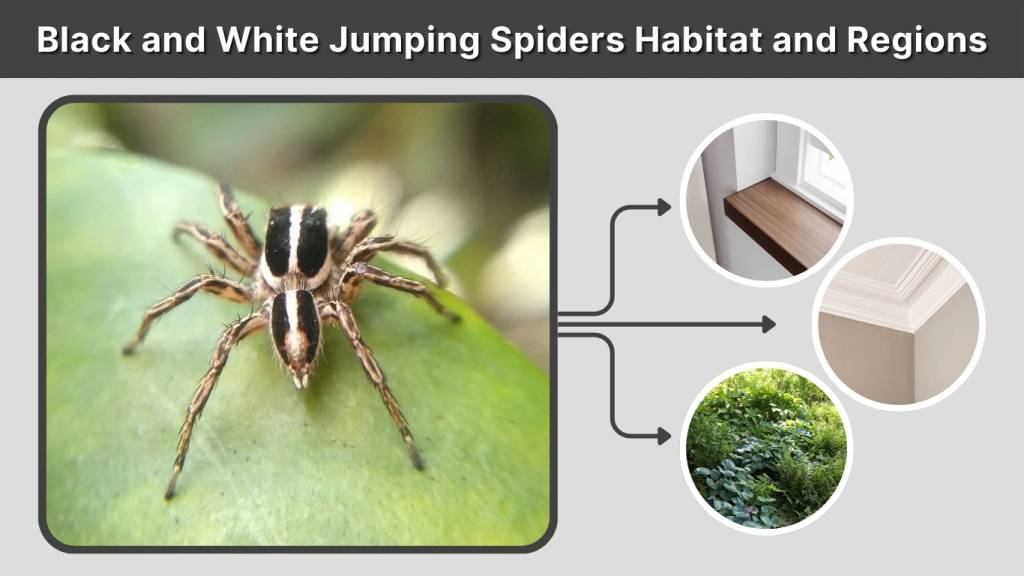
Black and white jumping spiders thrive in many environments, from human homes to wild landscapes. Their adaptability allows them to survive in cities, forests, deserts, and humid coastal areas. Their large eyes give them excellent vision in both bright and dim settings, making them successful hunters almost anywhere.
Indoor Sightings
These spiders often enter homes accidentally while hunting for insects. You may find them:
- On window sills
- Near ceiling corners
- Around plants
- On light-colored walls
Indoors, they pose no threat and rarely stay long unless they find a steady food source such as gnats or flies. Their presence usually indicates a healthy pest-control ally rather than an infestation.
Outdoor Habitats
Outdoors, black and white jumping spiders dwell in:
- Gardens
- Rock faces
- Wooden fences
- Tall grass
- Forest edges
They prefer sunlit areas where insects gather. Their contrasting markings help them blend into natural textures such as tree bark, stone, and leaf litter.
Venom, Bites & Safety
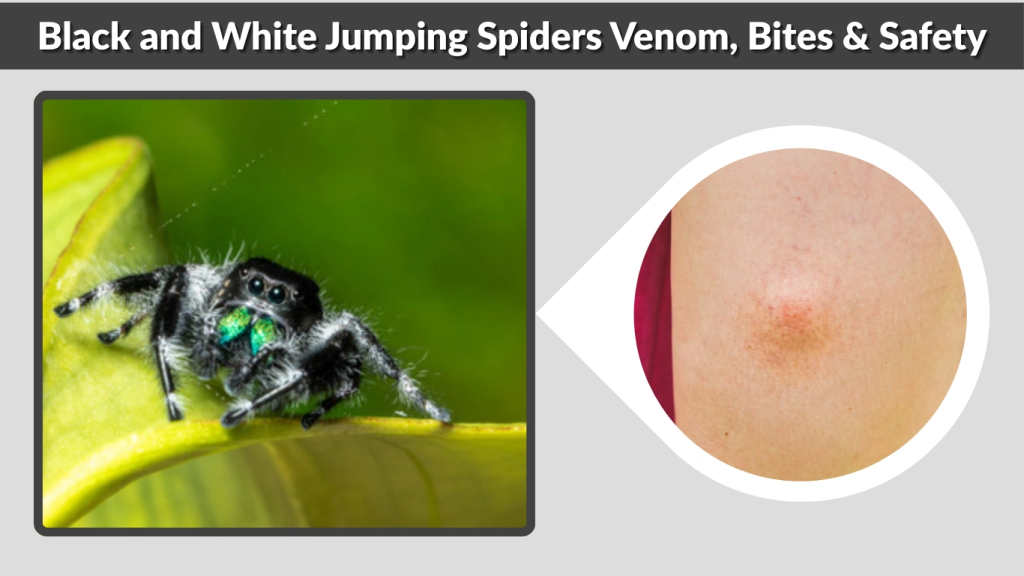
Are Black and White Jumping Spiders Poisonous?
A common question is whether these spiders are poisonous. The answer: No, not to humans. While all jumping spiders possess venom to subdue insect prey, theirs is not medically significant to people. They do not have the ability or inclination to harm humans, dogs, or cats.
Bite Symptoms
Bites happen rarely and typically only if the spider is pressed against skin. Reactions are mild and may include:
- Small red bump
- Mild itchiness
- Slight swelling
- Quick healing within a day or two
Serious reactions are extremely rare and usually tied to allergies.
Why They Are Considered Harmless
Jumping spiders are non-aggressive and shy. Their instincts push them to flee rather than bite. Their venom lacks the potency of medically important spiders like black widows or brown recluses.
Male vs. Female Differences
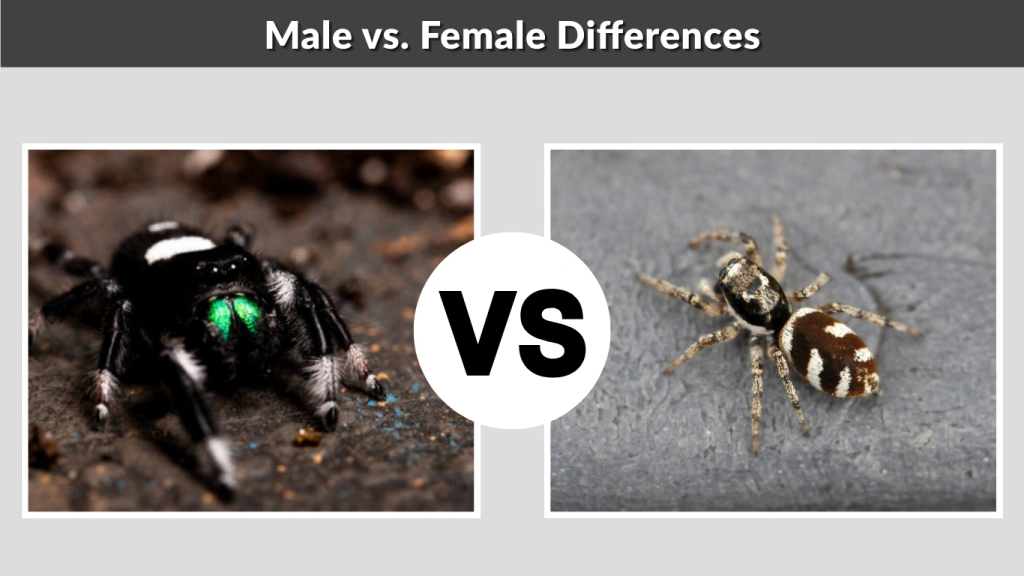
Sexual dimorphism is noticeable in several black-and-white species.
- Males often have brighter green or blue metallic fangs, slimmer bodies, and more vivid contrast in patterns.
- Females are usually larger, with softer or more blended markings, especially in bold and regal jumpers.
- Behavioral differences appear during courtship, where males perform dances, leg waves, or fang displays.
These distinctions help identify spider gender easily once you know what to look for.
Pictures & Identification Tips
When trying to identify a black and white jumping spider, consider the following:
- Look at the pattern – stripes suggest zebra jumpers; spots suggest bold or regal types.
- Observe the fang color – metallic green or blue often indicates Phidippus species.
- Check body size – some types are tiny (3–5 mm), while bold and regal jumpers can be large (up to 20 mm).
- Examine body hair – fuzzy legs and bodies are common in bold and regal species.
If available, photographs can help compare markings precisely.
How to Get Rid of Them (If Needed)
Although harmless, some homeowners prefer relocating them. Here are humane methods:
- Capture and release using a cup and card
- Seal window gaps and door cracks
- Reduce indoor insect populations to discourage them from staying
- Avoid pesticides, as they are unnecessary and harmful to beneficial spiders
These spiders are natural pest controllers, so releasing them outdoors is always the best option.
Comparison Table
| Feature | Bold Jumping Spider | Zebra Jumping Spider | Regal Jumping Spider |
| Pattern | Spots/white patches | Stripes | Polka dots or bold patches |
| Fang Color | Green/Blue | Silver/Black | Green/Blue metallic |
| Size | Medium–Large | Small | Large |
| Regions | Widespread U.S. | Worldwide | Southeastern U.S. |
FAQs
What species is the black and white jumping spider?
Black and white jumping spiders are commonly bold jumpers, zebra jumpers, or regal jumpers. Some regions also host unique striped or spotted species. Identifying the exact type relies on pattern, fang color, and location.
Are black and white jumping spiders poisonous?
They are venomous only to insects. For humans, their venom is too weak to cause serious symptoms. Bites are extremely rare, mild, and heal quickly.
Why do some black and white jumpers have green or blue fangs?
Metallic fangs are a distinctive feature of Phidippus species. The color helps in communication, especially courtship displays, and may deter predators.
Do black and white jumping spiders bite?
They can, but only if threatened or trapped. Most prefer to run or leap away from humans. If a bite occurs, symptoms are minimal and resolve quickly.
How do I identify a black and white jumping spider in my home?
Look for fuzzy legs, contrasting black-and-white markings, and curious behavior. Many sit near windows or ceilings, watching movement with their large forward-facing eyes.