
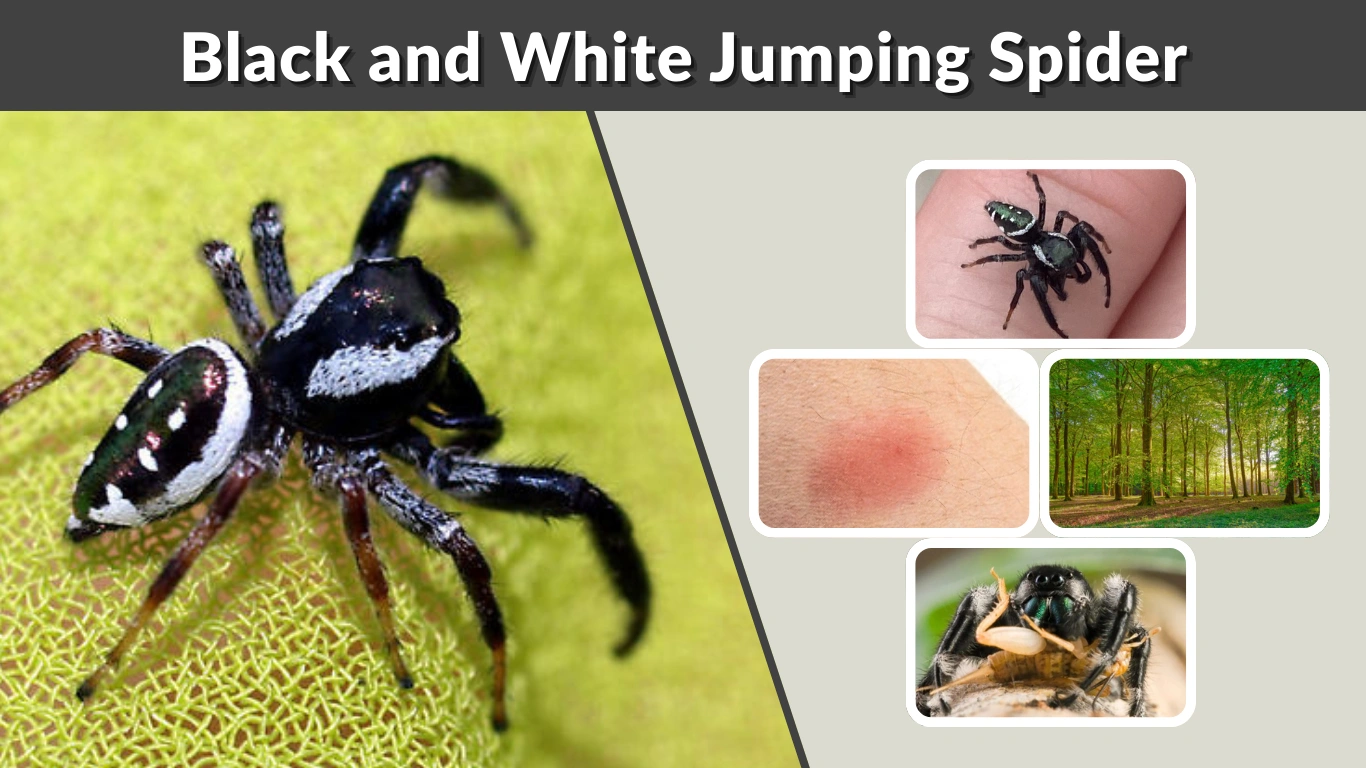
Black and white jumping spiders are some of the most noticeable spiders people encounter because of their bold patterns, fuzzy bodies, and active daytime behavior. They are often seen on walls, fences, windows, and garden plants, where they move in short bursts and suddenly leap. Because of their appearance and curious way of watching movement, many people wonder what they are and whether they are dangerous. This article explains how to identify black and white jumping spiders, where they live, how they behave, and what makes them different from other spiders.
What Is a Black and White Jumping Spider?
A “black and white jumping spider” is not a single species. It is a general term people use for any jumping spider that has a mostly black body with white bands, spots, or markings. These spiders belong to the family Salticidae, the largest spider family in the world, containing thousands of species.
Black and white patterns are especially common among jumping spiders because the high contrast helps with communication and camouflage. Many species use bold markings to recognize mates and rivals, while others use striping to break up their outline when resting on bark, stones, or walls.
People often assume all black and white jumping spiders are the same species, but in reality, many different spiders share this look. Some are small and delicate, while others are larger and fuzzier. Despite these differences, they all share similar traits: excellent eyesight, strong jumping ability, and an active hunting style.
Is It One Species or Many?
Black and white jumping spiders include many species rather than one. Common examples include the zebra jumping spider (Salticus scenicus), which has clear white bands across a black body, and the bold jumping spider (Phidippus audax), which often has bright white spots on a dark background. The regal jumping spider (Phidippus regius) can also appear black and white, especially in certain color forms.
Different regions have different black and white species, which is why spiders that look similar may actually belong to different genera. Local climate, habitat, and evolutionary history all influence their patterns and size.
Common Types of Black and White Jumping Spiders
Several well-known jumping spiders fit the black-and-white description. The zebra jumping spider is common in urban environments and often seen on walls and fences. It has sharp white stripes and is relatively small. The bold jumping spider is larger, fuzzier, and often has three white spots on its back. The regal jumping spider is one of the biggest and most striking species, sometimes showing white bands, spots, or metallic sheen.
Besides these, many lesser-known species across Asia, Europe, Africa, and the Americas display black and white patterning. Because of this diversity, identifying the exact species usually requires close examination or expert reference.
Identification of Black and White Jumping Spiders
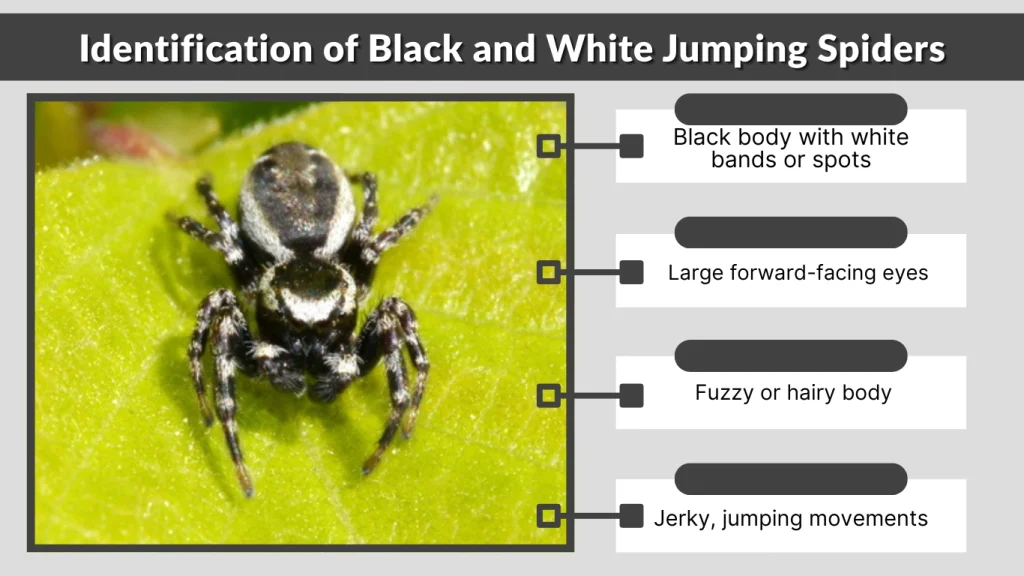
Black and white jumping spiders are usually easy to recognize once you know their key traits.
Key identification features
- Black body with white bands or spots
- Large forward-facing eyes
- Fuzzy or hairy body
- Jerky, jumping movements
- Active daytime behavior
Their large front eyes are their most distinctive feature. These eyes give them excellent vision and a characteristic “face-like” appearance. Their movements are also different from web-building spiders. Instead of waiting in webs, they actively walk, stop, turn, and jump.
They are often confused with wolf spiders or crab spiders. However, wolf spiders usually run quickly along the ground and have different eye arrangements, while crab spiders sit still with sideways-facing legs. Jumping spiders rely more on jumping and visual tracking.
How Big Do Black and White Jumping Spiders Get?
Most black and white jumping spiders range from about 5 to 15 millimeters in body length. Some larger species, such as certain Phidippus spiders, can reach close to 20 millimeters. Females are usually bigger and heavier-bodied than males.
Their compact build and thick legs often make them appear larger than they actually are. When they raise their front legs or face a person directly, they can look especially bold and prominent.
Compared to common house spiders, black and white jumping spiders are often shorter in leg length but thicker in body shape. This gives them a sturdy, “stocky” look rather than the delicate appearance of many web-building spiders.
Habitat and Distribution
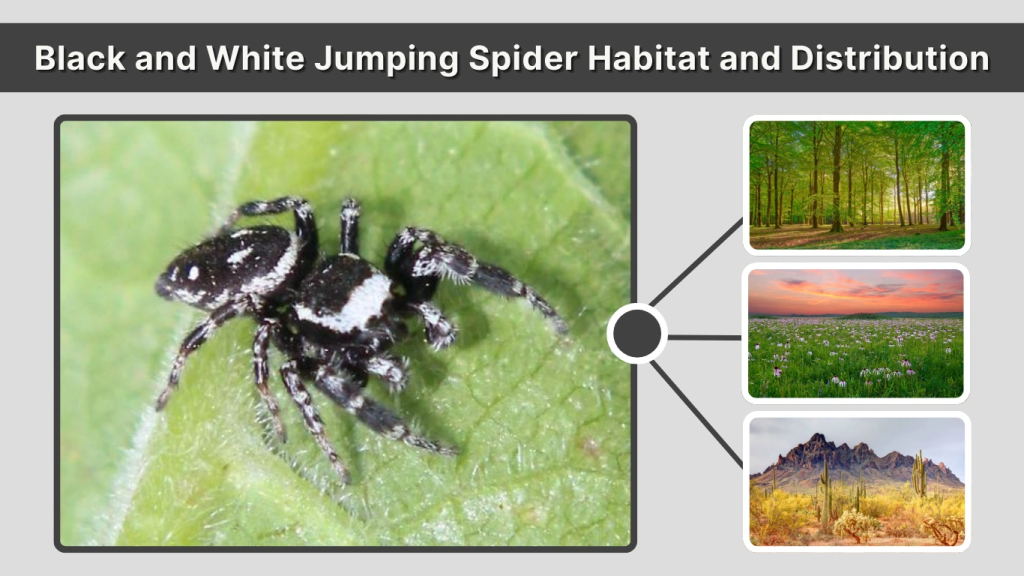
Black and white jumping spiders are found on every continent except Antarctica. They live in forests, grasslands, deserts, gardens, and urban areas. Many species adapt well to human environments and are frequently seen on walls, windowsills, fences, balconies, and outdoor furniture.
They are most active during the day, which is why people notice them more than many other spiders. Indoors, they usually wander in while following insects attracted to light. They do not build large webs and do not establish indoor infestations.
Behavior and Personality
How Black and White Jumping Spiders Hunt
These spiders are visual hunters. They carefully stalk prey, often stopping several times to judge distance. When close enough, they leap with surprising accuracy. A thin silk thread is usually attached behind them as a safety line in case they miss.
Curious and Interactive Behavior
Black and white jumping spiders often appear to watch people. They may turn their bodies, tilt their heads, or move closer to observe motion. Males of many species perform complex courtship dances involving leg waving and body vibrations.
Are Black and White Jumping Spiders Dangerous or Poisonous?
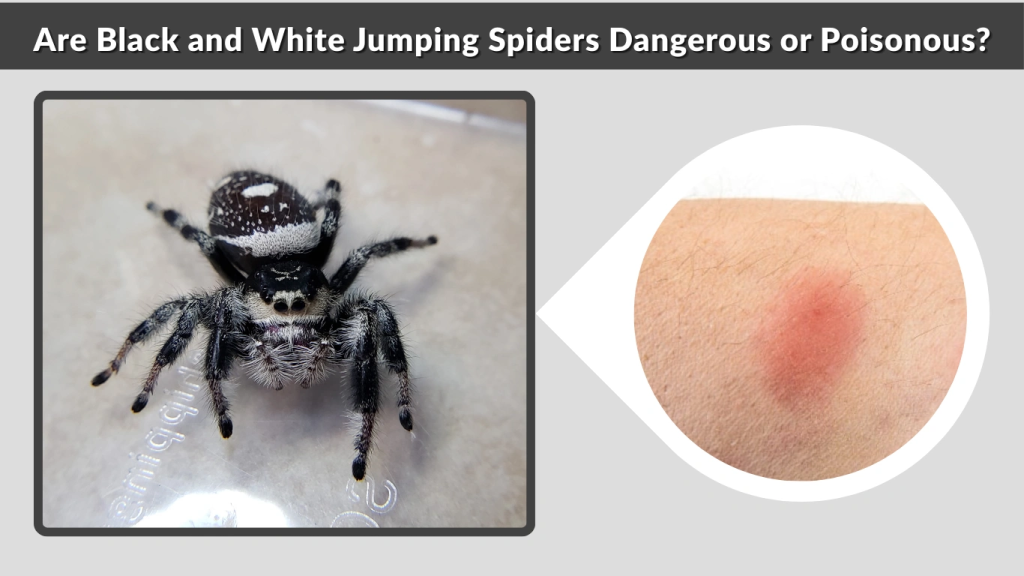
Black and white jumping spiders are venomous, not poisonous, which means they inject venom into prey but do not harm humans through contact. Their venom is very mild and is intended to immobilize small insects, not mammals.
Key safety facts
- Venomous, not poisonous
- Bites are extremely rare
- Symptoms are usually minor
- Not medically significant
- Serious allergic reactions are very uncommon
Compared to dangerous spiders like black widows or brown recluses, black and white jumping spiders pose virtually no risk to humans. Even if a bite occurs, it is typically similar to a mosquito bite, causing minor redness or mild itching.
Black and White Jumping Spider Bite — What to Expect
Bites are rare and usually accidental, often occurring if the spider is trapped against skin or handled roughly.
Typical bite symptoms
- Slight pinprick sensation
- Minor redness
- Mild swelling or itching
- Short duration (usually a few hours)
Rare reactions
A small number of people may have allergic reactions, including more noticeable swelling, irritation, or redness. If symptoms worsen, spread, or show signs of infection, medical advice is recommended.
Benefits of Black and White Jumping Spiders
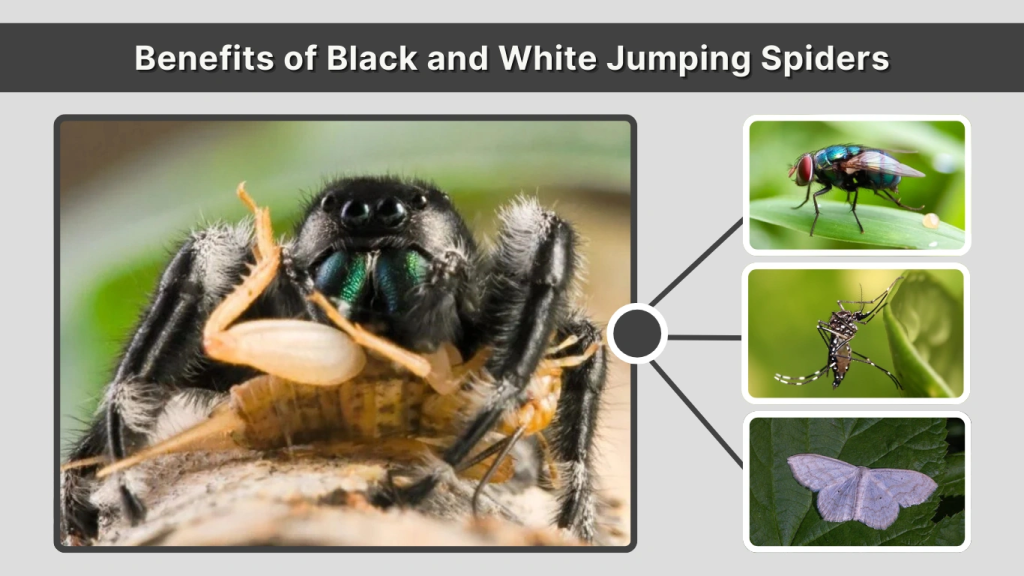
Despite their bold appearance, these spiders are beneficial.
- They act as natural pest control, feeding on flies, mosquitoes, moths, and other small insects.
- In gardens, they protect plants by reducing pest populations.
- Indoors, they quietly hunt insects attracted to light.
- They play a key ecological role, maintaining balance in insect populations.
- They do not spin messy webs or infest homes, making them mostly harmless visitors.
Allowing them to live or gently relocating them outside is usually the best option.
What to Do If You Find One Indoors
Black and white jumping spiders are safe to handle carefully or release outdoors.
Safe actions
- Leave it alone if it’s not bothering you
- Gently capture it with a cup and release it outside
- Avoid using chemical sprays
- Seal entry points in windows or doors
- Teach children not to touch spiders
Professional pest control is rarely needed because these spiders do not reproduce indoors in large numbers.
Black and White Jumping Spider vs Look-Alike Spiders
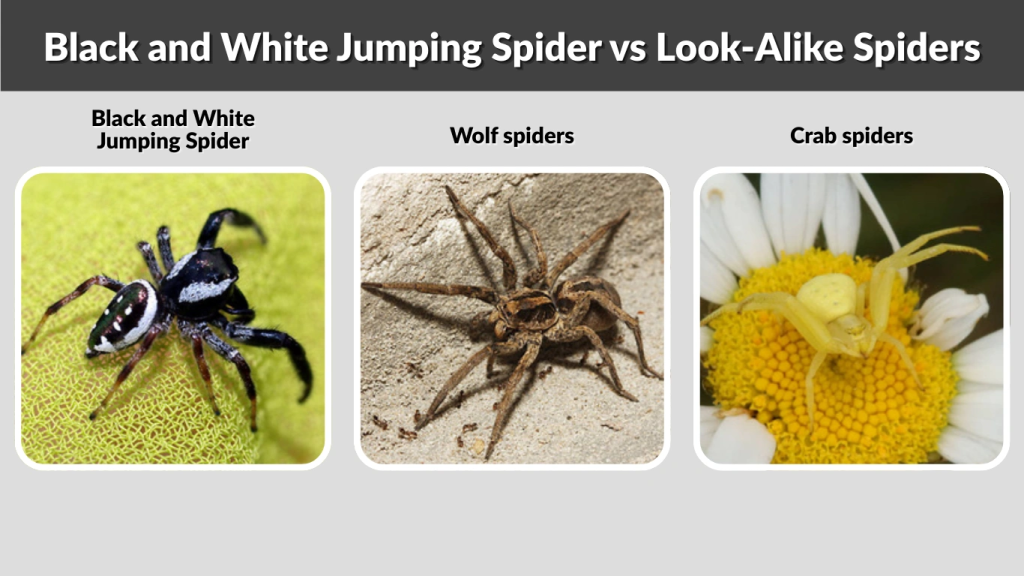
People often confuse them with:
- Wolf spiders – these run along the ground and have different eye arrangements
- Crab spiders – sit still and use sideways legs for hunting
- Other striped spiders – pattern differences and body shape help identification
Black and white jumping spiders are generally smaller, more compact, and more visually aware than these look-alikes.
Fascinating Facts About Black and White Jumping Spiders
- Exceptional eyesight: They can see in color and perceive depth.
- Advanced intelligence: They can plan hunting paths and learn from previous attempts.
- Courtship displays: Males perform leg waving and body vibrations to attract females.
- Pattern recognition: Some species can recognize other spiders or rivals.
- Curious behavior: They often turn their heads to watch movement, appearing “interactive.”
Final Thoughts on Black and White Jumping Spiders
Black and white jumping spiders are harmless, visually striking, and ecologically beneficial. They are not poisonous to humans, rarely bite, and provide natural pest control both indoors and outdoors. Their bold patterns, excellent vision, and curious movements make them fascinating to observe.
Key takeaways:
- Not dangerous or poisonous
- Bites are rare and mild
- Excellent natural pest controllers
- Easy to identify by color patterns and forward-facing eyes
- Should be left alone or gently relocated if indoors
FAQs
Are black and white jumping spiders poisonous?
No, they are venomous like all jumping spiders but their venom is extremely mild and not harmful to humans.
What is the black and white jumping spider called?
Common examples include the zebra jumping spider (Salticus scenicus), the bold jumping spider (Phidippus audax), and the regal jumping spider (Phidippus regius).
Can black and white jumping spiders bite humans?
Yes, but bites are rare. They occur only if a spider is trapped or handled roughly, usually causing minor redness and itching.
Where are black and white jumping spiders found?
They are found worldwide, in gardens, grasslands, forests, and urban areas, often seen on walls, fences, and window frames.
Should I remove black and white jumping spiders from my house?
Removal is usually unnecessary. They are harmless and help control pests. If preferred, gently capture and release them outside.