
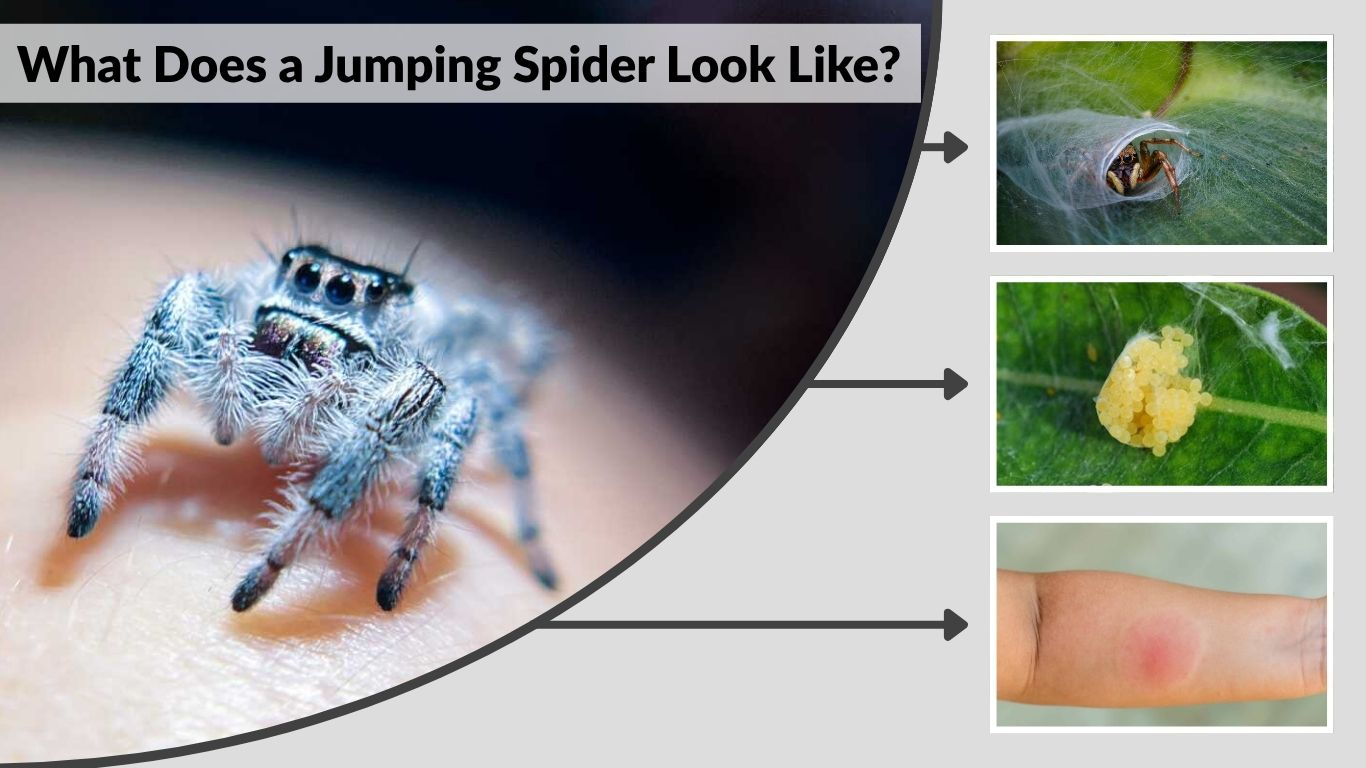
A jumping spider usually looks small, compact, hairy, and alert, with large front-facing eyes that make it seem curious. It often moves in short bursts, pauses, turns toward movement, and jumps when hunting or escaping. Many species have bold markings, fuzzy bodies, short strong legs, and colors such as black, brown, gray, white, orange, red, or metallic green.
What Does a Jumping Spider Look Like?
Jumping spiders are easy to recognize once you know their main features. They do not look long-legged and thin like cellar spiders, and they do not usually sit in messy webs like common cobweb spiders. Their body is short, sturdy, and often fuzzy, with a face that looks larger than expected for such a small spider.
Main Appearance
Most jumping spiders have a compact body with a rounded or oval abdomen. Their legs are usually short to medium in length, but the front legs may look thicker or more noticeable. The body can look fuzzy because of tiny hairs that help them sense movement and surfaces.
Common jumping spider features include:
- Small, compact body shape
- Large front-facing eyes
- Fuzzy or hairy appearance
- Short, strong legs
- Quick stop-and-go movement
- Sudden jumping ability
- Bright or contrasting markings
- Small silk dragline while jumping
- Active behavior during daylight
- Curious habit of turning toward movement
Their size can vary, but many common species are only a few millimeters to about 2 centimeters long. Because they are small and fast, people often notice their movement before they notice their body details.
Eye Pattern
The eyes are the best clue. Jumping spiders have eight eyes, but the two large middle eyes on the front of the face stand out the most. These big eyes give them a “curious” or “puppy-like” look.
From the front, a jumping spider may look like it is staring at you. This does not mean it is aggressive. It is using its strong vision to study movement, judge distance, and decide whether something is prey, danger, or just part of the environment.
Jumping Spider Colors and Markings
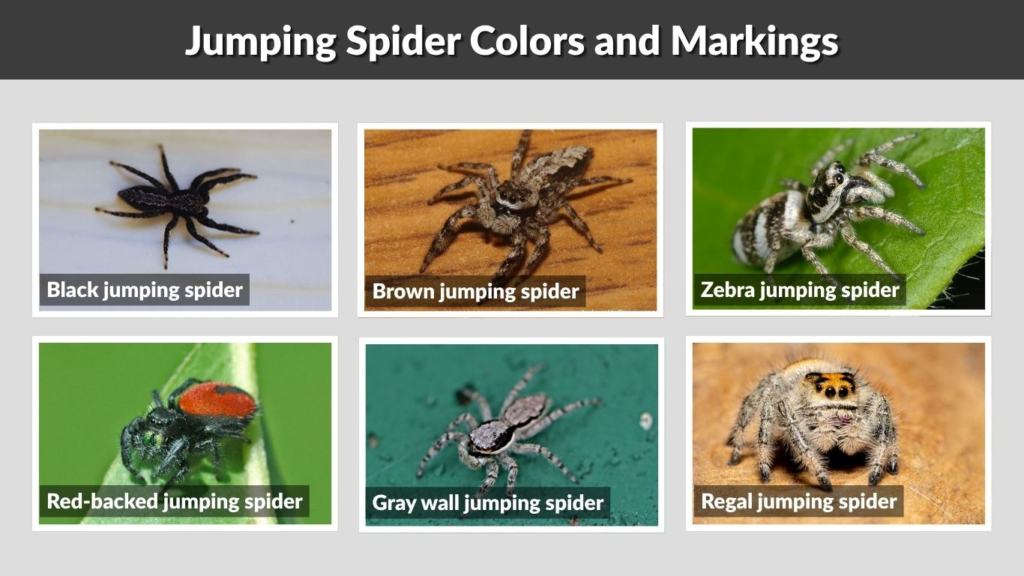
Jumping spiders come in many colors. Some look plain brown or gray, while others have bright white spots, orange patches, red backs, metallic green jaws, or zebra-like stripes. Color depends on species, age, sex, and location.
Common Color Patterns
Some jumping spiders are dark and bold, while others blend into bark, walls, leaves, or dry grass. This wide color range is one reason people sometimes confuse them with other spiders.
| Type or Look | Common Features | Notes |
| Black jumping spider | Black body with white or orange marks | Often a bold jumping spider |
| Brown jumping spider | Tan, gray, or brown body | Often blends with bark or walls |
| Zebra jumping spider | Black and white striped body | Common on walls and fences |
| Red-backed jumping spider | Dark body with reddish abdomen | Color looks alarming but is not always dangerous |
| Gray wall jumping spider | Flat gray body with pale markings | Often found on walls and buildings |
| Regal jumping spider | Larger, fuzzy, bold markings | Popular among spider keepers |
| Ant-like jumping spider | Narrow body and ant-like movement | Mimics ants for protection or hunting |
Metallic Green or Blue Jaws
Some jumping spiders, especially bold jumping spiders, have shiny green or blue mouthparts called chelicerae. These bright colors can look surprising, but they are normal for the species.
The metallic color does not mean the spider is dangerous. It is simply part of the spider’s natural appearance.
What Does a Bold Jumping Spider Look Like?
The bold jumping spider is one of the most recognized jumping spiders in North America. It often has a black body, white markings, and shiny green or blue chelicerae. Young bold jumpers may have orange markings that become white as they mature.
Identification
- Usually black with white spots or bands
- Often has a white mark on the back of the abdomen
- May have metallic green or blue mouthparts
- Compact and fuzzy body
- Large front-facing eyes
- Active during the day
- Moves with short jumps and quick pauses
- Often found on walls, fences, plants, and windows
This spider may look fearless because it turns toward people and cameras. That is normal jumping spider behavior, not a sign of attack.
Bold Jumping Spider Bite Appearance
A bold jumping spider bite usually looks like a small red bump if it causes any visible reaction. It may resemble a mosquito bite or minor skin irritation. Mild swelling, itching, or tenderness can happen.
A serious wound, spreading tissue damage, or a large open sore is not typical of a jumping spider bite. If a bite looks severe, infected, or unusual, it is better to seek medical advice and avoid guessing the spider species.
What Does a Jumping Spider Bite Look Like?
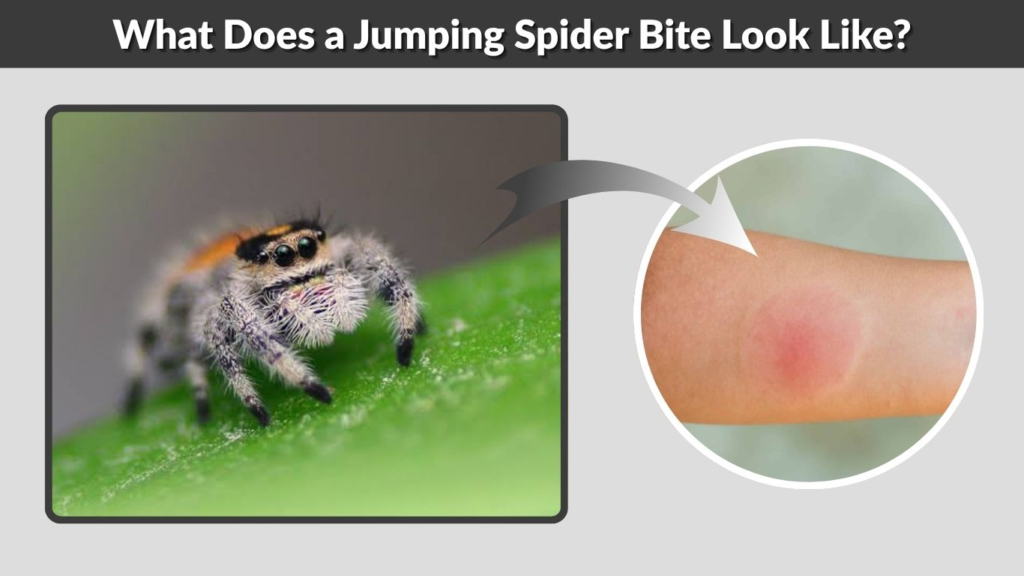
A jumping spider bite is usually mild and small. Many people never get bitten because jumping spiders prefer to run or jump away. When a bite happens, it is usually because the spider was trapped, squeezed, or handled roughly.
Common Bite Signs
A mild jumping spider bite may look like:
- A tiny red bump
- Mild swelling
- Slight itching
- Minor tenderness
- A small raised spot
- Light warmth around the area
- A mark similar to a mosquito bite
Most reactions stay local and improve naturally. Some people may feel a brief pinch when bitten, while others may only notice irritation later.
When a Bite Needs Attention
Most jumping spider bites are not dangerous, but any bite or skin mark should be watched if it worsens. Call a doctor if redness spreads, swelling becomes severe, pus appears, pain increases, fever develops, or breathing becomes difficult.
Also, if you did not clearly see the spider bite you, avoid assuming the mark came from a jumping spider. Many skin bumps come from mosquitoes, fleas, allergies, irritation, or infections.
What Do Jumping Spider Eggs Look Like?
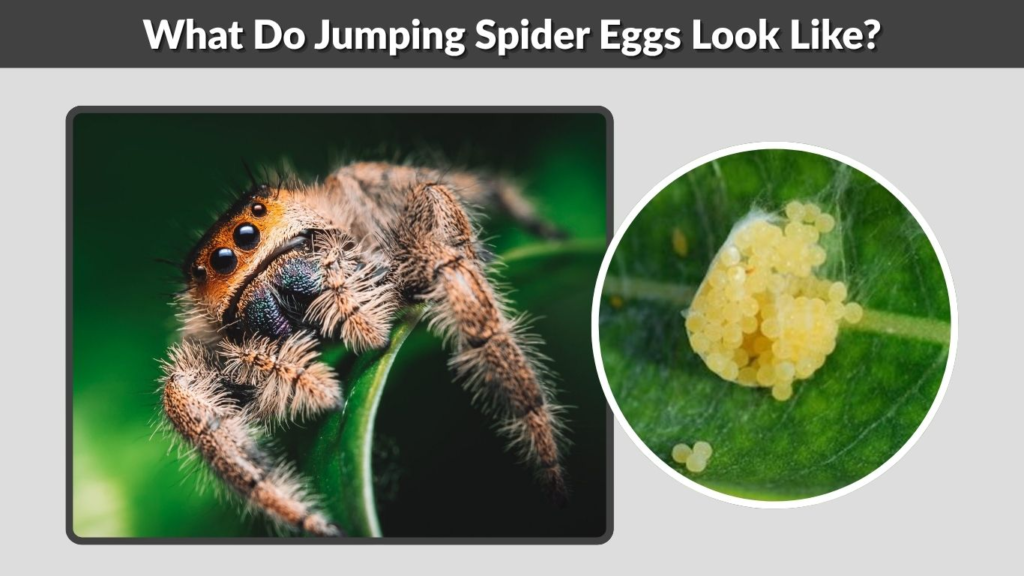
Jumping spider eggs are usually kept inside a silk egg sac. The sac may look white, cream, pale yellow, or slightly gray depending on age and environment. It is often hidden in a protected silk retreat.
Egg Sac Appearance
A jumping spider egg sac may look like a small silk-covered patch, pouch, or rounded bundle. It is usually thicker and more sealed than a normal resting web because it protects developing eggs.
You may find egg sacs in:
- Corners of enclosures
- Wall cracks
- Window frames
- Under bark
- Folded leaves
- Small crevices
- Hidden silk retreats
- Protected indoor or outdoor corners
Female jumping spiders may stay near the egg sac and guard it. A female that suddenly hides in a thick silk retreat may be guarding eggs or preparing to lay them.
Pregnant Jumping Spider Appearance
A gravid, or egg-carrying, female jumping spider often has a larger, rounder abdomen. Her body may look heavier than usual. She may eat more before laying eggs, then become less active while guarding the sac.
A large abdomen does not always mean eggs. A spider can also look round after a big meal. The difference is that a gravid female may start building a thicker retreat and spend more time hidden.
What Does a Jumping Spider Molt Look Like?
A jumping spider molt looks like an empty spider-shaped shell. It may look like a dead spider at first, but it is only the old outer skin. The spider sheds this skin as it grows.
Molting Signs
Before molting, a jumping spider may hide, stop eating, and stay inside a silk retreat. This is normal. During this time, it is vulnerable and should not be disturbed.
Signs of molting include:
- Hiding for long periods
- Refusing food
- Building a silk retreat
- Less movement
- Dull body color
- Empty spider-shaped skin after the molt
- Soft-looking new body
- Resting after shedding
Do not leave crickets or aggressive prey inside with a molting spider. The spider’s body is soft after a molt, and prey can injure it.
Molt vs Dead Spider
A molt is usually light, dry, hollow, and partly transparent. A dead spider usually looks heavier, darker, or curled in a firm position. If you see a spider-shaped shell and the spider is still alive nearby, it is simply a molt.
What Do Jumping Spider Webs and Nests Look Like?
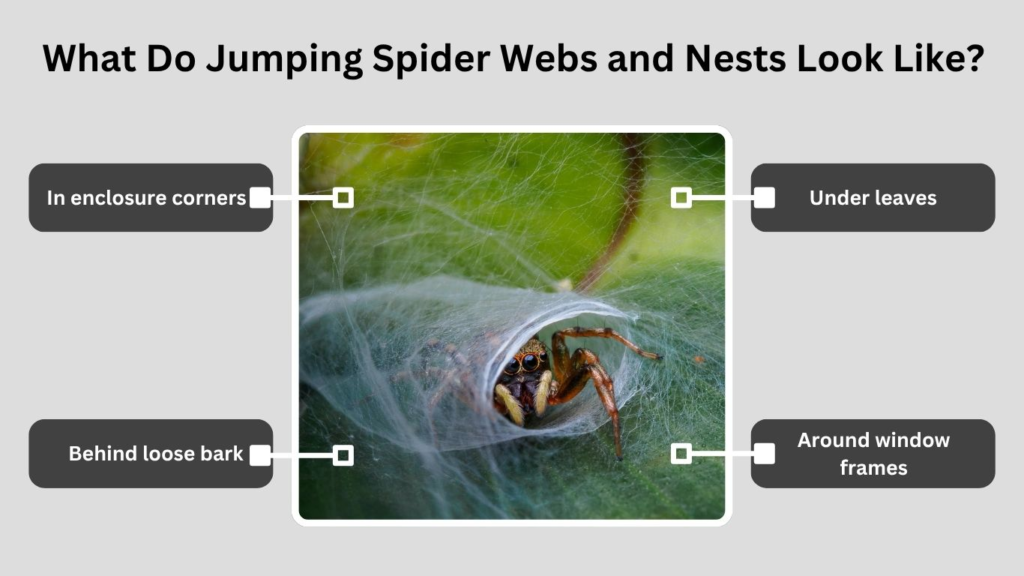
Jumping spiders do not build large prey-catching webs like orb weavers. Instead, they use silk for safety lines, resting shelters, egg sacs, and molting retreats. Their silk structures are usually small and hidden.
Web Appearance
A jumping spider web is often a small, thick silk retreat rather than a big open web. It may look like a little white hammock, tunnel, patch, or pouch in a corner.
You may see jumping spider silk:
- In enclosure corners
- Under leaves
- Behind loose bark
- Around window frames
- In cracks and crevices
- On walls or ceilings
- Under outdoor ledges
- Near egg sacs or molts
They may also leave single silk lines while moving or jumping. These draglines are safety lines that help them recover if they fall.
Nest Appearance
People often call the silk retreat a nest. It may be used for sleeping, hiding, molting, or protecting eggs. A resting retreat is usually thinner than an egg sac, while an egg sac area is thicker and more sealed.
Jumping Spiders That Look Like Ants or Crickets
Some jumping spiders mimic other animals. Ant-like jumping spiders can look narrow, shiny, and ant-shaped. Other jumping spiders may be confused with crickets because they jump suddenly.
Ant-Like Jumping Spiders
Ant-mimic jumping spiders may have a narrow waist, long front legs, and movement that resembles ants. This mimicry can help them avoid predators or get closer to certain prey.
They are still spiders, not insects. You can tell by counting legs: spiders have eight legs, while ants have six. Ant-like jumping spiders also have spider-style eyes and may jump when disturbed.
Spiders That Jump Like Crickets
A small spider that jumps suddenly may be a jumping spider, especially if it has a compact body and large front eyes. Crickets have long back legs, antennae, and six legs. Jumping spiders have eight legs, no antennae, and a more rounded body.
Some insects can jump and look spider-like, but the eye pattern and leg count help separate them.
Jumping Spider vs Similar Spiders
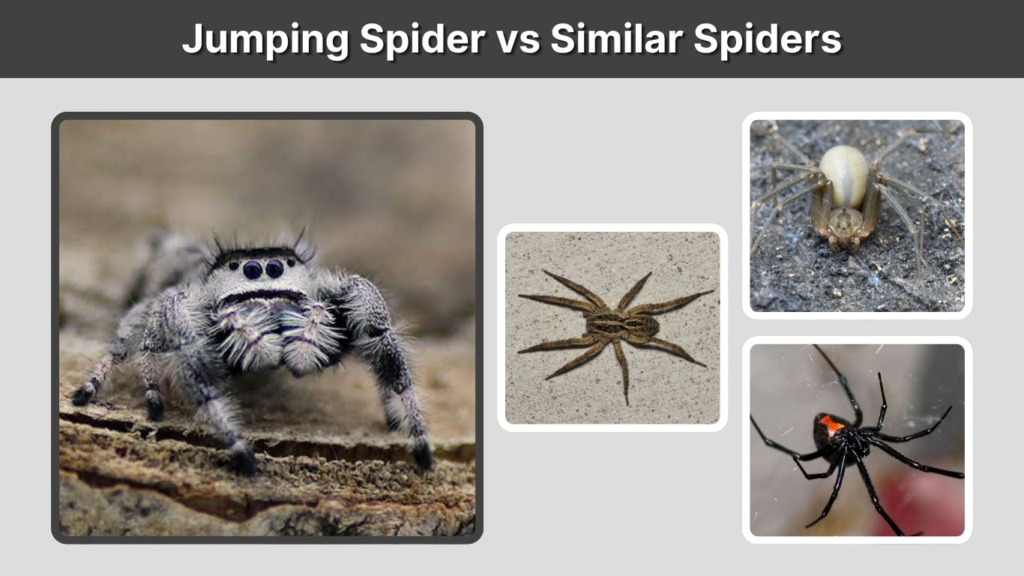
Jumping spiders are sometimes confused with wolf spiders, brown recluse spiders, small house spiders, or black widow spiderlings. Looking at body shape, eyes, movement, and web habits can help.
Jumping Spider vs Wolf Spider
Wolf spiders are usually larger, longer-legged, and more ground-running than jumping spiders. They do not have the same large front-eye appearance. Jumping spiders look more compact and often jump with sudden precision.
Wolf spiders may run fast, but jumping spiders pause, look around, and leap at prey.
Jumping Spider vs Brown Recluse
A brown recluse is usually plain brown with long slender legs and a violin-shaped mark behind the head. It has six eyes arranged differently, not the large front-facing eyes of a jumping spider.
A jumping spider is usually more compact, often fuzzy, and more active in daylight. If you are unsure about a brown spider, avoid handling it.
Jumping Spider vs Black Widow
Black widows have a shiny rounded body, long legs, and a red hourglass mark on the underside of the abdomen. Jumping spiders are usually fuzzier, more compact, and have large forward-facing eyes.
A black jumping spider with white spots is often a bold jumper, not a black widow. Still, never handle a spider if you are not confident about the identification.
Do Jumping Spiders Like Humans?
Jumping spiders do not “like” humans in the emotional way pets might, but they can become used to calm, gentle handling in captivity. Their curious behavior comes from strong vision and awareness of movement.
Why They Look Friendly
Jumping spiders may turn toward your face, camera, or hand because they are studying movement. Their large eyes and head-turning behavior make them look friendly or interested.
This does not mean they want to be touched. They may tolerate calm interaction, but they are still delicate animals.
How to Interact Safely
If you keep a pet jumping spider, move slowly and avoid forcing contact. Let the spider choose whether to walk onto your hand. Never grab or squeeze it.
For wild jumping spiders, the safest choice is to watch them without handling. If one is indoors, use a cup and paper to move it outside.
FAQs
What does a jumping spider look like?
A jumping spider looks small, compact, fuzzy, and alert, with large front-facing eyes. It often has short strong legs, bold markings, and quick stop-and-go movement. Many species are black, brown, gray, white, orange, or patterned, and they may jump suddenly when hunting or escaping.
What does a jumping spider bite look like?
A jumping spider bite usually looks like a small red bump with mild swelling, itching, or tenderness. It may resemble a mosquito bite. Serious wounds are not typical. If redness spreads, pain increases, pus appears, or breathing problems occur, seek medical advice.
What do jumping spider eggs look like?
Jumping spider eggs are usually hidden inside a silk egg sac. The sac may look white, cream, pale yellow, or slightly gray. It is often placed in a protected corner, crack, folded leaf, bark space, or thick silk retreat guarded by the female.
What does a molting jumping spider look like?
A molting jumping spider may hide in a silk retreat and stop eating. After molting, you may see an empty spider-shaped shell that looks like a dead spider. The real spider will look fresh and soft, so it should not be disturbed until hardened.
What spider looks like an ant and jumps?
An ant-mimic jumping spider can look like an ant and jump. It may have a narrow body, long front legs, and ant-like movement. The easiest difference is leg count: spiders have eight legs, while ants have six legs and antennae.
