
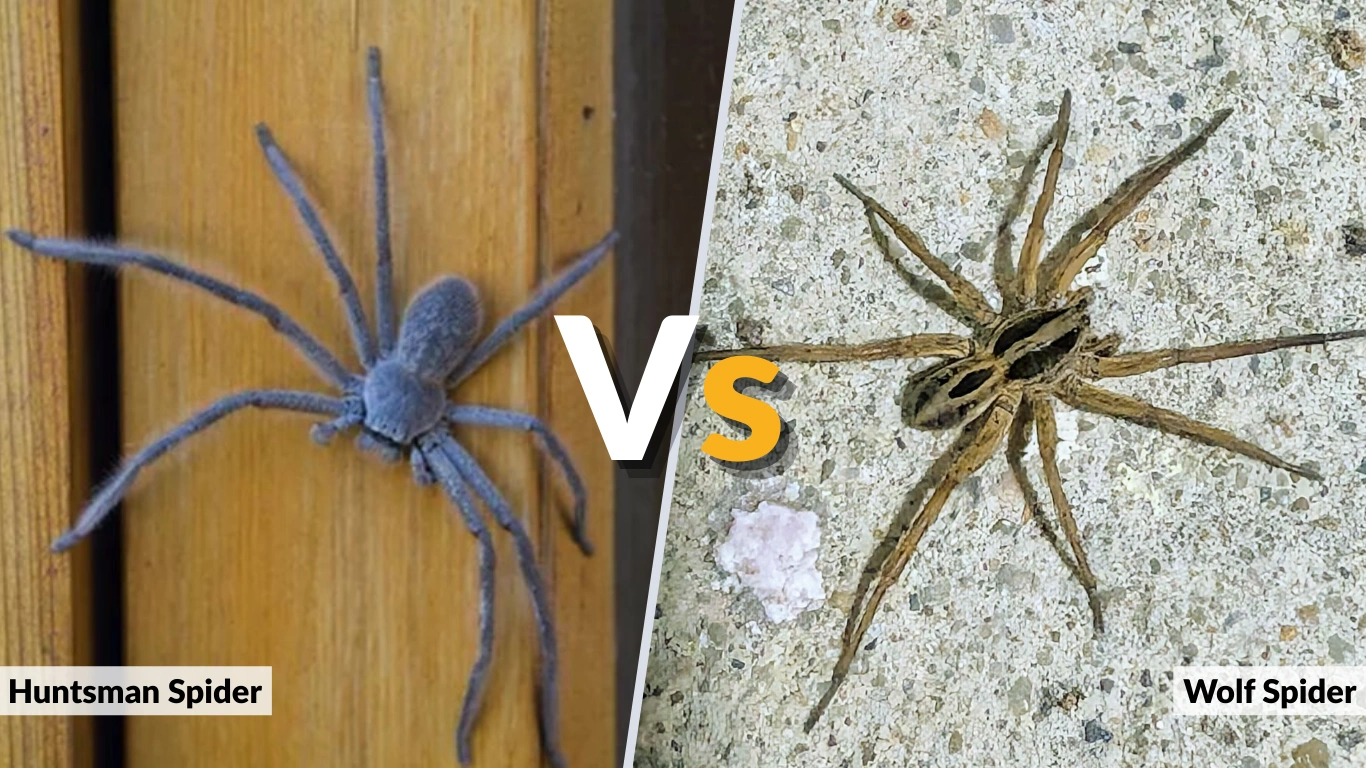
Large, fast-moving spiders often cause immediate alarm, especially when they appear suddenly inside homes or gardens. Two species that are frequently confused are the huntsman spider and the wolf spider. At first glance, they may look similar due to their size and speed. However, when comparing a huntsman spider vs wolf spider, there are clear differences in body shape, leg structure, habitat, and behavior. Understanding these distinctions can help you identify each spider correctly and determine whether there is any real cause for concern.
Overview of Huntsman Spider
Huntsman spiders belong to the Sparassidae family and are commonly known as giant crab spiders. They are famous for their wide leg span and flattened bodies. Instead of building webs to trap prey, huntsman spiders actively hunt insects and other small creatures.
These spiders are most common in warm climates, including Australia, Asia, Africa, and parts of the southern United States. They are often found:
- Under loose tree bark
- On walls and ceilings
- Inside sheds or garages
- Occasionally inside cars
One of the defining characteristics of huntsman spiders is their laterigrade legs. This means their legs extend outward and sideways, giving them a crab-like appearance. Their flattened bodies allow them to squeeze into narrow crevices, making them excellent at hiding.
Despite their intimidating size, huntsman spiders are not considered highly dangerous to humans.
Overview of Wolf Spider
Wolf spiders belong to the Lycosidae family and are found worldwide. Unlike huntsman spiders, wolf spiders are primarily ground dwellers. They are active hunters and rely on speed and strong eyesight to capture prey.
Wolf spiders typically live:
- In gardens and grasslands
- Under rocks and leaf litter
- In soil burrows
- In basements or ground-level indoor spaces
Their bodies are compact, hairy, and more robust compared to huntsman spiders. Wolf spiders are known for their excellent vision, which comes from their unique eye arrangement — eight eyes positioned in three distinct rows.
Like huntsman spiders, wolf spiders do not use webs to catch prey. Instead, they chase and ambush insects, making them beneficial predators in natural environments.
Huntsman Spider vs Wolf Spider – Quick Comparison

Although both spiders are hunters and can grow relatively large, several differences make identification easier.
| Feature | Huntsman Spider | Wolf Spider |
| Family | Sparassidae | Lycosidae |
| Body Shape | Flat | Stocky and compact |
| Leg Direction | Sideways (crab-like) | Forward/downward |
| Leg Span | Larger and wider | Moderate |
| Habitat | Walls, bark, ceilings | Ground, burrows |
| Maternal Care | Guards egg sac | Carries egg sac & spiderlings |
These key distinctions become clearer when examining their physical appearance more closely.
Size and Physical Appearance Differences
Many people assume the largest spider they see must be the most dangerous. However, size alone does not determine risk. When comparing huntsman spider vs wolf spider size, leg span plays a major role in perception.
Body Shape Comparison
The huntsman spider has a noticeably flattened body. This body shape helps it hide under bark, inside cracks, or behind objects. From above, its legs spread widely around its body, creating a broad appearance.
In contrast, the wolf spider has a thicker, more rounded body. Its abdomen appears fuller and more compact. Instead of looking flat, the wolf spider looks sturdier and more solid.
If the spider appears pressed low against a surface with legs extending outward in a wide circle, it is more likely a huntsman. If it appears bulkier and more upright, it is likely a wolf spider.
Leg Structure and Movement
One of the easiest ways to distinguish between these two spiders is by observing their legs.
Huntsman spiders have laterigrade legs, meaning they extend sideways from the body. This gives them a crab-like stance and allows them to move quickly in a sideways direction. Their long legs contribute to an impressive leg span, sometimes reaching up to 5 inches or more depending on the species.
Wolf spiders, on the other hand, have legs that extend forward and downward. Their legs are proportionate to their body and do not spread as widely. When they move, they typically run forward rather than sideways.
This difference in leg positioning is one of the most reliable identification features.
Eye Arrangement
Eye pattern is another major identifying factor.
Wolf spiders have a distinctive three-row eye arrangement:
- Four small eyes in the bottom row
- Two large, prominent eyes in the middle row
- Two medium-sized eyes on top
The large middle eyes often reflect light at night, making them easier to spot with a flashlight.
Huntsman spiders have eight eyes as well, but their eyes are arranged more evenly and are generally smaller. They do not have the same prominent, forward-facing middle eyes as wolf spiders.
If you can safely observe the eye pattern, it can quickly confirm whether you are looking at a wolf spider rather than a huntsman.
Habitat and Distribution

Where you find the spider can also provide a strong clue to its identity.
Where Huntsman Spiders Are Found
Huntsman spiders prefer warm environments. They are especially common in Australia but can also be found in tropical and subtropical regions worldwide.
They are often spotted:
- Climbing walls
- Resting on ceilings
- Hiding under tree bark
- Inside vehicles
Because they are comfortable on vertical surfaces, seeing a large spider spread across a wall is often a sign it may be a huntsman.
Where Wolf Spiders Are Found
Wolf spiders are much more likely to be found at ground level. They prefer soil, grass, and leaf litter. Some species dig burrows and line them with silk.
Indoors, wolf spiders usually appear in basements, garages, or lower levels of homes. They are rarely found on ceilings or high walls.
If the spider is running across the floor or emerging from the ground, it is more likely a wolf spider than a huntsman.
Behavior and Hunting Style
Both huntsman spiders and wolf spiders are active hunters. Unlike web-building spiders that wait for prey to become trapped, these species rely on speed, stealth, and strong sensory awareness to capture food. However, their movement style and general behavior can look quite different.
Speed and Movement Patterns
Huntsman spiders are known for their rapid, sideways movements. Thanks to their laterigrade legs, they can dart quickly in multiple directions, including sideways and diagonally. This crab-like motion often surprises people and contributes to their intimidating reputation.
Wolf spiders move differently. They typically sprint forward in short bursts. Their movements are direct and ground-focused rather than sideways. While they are also fast, their motion is more straightforward and less sprawling than a huntsman’s.
If you see a large spider rapidly skimming sideways across a wall, it is most likely a huntsman. If it runs straight across the floor or ground, it is more likely a wolf spider.
Defensive Behavior
Neither huntsman spiders nor wolf spiders are aggressive toward humans. Both prefer to escape rather than confront a threat.
When cornered, a huntsman spider may raise its front legs in a defensive posture. However, bites are uncommon and typically occur only if the spider is handled or trapped.
Wolf spiders may also display defensive body language, especially females guarding egg sacs. But in most cases, they will attempt to flee rather than bite.
Because both spiders move quickly, their sudden appearance can be mistaken for aggression. In reality, they are usually trying to escape.
Reproduction and Maternal Behavior

One of the biggest behavioral differences in a huntsman spider vs wolf spider comparison involves reproduction and maternal care.
Egg Sac Handling
Female huntsman spiders create an egg sac and place it in a sheltered location, such as under bark or inside a hidden crevice. Instead of carrying the egg sac with them, they typically guard it until the spiderlings hatch. During this time, the female may remain close to the eggs and act more defensive.
Female wolf spiders behave very differently. After producing an egg sac, they attach it directly to their spinnerets at the rear of their abdomen. They carry the egg sac everywhere — even while hunting.
This attachment is one of the easiest ways to identify a female wolf spider. If you see a spider moving around with a round sac attached to its back end, it is almost certainly a wolf spider.
Spiderlings After Hatching
After huntsman spider eggs hatch, the spiderlings usually disperse fairly quickly. While the mother may guard them briefly, extended maternal care is limited.
Wolf spiders, however, are well known for carrying their spiderlings on their backs after hatching. Dozens of tiny spiders may cling to the mother’s abdomen for days or even weeks. During this time, she continues hunting and protecting them.
This unique behavior is one of the most defining traits of wolf spiders and does not occur in huntsman spiders.
Bite Risk and Venom Comparison

A common question in the huntsman spider vs wolf spider debate is which one is more dangerous.
The good news is that neither spider is considered medically significant for most people.
Huntsman spider bites are rare. When they do occur, symptoms typically include:
- Mild to moderate pain
- Redness
- Swelling
- Temporary discomfort
Wolf spider bites produce similar symptoms. Their venom is not considered highly toxic to humans. Most reactions are localized and resolve within a few days.
Severe reactions are uncommon but can happen in individuals who are allergic or highly sensitive. In such cases, medical attention may be necessary.
Overall, both spiders are more intimidating in appearance than they are dangerous.
Which Spider Is Bigger?
When comparing size, huntsman spiders usually have the larger leg span. Their long, outward-stretching legs create an impressive visual width that can make them seem enormous.
Wolf spiders generally have a shorter leg span but a heavier, thicker body. Because of their stocky build, they may appear dense and solid rather than wide.
If measured strictly by leg span, the huntsman spider is typically bigger. If comparing body bulk, the wolf spider may seem more substantial.
This difference in proportions explains why people often overestimate the danger of huntsman spiders — their wide stance makes them look larger than they actually are.
How to Tell a Huntsman Spider from a Wolf Spider
If you are unsure which spider you are looking at, follow these simple identification steps:
- Check the legs. Sideways, crab-like legs indicate a huntsman. Forward-facing legs suggest a wolf spider.
- Observe body shape. Flat body equals huntsman; compact and stocky equals wolf spider.
- Look at eye patterns. Large central eyes in three rows indicate a wolf spider.
- Consider location. On a wall or ceiling? Likely huntsman. On the ground or in soil? Likely wolf spider.
- Look for maternal behavior. Egg sac attached to abdomen or spiderlings riding on back confirms wolf spider.
Using a combination of these traits provides the most accurate identification.
Ecological Importance of Both Spiders
Both huntsman and wolf spiders play important roles in controlling insect populations. They feed on common household and garden pests such as:
- Cockroaches
- Crickets
- Beetles
- Ants
- Moths
By reducing pest numbers naturally, they help maintain ecological balance. In many cases, having these spiders around can actually benefit homes and gardens.
Rather than viewing them as threats, it is helpful to understand their role as natural pest controllers.
Conclusion
When comparing a huntsman spider vs wolf spider, the differences become clear once you know what to look for. Huntsman spiders have flattened bodies and sideways legs, while wolf spiders are stockier with distinctive eye patterns and unique maternal behavior. Both are fast, active hunters and generally harmless to humans. By recognizing their physical traits, habitat preferences, and behaviors, you can confidently identify each species and better understand their role in the environment.
