
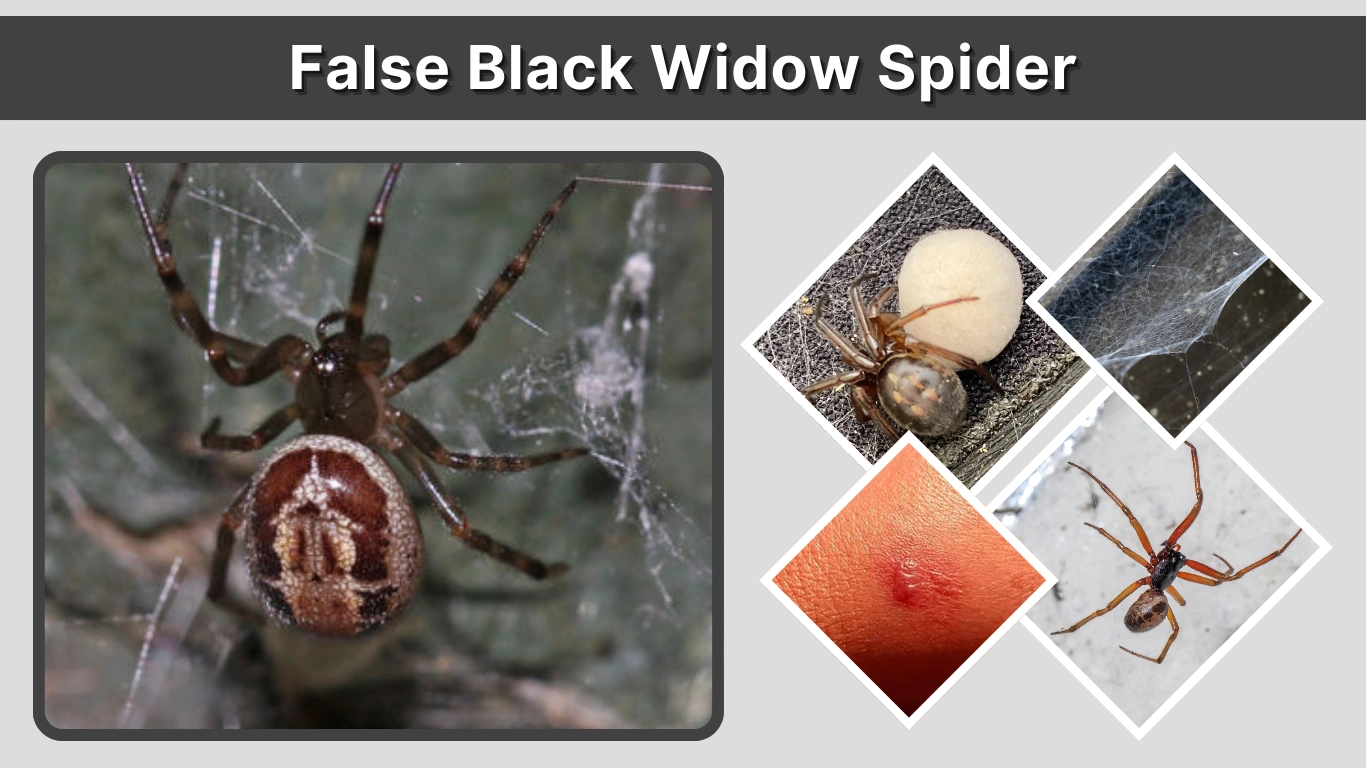
The false black widow spider is one of the most commonly misidentified spiders in homes and gardens. Because of its dark, shiny body and rounded abdomen, many people mistake it for the dangerous black widow. This confusion often leads to fear, especially when the spider is found indoors. In reality, false black widows are far less harmful. This article explains how to identify them, how big they grow, what their webs look like, and how risky their bites actually are.
What Is a False Black Widow Spider?
The term “false black widow spider” refers to several species in the genus Steatoda, which belong to the cobweb spider family (Theridiidae). These spiders are called “false widows” because their shape, glossy appearance, and web style resemble those of true black widows (Latrodectus), even though they are a different genus.
The most well-known species is the noble false widow (Steatoda nobilis), now common in the UK, Ireland, and parts of Europe, with expanding populations in North America and Australia. False black widows are highly adaptable spiders. They thrive around human structures, often living in sheds, garages, window frames, outdoor furniture, and quiet indoor corners. Their ability to survive year-round indoors has helped them spread widely.
False Black Widow Spider Identification

Short overview: Correct identification is the most important step in avoiding unnecessary panic. While false black widows look intimidating, several physical traits clearly separate them from true black widows and other house spiders.
- Body color and surface texture – Usually dark brown, purplish-black, or charcoal with a glossy, smooth appearance
- Abdomen shape and markings – Rounded, bulbous abdomen with pale cream, beige, or marbled patterns rather than a red hourglass
- Leg structure – Long, slender legs, often brown with faint banding
- Head and eye arrangement – Small cephalothorax with the typical cobweb-spider eye layout
- Common look-alikes – Black widow spiders, cupboard spiders, and large house spiders
What Does a False Black Widow Spider Look Like?

False black widow spiders are compact but robust spiders with a noticeably swollen abdomen. Their color can vary from chocolate brown to nearly black, often with lighter marbling or skull-like patterns on the back. Unlike true black widows, they do not have a bright red hourglass on the underside.
Their legs are relatively thin compared to the abdomen and may show subtle rings. When viewed closely, the spider’s body appears smooth and polished rather than hairy. Because coloration changes with age and sex, people often see different-looking spiders and assume they are separate species.
Female False Black Widow Spider
Females are the largest and most frequently encountered. They have a fuller, rounder abdomen and more noticeable cream or beige markings. Females are also responsible for nearly all documented bites, mainly because they remain near their webs and egg sacs.
Male False Black Widow Spider
Males are much smaller and slimmer. They have longer legs relative to body size and less pronounced abdominal markings. Males wander more in search of mates and are rarely blamed for bites.
Juvenile False Black Widow Spider
Juveniles are lighter in color, often tan or light brown, with clearer patterns. As they mature, their bodies darken. Young spiders are commonly mistaken for other harmless house spiders.
How Big Is a False Black Widow Spider?
Adult female false black widows typically measure about 7 to 14 mm in body length, while males are smaller, often 4 to 7 mm. When the legs are included, the total span can reach 25 to 35 mm, making them appear larger than they really are.
Their size is comparable to a small coin or the tip of a thumb. Although they are not as large as some house spiders, their bulbous abdomen makes them look heavier. Compared to true black widows, false widows are often slightly smaller and less uniformly black, but size alone is not a reliable way to identify them.
False Black Widow Spider Web

Short overview: False black widows build messy, irregular cobwebs rather than neat orb webs.
- Webs are tangled, three-dimensional, and sticky
- Usually found in dark corners, behind furniture, in sheds, or under outdoor objects
- Strong silk helps them capture flies, woodlice, and small spiders
- Females often remain hidden near the center of the web
- Egg sacs are commonly suspended within the web structure
Their webs look very similar to black widow webs, which is another reason these spiders are frequently misidentified.
False Black Widow Spider Bite

Short overview: Bites are uncommon and usually defensive, happening when the spider is pressed against skin.
- Most bites occur when trapped in clothing, gloves, bedding, or towels
- The bite often feels like a sharp pinprick or mild sting
- Redness and localized swelling are common
- Pain may increase over several hours
- Serious complications are rare in healthy adults
What Does a False Black Widow Spider Bite Look Like?
A bite typically appears as a small red area with slight swelling. In some cases, a pale center or blister-like spot may develop. The skin around the bite can become warm, tender, and mildly inflamed, but severe tissue damage is very uncommon.
False Black Widow Spider Bite Symptoms
Most false black widow bites cause only mild, localized symptoms. The most common reactions include redness, swelling, and a burning or throbbing sensation around the bite site. Some people report itching, stiffness, or tenderness that lasts from several hours to a few days.
In a small number of cases, slightly wider symptoms may appear, such as headache, fatigue, mild fever, nausea, or muscle discomfort. These effects are usually temporary and resolve without medical treatment. Severe reactions are rare and are more likely linked to allergic responses or secondary infection rather than venom strength.
Is the False Black Widow Spider Poisonous?
False black widow spiders are venomous, but they are not considered medically dangerous to most people. The term “poisonous” is often misused; these spiders deliver venom through a bite, but their venom is far weaker than that of true black widows.
Their venom is designed to subdue small insects, not humans. While a bite can be painful, it does not typically cause the intense muscle cramps or neurological symptoms associated with black widow bites. Basic first aid—cleaning the area, applying a cold compress, and monitoring symptoms—is usually sufficient.
False Black Widow Spider vs Black Widow Spider

Although they look similar, false black widows and black widows differ in several important ways.
- Markings and coloration – False widows often have cream or marbled patterns, while black widows are usually jet black with a red hourglass
- Venom strength – False widow venom is mild; black widow venom is medically significant
- Size and build – False widows are often slightly smaller with less uniform coloring
- Behavior – False widows are shy and reclusive; black widows are more defensive around egg sacs
- Medical risk – False widow bites are rarely serious, while black widow bites may require medical treatment
Correct identification helps prevent unnecessary fear and improper pest control.
Where Are False Black Widow Spiders Found?
False black widow spiders are now widely distributed and strongly associated with human environments. They prefer sheltered, undisturbed locations where insects are abundant.
False Black Widow Spider in the UK and Ireland
The noble false widow is now common across England, Wales, and Ireland, especially in coastal and urban areas. They are frequently found in sheds, outdoor furniture, window frames, and indoor corners. Their spread has made them one of the most talked-about spiders in Britain.
False Black Widow Spider in the United States and Canada
False widows have been recorded in states such as Ohio, California, Oregon, Washington, and Texas, as well as parts of Canada. They often appear around ports, warehouses, and residential buildings, likely spreading through trade and transported goods.
False Black Widow Spider in Australia
In Australia, false widows are less common but increasingly reported in urban areas. They typically live around buildings, storage spaces, and garden structures, sometimes mistaken for native spiders.
False Black Widow Spider Egg Sac and Eggs

Female false black widows produce round, pale egg sacs that are suspended in their webs. Each sac may contain dozens to over a hundred eggs. The female often guards the sacs, remaining close and becoming more defensive if disturbed.
Spiderlings hatch after several weeks and stay near the web initially before dispersing. Indoors, where temperatures are stable, false widows can reproduce year-round, allowing populations to build quickly in undisturbed spaces.
False Black Widow Spider Facts
Short overview: Despite their reputation, false black widows play a useful role in controlling household insect populations.
- They belong to the cobweb spider family (Theridiidae)
- The noble false widow (Steatoda nobilis) is the most widespread species
- They actively hunt flies, mosquitoes, ants, and other spiders
- They can live one to three years in sheltered environments
- They often remain hidden and avoid human contact
Are False Black Widow Spiders Dangerous to Humans?
For most people, false black widow spiders are not dangerous. Bites are uncommon and typically mild. The main risks come from misidentification, unnecessary pesticide use, and secondary infection if a bite is scratched excessively.
Children, the elderly, and individuals with allergies or weakened immune systems should be more cautious, as reactions may be stronger. However, there is no strong evidence that false black widows pose a serious public health threat.
How to Get Rid of False Black Widow Spiders
Effective control focuses on prevention rather than killing.
Seal cracks around doors, windows, and vents to block entry. Reduce insects that attract spiders by keeping lights away from entry points and maintaining cleanliness. Remove webs with a vacuum and relocate spiders outdoors if found indoors. Regular cleaning of sheds, garages, and storage areas greatly reduces suitable habitats. Professional pest control is rarely necessary unless infestations are heavy.
FAQs
Are false black widow spiders really dangerous?
False black widow spiders are not considered dangerous to most people. Their venom is mild, and bites usually cause only localized pain, redness, and swelling. Serious reactions are rare and are more often related to allergies or infection rather than the spider’s venom itself.
How can you tell a false widow from a black widow?
False widows usually have cream or marbled markings on their abdomen and lack the red hourglass seen on black widows. Their color is often dark brown rather than jet black, and their bites are far less severe than true black widow bites.
Do false black widow spiders bite often?
Bites are uncommon. False black widows are shy spiders that prefer to hide. Most bites occur accidentally when a spider is trapped in clothing, gloves, or bedding, or when someone presses directly against its web.
Where are false black widow spiders most commonly found?
They are common in the UK and Ireland and increasingly reported in the United States, Canada, and Australia. They prefer sheds, garages, window frames, outdoor furniture, and quiet indoor corners.
Should I see a doctor for a false black widow bite?
Most bites can be managed at home by cleaning the area and applying a cold compress. Medical advice should be sought if pain becomes severe, symptoms spread, or signs of infection such as fever or pus develop.
