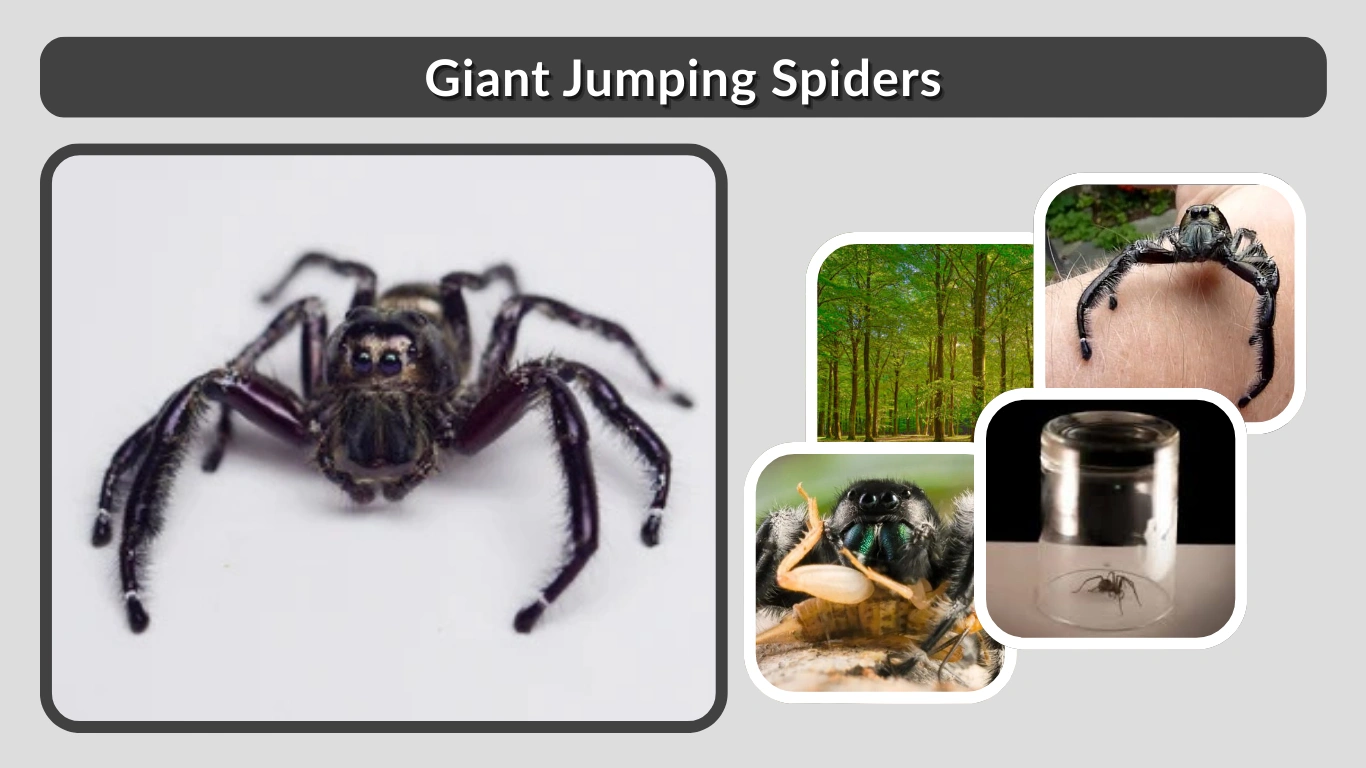
The term “giant jumping spider” is often used when people see a jumping spider that looks much larger than expected. While most jumping spiders are small, some species grow noticeably bigger and can appear intimidating because of their size, bold movements, and intense stare. This article explains what giant jumping spiders really are, how large they can become, how to identify them, where they live, and whether they pose any real danger to humans.
What Is a Giant Jumping Spider?
“Giant jumping spider” is not a scientific name. It is a common phrase people use to describe larger-than-average members of the jumping spider family, known scientifically as Salticidae. With more than 6,000 species worldwide, this family includes both tiny spiders and relatively large ones that can surprise people who expect all jumping spiders to be small.
Several genera are frequently called giant jumping spiders, including Hyllus, Phidippus, and Plexippus. These spiders have the same body structure and behavior as smaller jumping spiders but on a larger, thicker frame. Their strong front legs, fuzzy bodies, and bold color patterns often make them appear much bigger than they actually are.
People often misidentify wolf spiders or huntsman spiders as giant jumping spiders. However, true giant jumping spiders can be recognized by their large forward-facing eyes and their distinctive, jerky movements. The word “giant” is relative; compared to most jumping spiders, they are large, but compared to spiders like tarantulas, they are still quite small.
Is “Giant Jumping Spider” a Real Scientific Name?
No, “giant jumping spider” is only a descriptive label. Scientists identify spiders by genus and species names, such as Hyllus diardi or Phidippus regius. The term “giant” simply reflects human perception, not formal classification. Social media, wildlife videos, and viral images have helped popularize the name, even though it does not refer to one specific species.
How Big Can Giant Jumping Spiders Get?

Most jumping spiders measure between 3 and 10 millimeters in body length. Giant jumping spiders, however, can reach 15 to 25 millimeters, and in rare cases slightly more. When their legs are extended, they often appear even larger.
Females are usually bigger and heavier-bodied than males, especially when carrying eggs. Their compact shape, thick legs, and fuzzy appearance make them seem larger than long-legged spiders of similar length.
Even the largest jumping spiders are still much smaller than huntsman spiders or tarantulas. However, among jumping spiders, they are considered giants, and their size alone often leads people to wonder if they are dangerous.
Are Giant Jumping Spiders Dangerous or Poisonous?
Giant jumping spiders are not dangerous to humans. Like almost all spiders, they are venomous, not poisonous, meaning they use venom to subdue prey rather than harming through touch or ingestion.
Key safety facts
- They are venomous, not poisonous
- Venom is very mild
- Not medically significant
- Bites are rare
- Serious reactions are extremely uncommon
Their venom is designed to quickly immobilize insects, not large animals. The amount of venom they can inject is tiny, and their small fangs often cannot easily pierce human skin. There are no verified medical reports of severe injury caused by giant jumping spider bites.
Compared to medically important spiders such as black widows or brown recluses, giant jumping spiders have extremely weak venom. Scientists and medical professionals classify them as harmless.
Identification of Giant Jumping Spiders

Giant jumping spiders share the same core traits as other jumping spiders, but on a more robust body.
Common identification features
- Large forward-facing eyes
- Thick, compact body
- Strong front legs
- Hairy or fuzzy appearance
- Jerky, jumping movement
They are often brightly colored or boldly patterned, which helps with species recognition and courtship. Their alert posture and tendency to watch movement closely are strong clues.
Giant jumping spiders are commonly mistaken for wolf spiders. The key difference is eye arrangement: jumping spiders have prominent front eyes that face forward, while wolf spiders have smaller eyes arranged in rows. Jumping spiders also rely more on vision and jumping rather than running.
Habitat and Distribution

Large jumping spiders are found on every continent except Antarctica. Different species inhabit tropical forests, grasslands, deserts, and mountainous regions. Many adapt well to urban environments and are frequently seen on walls, fences, window frames, and garden plants.
They are active during the day, which is why people notice them more often than many other spiders. Indoors, they usually wander in while following insects attracted to light. They do not build webs for trapping prey and do not create infestations inside homes.
Behavior and Hunting Style
How Giant Jumping Spiders Hunt
Giant jumping spiders are visual hunters. They stalk prey slowly, stopping often to reassess distance. Once close enough, they leap with remarkable accuracy, using a silk safety line in case they miss. Their strong front legs help secure prey instantly.
Daily Activity and Personality
They are alert, curious, and often appear to “watch” people. This behavior is not aggression but visual tracking. Males may perform elaborate dances to attract females, using leg waves, body vibrations, and bright colors.
What Do Giant Jumping Spiders Eat?

Giant jumping spiders are active predators that feed mainly on insects and other small arthropods. Their excellent eyesight allows them to target prey accurately, even from a distance. Common prey includes flies, mosquitoes, moths, beetles, ants, and caterpillars. Larger species may also hunt smaller spiders.
Because of their size and strength, giant jumping spiders can overpower insects that many smaller jumping spiders cannot. They usually hunt several times a day, depending on prey availability and environmental conditions. After capturing prey, they inject venom to immobilize it, then use digestive enzymes to liquefy the tissues before feeding.
Their feeding behavior makes them valuable natural pest controllers in gardens, farms, and even inside homes where they reduce populations of nuisance insects.
Giant Jumping Spider Bite — What Really Happens
Giant jumping spiders can bite, but bites are rare. These spiders are not aggressive and almost always choose to flee rather than defend themselves. Bites typically occur only if a spider is trapped against skin, handled roughly, or accidentally pressed inside clothing.
When a bite does happen, symptoms are usually mild. Most people describe a slight pinprick feeling followed by minor redness or itching. Mild swelling may occur, but it normally fades within a few hours to a day. The bite does not cause tissue damage, necrosis, or serious systemic symptoms.
Rarely, a person may experience a stronger local reaction due to individual sensitivity. Signs that deserve medical attention include increasing pain, spreading redness, pus, fever, or allergic symptoms such as facial swelling or difficulty breathing. These cases are related to immune response or infection, not dangerous venom.
Are Giant Jumping Spiders Good or Bad to Have Around?
Giant jumping spiders are beneficial and should generally be considered helpful rather than harmful. They reduce populations of flies, mosquitoes, moths, and agricultural pests. In gardens, they protect plants by hunting insects that damage leaves and flowers.
Indoors, they quietly patrol walls and windows, feeding on insects attracted to light. Unlike many other spiders, they do not build messy webs, do not infest houses, and do not reproduce in large indoor populations.
Because they pose almost no risk to humans and provide natural pest control, killing giant jumping spiders is unnecessary. In most cases, allowing them to live outdoors or gently relocating them is the best option.
What to Do If You Find a Giant Jumping Spider Indoors

Finding a giant jumping spider inside your home is not a reason to panic.
Safe actions
- Leave it alone and let it hunt insects
- Capture it gently with a cup and release it outside
- Avoid spraying chemicals
- Seal cracks and window gaps
- Teach children not to touch spiders
Pest control is almost never needed for jumping spiders. A single spider usually wandered indoors accidentally while following prey.
Giant Jumping Spider vs Other Large Spiders
Giant jumping spiders are often confused with wolf spiders, huntsman spiders, or even small tarantulas. Wolf spiders are ground runners with different eye arrangements and are usually faster on surfaces than jumpers. Huntsman spiders are much larger, flatter, and rely on speed rather than jumping. Tarantulas are vastly larger, slower-moving, and live very different lifestyles.
Compared to these spiders, giant jumping spiders are smaller, more compact, more visually oriented, and significantly less intimidating. They are also far less medically relevant than black widows or brown recluses.
Fascinating Facts About Giant Jumping Spiders
Giant jumping spiders possess some of the most advanced vision among invertebrates. They can see colors, perceive depth, and recognize complex shapes. Studies show they can solve simple problems, plan routes, and even remember successful hunting strategies.
Males of many large species perform elaborate courtship dances, using body vibrations, leg waves, and bright colors to communicate with females. Some species can recognize other jumping spiders individually and respond differently to rivals and mates.
Their intelligence, awareness, and expressive movements are why many people find giant jumping spiders surprisingly fascinating rather than frightening.
Final Answer — What “Giant Jumping Spider” Really Means
A giant jumping spider is simply a larger-than-average member of the jumping spider family. It is not a dangerous spider, not poisonous, and not a medical concern. These spiders are active daytime hunters with excellent vision, mild venom, and helpful pest-control behavior.
Despite their size, giant jumping spiders are shy, curious, and beneficial creatures that play an important role in controlling insect populations.
FAQs
Are giant jumping spiders poisonous?
Giant jumping spiders are not poisonous. They are venomous like almost all spiders, but their venom is very mild and designed only to subdue insects. It is not medically significant to humans.
What is the largest jumping spider in the world?
Some of the largest jumping spiders belong to the genus Hyllus, with certain species reaching around 20–25 mm in body length. Even the largest are still much smaller than huntsman spiders or tarantulas.
Can giant jumping spiders hurt humans?
They are very unlikely to hurt humans. Bites are rare and usually cause only mild redness or itching. There are no confirmed cases of serious injury caused by giant jumping spiders.
Where are giant jumping spiders commonly found?
Large jumping spiders are found worldwide in warm and temperate regions. They live in forests, gardens, grasslands, and urban areas, often seen on walls, fences, and plant leaves.
Should I remove a giant jumping spider from my house?
Removal is not necessary because they are harmless and beneficial. If you prefer, gently capture and release it outside instead of killing it.
