
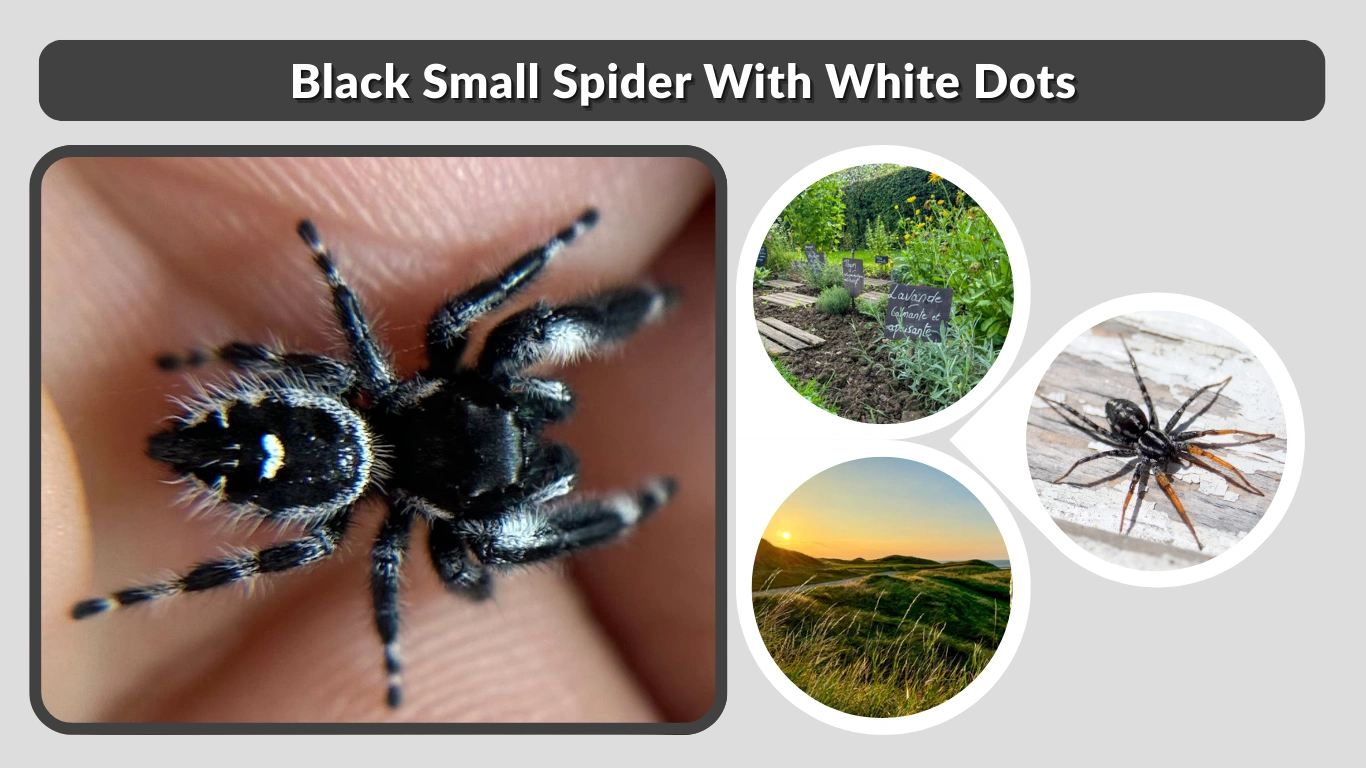
Small black spiders with white dots are commonly spotted around homes, gardens, and outdoor structures, and while their appearance can seem alarming, most belong to harmless and beneficial species—often jumping spiders or ground spiders. These distinctive markings help narrow down identification and offer insight into habitat, behavior, and potential risks. This guide explores key identification traits, possible species, natural range, and how to differentiate similar spiders you may encounter.
Identification

Identifying a small black spider with white dots begins with observing its most visible traits. While several species share this appearance, a few features can help narrow it down:
- Small body size ranging from 3–12 mm
- Predominantly black coloration with clear white spots or patches
- Compact or slightly fuzzy body structure
- Quick, agile movement, sometimes with pronounced jumps
- Large, forward-facing eyes (if a jumping spider)
- Commonly seen on outdoor walls, window frames, plants, or indoor corners
These combined features most often point toward the group known as jumping spiders, though a few ground spiders and orb-weavers also show similar patterns.
Possible Species

Daring Jumping Spider (Phidippus audax)
One of the most commonly identified black spiders with white spots, this species features vivid dot patterns on the abdomen and metallic green or blue chelicerae. It moves confidently, leaps long distances, and often inhabits sunny walls and garden spaces. Juveniles may have more pronounced white markings than adults.
White-Spotted Jumping Spider (Regional Variants)
Many small jumping spiders across North America and Europe display white speckling on otherwise dark bodies. While less bold in pattern than the Daring Jumping Spider, these species share a similar hunting style and behavior. They may appear fuzzy and compact, often seen scanning their environment with large, forward-facing eyes.
Spotted Ground Spider
These spiders are typically smaller and sleeker than jumping spiders. Their white spots may appear as subtle streaks or patches. Unlike jumpers, ground spiders do not leap; instead, they move quickly across flat surfaces. They are more likely to be seen at night or when disturbed under objects.
Spotted Orb-Weaver (Juveniles)
Young orb-weavers sometimes show dotted abdominal patterns before maturing into more recognizable adult forms. Though they may resemble small jumpers from a distance, they are slower, less agile, and usually found near webs rather than exploring openly.
Size
Most small black spiders with white dots fall between 3 mm and 12 mm in body length. Jumping spiders typically appear thicker and bulkier for their size due to their dense body structure, while ground spiders look more elongated and low to the ground. Juveniles of all species may display proportionally larger markings and may seem more delicate or quick-moving compared to adults.
Size also varies by sex, with females typically larger and more robust. Males, especially among jumping spiders, may have brighter or more exaggerated white markings used in courtship displays. Environmental factors, such as access to prey and habitat temperature, further influence growth rate and adult size.
Habitat

Small black spiders with white dots adapt easily to a wide range of environments. They are commonly encountered in gardens, landscapes, and around human structures where insect prey is abundant. Jumping spiders, in particular, favor sunny surfaces like brick walls, fences, porch railings, and windowsills where they can actively hunt during the day.
Indoors, these spiders sometimes wander into quiet corners, basements, and window ledges. They do not rely on webs for hunting, so they prefer spaces where they can freely explore. Orb-weaver juveniles, on the other hand, remain close to areas suitable for web-building, including shrubs, eaves, and outdoor lighting zones that attract insects.
Seasonal changes also influence habitat use. Many species become more visible in warmer months when mating activity increases and prey populations peak. During cooler periods, they may retreat to sheltered areas or reduce activity, making sightings less frequent.
Range
These spiders are found across North America, Europe, and parts of Asia, depending on the species. Jumping spiders like Phidippus audax are widespread throughout the United States and southern Canada, thriving in rural, suburban, and urban settings. Their adaptability allows them to inhabit everything from forests and grasslands to residential yards.
Behavior
The behavior of small black spiders with white dots varies slightly by species, but most—especially jumping spiders—are highly active daytime hunters. Instead of relying on webs, they stalk prey visually, using their excellent eyesight to track insects before leaping forward with speed and precision. Their movements can seem curious or playful, especially when they pause to observe humans or follow motion with their eyes.
Ground spiders, although less visually oriented, move quickly and often retreat when disturbed. They prefer dark, sheltered spaces and come out primarily at night to hunt. Orb-weaver juveniles behave differently; they rely on silk structures to capture prey and typically remain near vegetation or corners where a web can anchor securely. Despite these variations, all are beneficial predators that help reduce pest insects around homes.
Bite Information
Most spiders matching this appearance are not medically significant, and bites are rare. Jumping spiders, which make up the largest portion of sightings, are timid and generally bite only if trapped against the skin. When a bite does occur, symptoms are usually mild—slight redness, itching, or localized swelling that fades within a day or two.
More sensitive individuals may experience prolonged irritation, but serious reactions are extremely uncommon. Typical home care, such as washing the area and applying a cold compress, is usually sufficient. Medical attention is advisable only if severe pain, spreading redness, fever, or signs of allergy develop. Because these spiders are defensive rather than aggressive, avoiding direct handling is the simplest prevention method.
Black Spider With White Dots vs. Other Species

| Feature | Jumping Spiders | Ground Spiders | Orb-Weavers |
| Eye Shape | Large front eyes | Small uniform eyes | Evenly spaced eyes |
| Movement | Quick jumps | Fast runners | Slow, web builders |
| Body Texture | Fuzzy, thick | Sleek, smooth | Rounded abdomen |
| White Dots | Pronounced | Occasional | More patterned |
| Common Indoors | Yes | Sometimes | Rare |
Is It Dangerous?
A small black spider with white dots is almost never dangerous. The most frequently encountered species—jumping spiders—have mild, non-threatening venom that poses no significant risk to humans or pets. Their primary response to disturbance is retreat, not aggression. Misidentifications sometimes cause concern, especially when people confuse them with more harmful species, but their behaviors and markings are distinct.
These spiders play an important ecological role by controlling flies, gnats, moths, and other small pests. Encouraging their presence outdoors contributes to natural pest management, and even indoor encounters are harmless and easily resolved by gently relocating the spider outside.
FAQs
What spider is small, black, and has white dots?
The most likely candidate is the Daring Jumping Spider or a related jumping spider species. These spiders are small, agile, and known for their bright white abdominal spots. Ground spiders and young orb-weavers may look similar, but jumping spiders are by far the most commonly encountered type.
Are black spiders with white spots dangerous?
No—these spiders are considered harmless. Their venom is designed to subdue insects, not humans, and bites are extremely rare. When bites do happen, symptoms are mild and short-lived. Most of these spiders prefer to escape rather than confront larger animals or people.
Why do jumping spiders have white spots?
White spots serve several purposes, including camouflage, signaling to mates, and blending into bright or dappled environments. For some species, the contrast helps break up the spider’s outline, making it harder for predators to detect. Juveniles often display more pronounced markings.
Do these spiders live indoors?
They may wander indoors but do not prefer permanent indoor living. Jumping spiders explore walls, ceilings, or windowsills while searching for prey. They do not infest homes or reproduce indoors at large scales and are easily removed or guided back outside.
How can I tell if the spider is a jumping spider?
Jumping spiders have large, forward-facing eyes, a compact and somewhat fuzzy body, and exhibit quick, deliberate movements. They pause frequently to observe their surroundings and can leap impressive distances for their size. These traits make them easy to distinguish from ground spiders or orb-weavers.
