
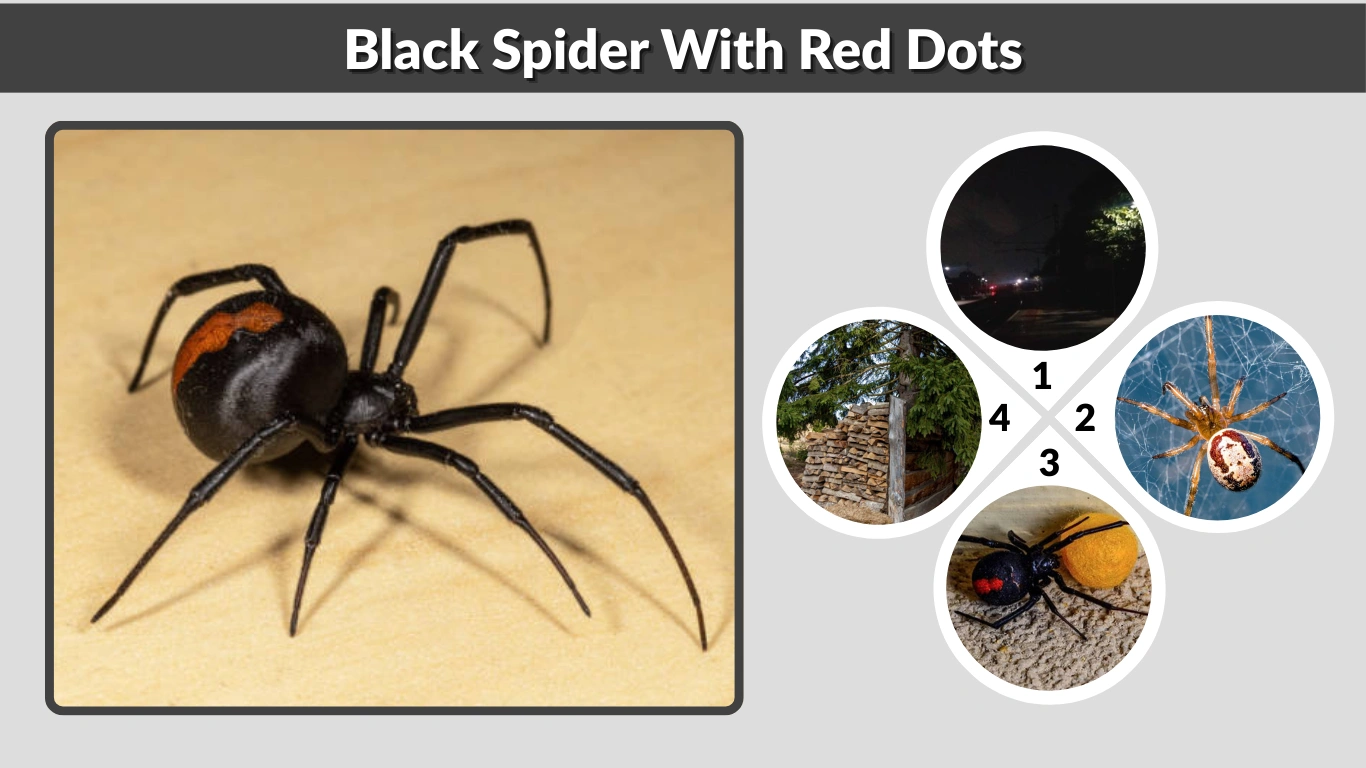
Black spiders with red markings—whether a single red dot, 2–4 red dots, or entire rows of spots—are among the most commonly misidentified spiders in North America. These markings appear in harmless jumping spiders, juvenile black widows, false widows, orb-weavers, and several fuzzy or hairy species. Because these spiders vary in appearance, size, and behavior, identifying them correctly helps determine if the spider is dangerous or simply a harmless guest in your home or yard.
Identification

Many species share the “black spider with red dot on back” appearance. These traits help you narrow possibilities:
- Body Texture: shiny, matte, fuzzy, or hairy
- Marking Pattern: one dot, two dots, three or four dots, dotted lines, or mixed colors (red + white or yellow)
- Placement: usually on top of the abdomen (dorsal), occasionally on sides or underside
- Shape: round glossy abdomen (widows), compact fuzzy shape (jumpers), or elongated sleek form (ground spiders)
- Movement: jumping, sprinting, slow crawling, or hanging in webs
- Web Style: messy tangle webs, orb webs, or no web at all
- Size: tiny (3 mm), small (6–8 mm), medium (10–12 mm), or large (1 inch)
- Location: indoors, garages, windows, patio furniture, gardens, woodpiles
- Eyes: large front eyes usually indicate a jumping spider
These identifiers cover all major keyword variations, including tiny, small, little, big, shiny, or fuzzy spiders with red dots.
Common Species With Red Dots on the Back

Juvenile Black Widow Spiders
Many searches—such as “black spider with 1 red dot,” “3 red dots,” “4 red dots,” “small red dots,” or “red dotted line”—match juvenile black widows. Unlike adults, juveniles have multiple bright red dorsal spots, often arranged in lines or small clusters.
Traits include:
- Very shiny black abdomen
- Long thin legs
- Messy tangled web
- Multiple red dots or red-and-white accents
These juveniles appear in California, Florida, Michigan, Missouri, Texas, Georgia, Arkansas, Oklahoma, Indiana, Illinois, Ohio, Virginia, Colorado, and Louisiana—matching nearly all state-specific keywords you listed. Despite their size, they can still deliver a medically significant bite, so caution is advised.
False Widows (Steatoda Species)
False widows resemble black widows but are less shiny and usually have faint red, reddish-brown, or red + white dots. People often search for:
- “black spider with red and white dots”
- “black spider with red dot not black widow”
- “black spider with red dots on back pictures”
Key features:
- Oval abdomen instead of spherical
- Semi-gloss texture
- Mild venom
- Web found in low corners
These spiders occur indoors across the U.S. and UK.
Jumping Spiders (Phidippus)
Jumping spiders account for most “fuzzy” searches, such as:
- “fuzzy black spider with red dot”
- “hairy black spider with red dot”
- “bold jumper fuzzy black spider with red dots”
- “small black fuzzy spider with red dot”
- “black spider with green eyes and red dots”
Jumpers have:
- Fuzzy, compact bodies
- Large forward-facing eyes
- Quick jumps and active daytime hunting
- Red, orange, or red-white spot patterns
They are harmless, easy to identify by their fuzzy texture, and frequently found indoors.
Orb-Weavers
Orb-weavers sometimes display red dots, red rows, red + yellow spots, or red dotted lines along the abdomen. These spiders build large circular webs outdoors and are sometimes mistaken for venomous species when their patterns resemble widow juveniles.
Ground Spiders & Wolf Spider Relatives
Ground spiders sometimes have small reddish patches or stripes. They move quickly, do not build suspended webs, and are not harmful. Searches referencing “short legs,” “fat black spider with dot,” or “running spider with red dot” may refer to these species.
Marking Variations Explained
One Red Dot
Often a juvenile widow or a jumping spider. Placement and body texture determine which.
Two Red Dots
Common on young widows; may also appear on some orb-weavers.
Three Red Dots
Many juvenile widows show three dots. Jumping spiders also display 3-dot groupings.
Four Red Dots
Frequently reported in Arkansas, Louisiana, and parts of Texas. Usually juvenile widows.
Red Dotted Line
Seen in patterned orb-weavers and sometimes a developmental pattern in widow juveniles.
Red + White or Red + Yellow Dots
Almost never widows—these patterns belong to jumping spiders or orb-weavers.
Size
Tiny spiders (3 mm) with a red dot indoors are typically small jumpers or early-stage widows. Their markings are particularly bright at young ages.
Small spiders (6–8 mm) are usually jumping spiders. Their fuzzy appearance differentiates them quickly from shiny widow species.
Medium spiders (10–12 mm) may be false widows or orb-weavers. Their patterns can include multiple red dots in symmetrical arrangements that cause confusion.
Large spiders (1 inch) described with red dots are usually orb-weavers or adult widows, depending on texture and web type.
Where These Spiders Are Found (State-by-State Guide)

Understanding which species commonly appear in your state helps narrow identification. Because black spiders with red dots appear nationwide, different states have different likely matches.
California
California is home to western black widows, false widows, and many jumping spiders. Juvenile widows with 1–4 dorsal red dots are especially common in garages, patio furniture, and outdoor storage areas.
Florida
Florida hosts black widows, red widows, wolf spiders, and numerous jumping spider species. Small or shiny spiders with a single red dot indoors often turn out to be young widows, while fuzzy spiders with red dots are typically Phidippus jumpers.
Texas
Texas sees the full spectrum of red-dotted spiders—juvenile widows, false widows, bold jumpers, orb-weavers, and ground spiders. Searches such as “black spider with red dot in Texas” are among the most frequently reported widow identifications.
Michigan, Ohio, Indiana, Illinois
Widows occur indoors in protected structures, but most black spiders with red dots here are harmless jumpers. Small or tiny red-dotted spiders found inside homes almost always belong to the Phidippus group.
Missouri, Arkansas, Oklahoma, Louisiana
These states have strong widow populations, making 3-dot and 4-dot sightings especially common. Orb-weavers with red lines or dotted rows also appear frequently in these southern climates.
Virginia & Georgia
Both states have widows and false widows. Many homeowners discover tiny black spiders with a single red dot indoors during late summer and fall—often young widows.
Colorado
Colorado has fewer black widows outdoors but still hosts jumping spiders and ground spiders with red markings. Red-dotted spiders found on walls or patios are usually jumpers.
UK Sightings
In the UK, red-dotted spiders are almost always false widows or orb-weavers, as true black widows are not native.
Indoor Sightings
Many people report finding a tiny black spider with a red dot in the house. Indoors, the most common matches are:
- Jumping spiders, attracted to windows, corners, and walls
- Juvenile widows, often hiding behind furniture or in garage crevices
- False widows, living in storage areas, closets, or basements
Indoor spiders rarely bite unless trapped or provoked. Because widows prefer low, hidden, dusty areas, fuzzy spiders seen openly on walls are almost always jumpers.
Behavior & Habitat

Understanding behavior eliminates most misidentifications.
Jumping Spiders
- Active during the day
- Leap between surfaces
- Explore walls, ceilings, and windows
- Build small silk retreats, not messy webs
Black Widows
- Remain still inside messy, sticky webs
- Hide in corners, crevices, woodpiles
- Active mostly at night
- Shiny round abdomen easy to identify
False Widows
- Stay near web retreats
- Slow movers
- Not as glossy as true widows
Orb-Weavers
- Seen outdoors in circular webs
- Often show symmetrical red dot patterns
Behavior is one of the strongest clues to distinguish a harmless jumper from a potentially dangerous widow.
Venom & Danger
Many searches include “poisonous,” but the majority of red-dotted black spiders are not medically dangerous.
Dangerous:
- Black widows have potent neurotoxic venom. Symptoms include muscle pain, cramping, sweating, and nausea. Children and older adults are most at risk.
Mild or Harmless:
- Jumping spiders
- Orb-weavers
- False widows
- Ground spiders
A red spot alone does not indicate danger—body shape, shine, and behavior are far more important.
Red Dot & Pattern Guide
| Pattern | Likely Species |
| One red dot | Jumper or juvenile widow |
| Two red dots | Juvenile widow |
| Three red dots | Widow or jumper |
| Four red dots | Southern widow juveniles |
| Dotted line | Orb-weaver |
| Red + white dots | Jumping spider |
| Red + yellow dots | Orb-weaver or jumper |
| Many small red dots | Juvenile widow |
FAQs
What is a black spider with a red dot on its back?
Most commonly a jumping spider or juvenile black widow. Jumpers are fuzzy and active during the day, while juvenile widows are shiny and web-bound. The exact species depends on size, behavior, and whether the spider is indoors or outdoors.
Is a black spider with red dots poisonous?
Only black widows pose medical danger. Jumping spiders, false widows, orb-weavers, and ground spiders with red dots are not dangerous. If the spider is fuzzy, jumping, or not in a messy web, it is almost certainly harmless.
Why does the spider have multiple red dots?
Juvenile widows naturally develop 2–4 red spots on their backs before forming the adult hourglass symbol underneath. Jumping spiders and orb-weavers also display multiple dots, but their bodies are fuzzy or patterned rather than glossy.
How can I tell if it’s a black widow or not?
Widows are shiny, round-abdomened, slow, and live in messy webs. Jumpers are fuzzy; orb-weavers build circular webs; false widows have oval bodies. If it jumps or has a fuzzy body, it is not a widow.
What should I do if I find one in my house?
If it is a harmless jumping spider, gently relocate it. If it resembles a widow—shiny, red dots, messy web—avoid touching it and use a container for removal. Seal cracks and reduce clutter to prevent future entry.
