
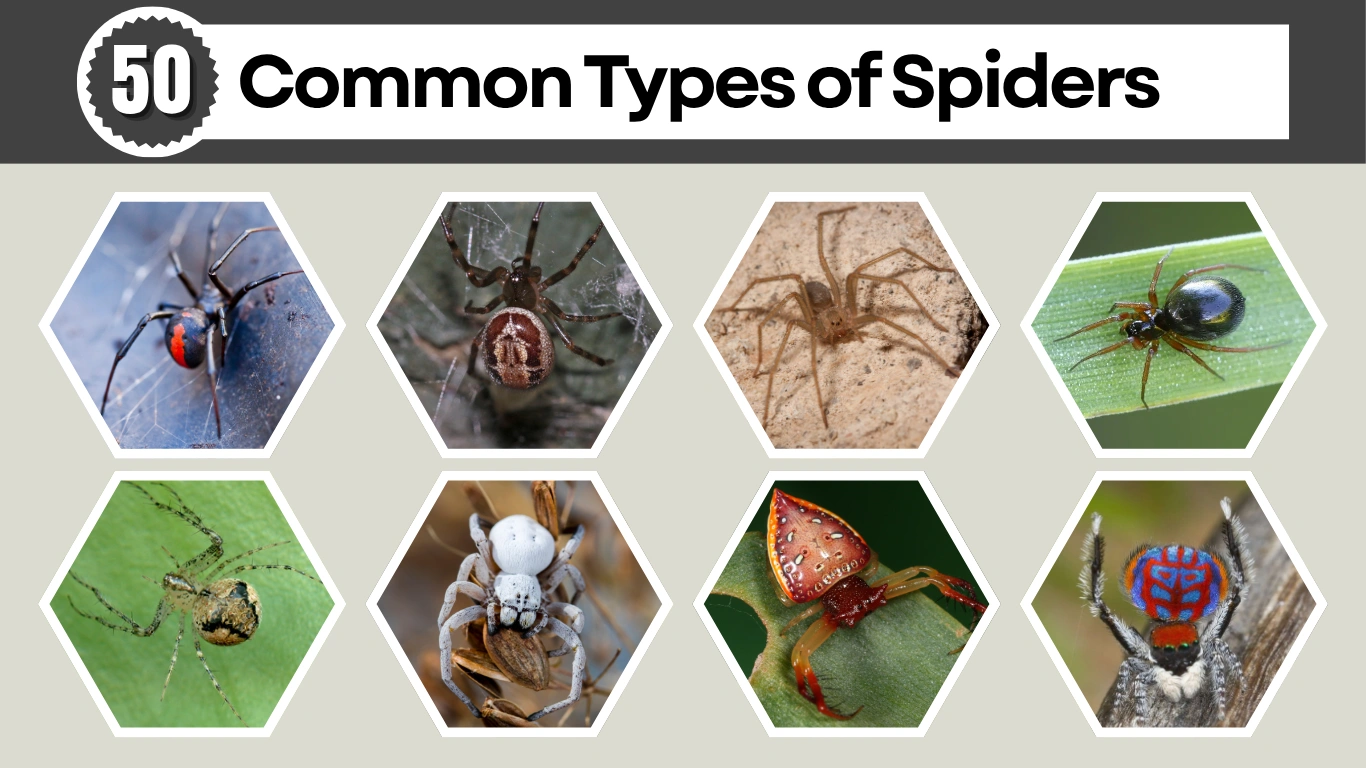
Spiders are among the most diverse creatures on Earth, with thousands of species found in every environment—from forests and deserts to homes and gardens. Each species has unique features, behaviors, and survival strategies, from web-weaving orb-weavers to stealthy hunters like wolf and trapdoor spiders. In this list, you’ll discover 50 common spider types, their habitats, diets, and lifespans. Whether you’re a nature enthusiast or simply curious, this guide offers a fascinating look into the world of these eight-legged architects and hunters.
1. Black Widow Spider

The Black Widow spider is one of the most recognizable and infamous spiders in the world. Known for its shiny black body and red hourglass marking, it has a reputation for being venomous and reclusive. Despite its fearsome image, it is not aggressive and bites only when threatened.
Identification
- Scientific Name: Latrodectus mactans
- Color: Glossy black with red or orange hourglass marking on the abdomen
- Size: Females about 1.5 inches (including legs); males smaller
- Distinct Feature: Spherical abdomen and long, thin legs
Habitat
Black Widows prefer dark, undisturbed areas such as woodpiles, garages, basements, and sheds. They are commonly found in temperate regions around the world, especially in North America. They build irregular, tangled webs close to the ground for trapping prey and shelter.
Diet
These spiders mainly feed on small insects like flies, mosquitoes, beetles, and grasshoppers. They capture prey using sticky silk threads, inject venom to immobilize it, and then digest it externally before consuming the liquid nutrients.
Lifecycle & Lifespan
Female Black Widows lay eggs in silken sacs, each containing hundreds of eggs. Spiderlings hatch after about 20 days and disperse quickly. Females live for up to three years, while males typically survive only a few months, often dying soon after mating.
2. Brown Recluse Spider

The Brown Recluse is a small, shy spider recognized for its violin-shaped marking on the back. It’s one of the few venomous spiders in North America, known for its potent bite that can cause skin irritation but rarely poses a serious threat to humans.
Identification
- Scientific Name: Loxosceles reclusa
- Color: Light to dark brown with a darker violin shape on the cephalothorax
- Size: Around 0.5 inches (body length)
- Distinct Feature: Six eyes arranged in pairs instead of the usual eight
Habitat
Brown Recluses favor dark, dry, and undisturbed environments such as attics, closets, and behind furniture. Outdoors, they hide under rocks, logs, and woodpiles. They are most commonly found in the central and southern United States.
Diet
They primarily feed on small insects and other spiders. The Brown Recluse hunts at night, using its venom to immobilize prey before consuming the liquefied tissue.
Lifecycle & Lifespan
Females lay eggs in silken sacs during the warmer months, with spiderlings hatching after about a month. Adults can live from one to two years, with females typically outliving males.
3. Wolf Spider

Wolf Spiders are fast-moving, robust hunters found in a variety of habitats. Unlike web-building spiders, they chase and ambush their prey, relying on excellent eyesight and speed rather than webs for hunting.
Identification
- Scientific Name: Lycosidae family
- Color: Brown to gray with darker markings
- Size: 0.4 to 1.4 inches in body length
- Distinct Feature: Large eyes in three rows and a furry appearance
Habitat
Wolf Spiders inhabit grasslands, forests, gardens, and even urban areas. They often live in burrows or under rocks and leaves, emerging mainly at night to hunt.
Diet
Their diet includes insects, small arthropods, and even other spiders. They rely on agility and stealth to capture prey and inject venom to subdue it before feeding.
Lifecycle & Lifespan
Females carry their egg sacs attached to their spinnerets, and after hatching, spiderlings ride on the mother’s back for several days. Wolf Spiders live about one year, though some species can survive up to two years in ideal conditions.
4. Jumping Spider

Jumping Spiders are energetic and visually striking creatures known for their excellent eyesight and acrobatic leaps. They are non-aggressive and often display curious behavior toward humans, making them one of the most observed spiders in homes and gardens worldwide.
Identification
- Scientific Name: Salticidae family
- Color: Varies — often black, brown, or iridescent with vivid patterns
- Size: 0.1 to 0.8 inches
- Distinct Feature: Large front-facing eyes and compact, furry body
Habitat
Jumping Spiders thrive in a wide range of habitats including forests, grasslands, and urban areas. They prefer sunny spots such as walls, fences, and windowsills where they can actively hunt during the day.
Diet
They primarily eat small insects like flies, moths, and ants. Jumping Spiders stalk their prey closely and pounce with precision, relying on their exceptional vision to judge distance and movement before attacking.
Lifecycle & Lifespan
Females lay eggs in silk retreats, protecting them until they hatch. Spiderlings grow through several molts before reaching adulthood. The typical lifespan of a Jumping Spider ranges from 1 to 2 years in the wild.
5. Orb-Weaver Spider

Orb-Weaver Spiders are famous for their intricate, wheel-shaped webs. These harmless arachnids play a vital role in pest control by capturing flying insects. Their striking colors and symmetrical webs make them easy to recognize and fascinating to observe.
Identification
- Scientific Name: Araneidae family
- Color: Ranges from yellow and orange to brown or gray
- Size: 0.2 to 1 inch (body length)
- Distinct Feature: Rounded abdomen and symmetrical web design
Habitat
They are commonly found in gardens, forests, and around lights where flying insects gather. Orb-Weavers rebuild their webs regularly, usually in the evening, and rest in the center or nearby during the night.
Diet
Their diet mainly consists of flying insects such as mosquitoes, flies, and moths. Once prey is caught in the web, the spider quickly immobilizes it with silk and injects digestive enzymes before feeding.
Lifecycle & Lifespan
Females lay hundreds of eggs in silken sacs attached to sheltered surfaces. Most adults live for about one year, typically dying as winter approaches, while the eggs survive to hatch in spring.
6. Garden Spider

The Garden Spider, also known as the Writing Spider, is a large and colorful orb-weaver often seen in gardens during late summer. Recognized by its bold yellow and black markings, it spins elaborate circular webs that glisten beautifully in sunlight.
Identification
- Scientific Name: Argiope aurantia
- Color: Yellow and black body with silver hairs on the head
- Size: Females up to 1.1 inches; males smaller
- Distinct Feature: Zigzag pattern (stabilimentum) in the center of the web
Habitat
Garden Spiders prefer open sunny areas such as gardens, meadows, and tall grass. They build their webs between plants, fences, or shrubs and remain motionless at the center, waiting for flying insects.
Diet
Their diet mainly includes flies, bees, moths, and small beetles. The Garden Spider paralyzes prey with venom, wraps it in silk, and consumes it later.
Lifecycle & Lifespan
Females lay egg sacs containing hundreds of eggs that hatch in spring. Adults usually live for about one year, with males dying shortly after mating.
7. House Spider

The House Spider is one of the most familiar species found in homes worldwide. These spiders are harmless to humans and help control indoor insect populations by preying on small pests.
Identification
- Scientific Name: Parasteatoda tepidariorum
- Color: Brownish or gray with chevron patterns on the abdomen
- Size: 0.2 to 0.4 inches (body length)
- Distinct Feature: Irregular cobwebs in corners and basements
Habitat
House Spiders prefer warm, dark, and undisturbed indoor spaces such as attics, basements, closets, and garages. They are well adapted to living close to humans and can thrive year-round indoors.
Diet
They feed on insects like flies, mosquitoes, and cockroaches that become trapped in their sticky webs. Once caught, the prey is paralyzed and consumed gradually.
Lifecycle & Lifespan
Females produce several egg sacs yearly, each containing hundreds of eggs. Spiderlings disperse after hatching and mature within months. The average lifespan of a House Spider is 1 to 2 years, depending on environmental conditions.
8. Yellow Sac Spider

The Yellow Sac Spider is a small but active hunter often found indoors. Known for its pale yellow color and nocturnal habits, it hides in silk sacs during the day and roams at night in search of prey. Though its bite can cause mild irritation, it is not considered dangerous.
Identification
- Scientific Name: Cheiracanthium inclusum
- Color: Pale yellow to light green
- Size: 0.2 to 0.4 inches (body length)
- Distinct Feature: Creates small silk sacs instead of webs
Habitat
Yellow Sac Spiders are often found in corners of ceilings, under furniture, or behind pictures indoors. Outdoors, they hide under leaves or tree bark. They prefer warm, dry environments and are common in homes during cooler months.
Diet
They feed on small insects and other spiders, capturing prey by ambush rather than using webs. They use venom to immobilize their prey quickly before consuming it.
Lifecycle & Lifespan
Females lay eggs in silk sacs, usually hidden in sheltered locations. Spiderlings hatch in a few weeks and mature rapidly. The typical lifespan of a Yellow Sac Spider is around 1 year.
9. Cellar Spider

Commonly called “Daddy Longlegs,” the Cellar Spider is a delicate, long-legged species often found hanging upside down in dark corners. Despite its fragile appearance, it is an effective predator and frequently preys on other spiders.
Identification
- Scientific Name: Pholcus phalangioides
- Color: Pale brown or gray
- Size: Body length about 0.3 inches; legs can be up to 2 inches long
- Distinct Feature: Very long, thin legs and small oval body
Habitat
They thrive in basements, garages, and crawl spaces, preferring cool, dark, and damp locations. Their loose, irregular webs are often built high in corners or ceilings.
Diet
Cellar Spiders feed on small insects and other spiders, including dangerous ones like the Black Widow. They use their long legs to wrap prey in silk before delivering a venomous bite.
Lifecycle & Lifespan
Females carry eggs in their mouthparts until hatching. The young develop through several molts to reach adulthood. Cellar Spiders typically live for about 2 years under favorable indoor conditions.
10. Crab Spider

Crab Spiders are ambush predators known for their crab-like stance and sideways movement. They don’t spin webs to catch prey but rely on camouflage to blend into flowers, waiting to snatch unsuspecting insects like bees or butterflies.
Identification
- Scientific Name: Thomisidae family
- Color: White, yellow, green, or pink depending on surroundings
- Size: 0.2 to 0.4 inches (body length)
- Distinct Feature: Flat body and crab-like legs extending sideways
Habitat
Crab Spiders are often found on flowers, plants, and shrubs where they camouflage perfectly to match petals or leaves. They thrive in gardens, meadows, and forest edges, especially during spring and summer.
Diet
Their diet mainly includes pollinating insects such as bees, flies, and butterflies. Crab Spiders grasp prey with strong front legs and inject venom to paralyze before feeding.
Lifecycle & Lifespan
Females lay eggs in silken sacs hidden under leaves. Spiderlings hatch after a few weeks and disperse to hunt independently. The average lifespan of a Crab Spider is 1 to 2 years.
11. Funnel-Web Spider

The Funnel-Web Spider is known for its distinctive funnel-shaped web, with a narrow retreat where the spider hides, waiting for prey to enter. Although some species are highly venomous, most are harmless and play a vital role in controlling insect populations.
Identification
- Scientific Name: Agelenidae family
- Color: Brown to dark gray
- Size: 0.4 to 1 inch (body length)
- Distinct Feature: Funnel-shaped web with a tubular retreat
Habitat
They prefer grassy areas, gardens, and forests where they can attach their webs between rocks, shrubs, or logs. Some species adapt well to human environments, spinning webs around window frames or corners.
Diet
Funnel-Web Spiders feed on insects such as moths, beetles, and crickets that get caught in their web. Once prey enters the funnel, the spider rushes out swiftly to deliver a venomous bite.
Lifecycle & Lifespan
Females create egg sacs in silk-lined retreats, and spiderlings emerge after several weeks. Adults typically live for about 2 years, while some larger species can live even longer under favorable conditions.
12. Trapdoor Spider

Trapdoor Spiders are fascinating ground-dwellers known for their burrows, which feature a hinged “trapdoor” made of soil and silk. They ambush prey by waiting near the entrance, striking swiftly when vibrations signal a nearby insect.
Identification
- Scientific Name: Ctenizidae family
- Color: Dark brown or black
- Size: 0.8 to 1.5 inches (body length)
- Distinct Feature: Burrow with a silk-hinged door used for ambush hunting
Habitat
They live in warm, dry environments such as grasslands, forests, and deserts. Trapdoor Spiders build burrows in soft soil, often camouflaged with plant material to hide the entrance from predators.
Diet
Their diet includes ants, beetles, and other small invertebrates. They detect vibrations near their burrow and attack quickly, dragging prey inside to consume.
Lifecycle & Lifespan
Females lay eggs inside their burrows, protecting them until hatching. Young spiders remain with the mother for a short time before dispersing. Trapdoor Spiders can live remarkably long lives — up to 10 to 20 years, especially females.
13. Huntsman Spider

The Huntsman Spider is one of the largest and fastest spider species in the world. Despite their intimidating size, they are generally harmless to humans and valued for controlling household pests like cockroaches.
Identification
- Scientific Name: Sparassidae family
- Color: Brown, gray, or tan with mottled patterns
- Size: Up to 5 inches leg span
- Distinct Feature: Flat body and long, outward-stretched legs enabling fast movement
Habitat
Huntsman Spiders prefer warm climates and are often found under bark, rocks, or inside homes. They are native to tropical and subtropical regions, especially in Australia and Asia, and sometimes hide behind curtains or picture frames indoors.
Diet
They primarily eat insects, small reptiles, and other spiders. Instead of webs, Huntsman Spiders rely on speed and ambush tactics, catching prey with precision and agility.
Lifecycle & Lifespan
Females lay egg sacs attached to surfaces or hidden under bark. They guard their eggs until hatching and may live with spiderlings for a short period. Huntsman Spiders typically live for 2 to 3 years, though some can survive longer in captivity.
14. Fishing Spider

Fishing Spiders are semi-aquatic hunters often found near ponds, lakes, and streams. They can walk on water and even dive beneath the surface to catch small fish or insects, using air trapped in their body hairs to breathe underwater.
Identification
- Scientific Name: Dolomedes genus
- Color: Brown or gray with pale stripes along the body
- Size: Up to 3 inches leg span
- Distinct Feature: Ability to walk on water and dive beneath the surface
Habitat
They prefer wet environments such as marshes, riverbanks, and ponds. Fishing Spiders build retreats in vegetation near water and are often active at night, patrolling the water’s edge for prey.
Diet
Their diet consists of aquatic insects, tadpoles, and even small fish. They detect vibrations on the water’s surface, then leap to grab prey, immobilizing it with venom before feeding.
Lifecycle & Lifespan
Females carry egg sacs with their jaws until hatching. Spiderlings are often seen riding on the mother’s back shortly after birth. The average lifespan of a Fishing Spider is 1 to 2 years in the wild.
15. Daddy Longlegs

The Daddy Longlegs, also called the Harvestman or Cellar Spider (depending on species), is famous for its thin, elongated legs and small round body. Despite myths about extreme venom, most are harmless and beneficial pest controllers.
Identification
- Scientific Name: Opiliones order or Pholcus phalangioides (for true spiders)
- Color: Pale gray or tan
- Size: Body around 0.3 inches, legs up to 2 inches long
- Distinct Feature: Extremely long legs and small oval body
Habitat
They inhabit dark, damp areas such as basements, attics, and under logs or stones outdoors. Some species prefer sheltered corners of homes and garages, spinning loose, irregular webs.
Diet
Daddy Longlegs feed on small insects, mites, and decaying organic matter. They often scavenge for food and sometimes prey on other spiders.
Lifecycle & Lifespan
Females lay eggs in secluded locations, often guarded until hatching. The young molt several times before maturing. The typical lifespan of a Daddy Longlegs is 1 to 2 years, depending on habitat and temperature.
16. Green Lynx Spider

The Green Lynx Spider is a vibrant and agile hunter recognized for its bright green color and long spiny legs. It doesn’t build webs to trap prey but actively hunts among plants, making it a natural pest controller in gardens and fields.
Identification
- Scientific Name: Peucetia viridans
- Color: Bright green with red spots and long spiny legs
- Size: Up to 0.8 inches (body length)
- Distinct Feature: Excellent camouflage among green vegetation and jumping ability
Habitat
They are commonly found in shrubs, flowering plants, and crops in warm regions, especially in the southern United States, Mexico, and the Caribbean. Green Lynx Spiders prefer sunny, open areas where they can ambush pollinating insects.
Diet
Their diet consists mainly of moths, flies, and bees. They are skilled ambush predators, relying on vision and speed rather than webs, and can leap several inches to seize prey.
Lifecycle & Lifespan
Females guard their egg sacs fiercely, often displaying defensive behavior. Spiderlings hatch within a few weeks and disperse quickly. The Green Lynx Spider’s lifespan averages 1 to 2 years, depending on environmental conditions.
17. Mouse Spider

Mouse Spiders are burrowing spiders with strong bodies and large fangs, often mistaken for Funnel-Web Spiders. Although their venom is potent, bites are extremely rare due to their reclusive nature.
Identification
- Scientific Name: Missulena genus
- Color: Dark brown to black, sometimes with reddish head region
- Size: Up to 1.2 inches (body length)
- Distinct Feature: Bulky body, glossy cephalothorax, and short legs
Habitat
They are found mainly in Australia and South America, living in silk-lined burrows with trapdoors or side chambers. Mouse Spiders prefer dry, open areas such as scrublands and bushy plains.
Diet
Their diet includes insects and small arthropods. They wait near their burrow entrance at night, ambushing prey that passes by, injecting venom to subdue it instantly.
Lifecycle & Lifespan
Females remain in their burrows most of their lives, while males wander during mating season. Females can live for up to 10 years, whereas males typically survive only 1 to 2 years.
18. Tarantula

Tarantulas are large, hairy spiders admired for their size and calm temperament. Despite their intimidating appearance, most tarantulas are harmless to humans and even kept as exotic pets. They play an important ecological role as ground-dwelling predators.
Identification
- Scientific Name: Theraphosidae family
- Color: Brown, black, or tan with varying color patterns
- Size: 4 to 11 inches leg span (depending on species)
- Distinct Feature: Large, hairy body and powerful fangs
Habitat
Tarantulas live in burrows or under rocks in warm regions across the Americas, Africa, and Asia. They prefer dry, arid environments but can also thrive in tropical forests. Burrows are lined with silk to maintain humidity and protect against predators.
Diet
Their diet includes insects, small lizards, frogs, and occasionally mice. Tarantulas ambush prey, injecting venom to liquefy internal tissues before consuming. They are slow hunters but rely on stealth and patience.
Lifecycle & Lifespan
Females can live remarkably long lives—up to 20 years or more—while males generally live 5 to 7 years. Females guard their eggs in silk sacs and protect spiderlings until they disperse.
19. Redback Spider

The Redback Spider is a close relative of the Black Widow, easily recognized by its distinctive red stripe. Native to Australia, it’s highly venomous but rarely fatal due to effective antivenom and its shy behavior.
Identification
- Scientific Name: Latrodectus hasselti
- Color: Glossy black with a red or orange stripe on the upper abdomen
- Size: Females about 0.4 inches; males much smaller
- Distinct Feature: Red dorsal stripe and tangled, messy web
Habitat
Redback Spiders are found throughout Australia, often around houses, sheds, mailboxes, and outdoor furniture. They prefer sheltered, dry environments and construct irregular webs in quiet corners.
Diet
Their diet includes flies, beetles, ants, and other insects trapped in sticky webs. The Redback injects venom to paralyze prey, then liquefies it for feeding.
Lifecycle & Lifespan
Females produce several egg sacs each summer, containing hundreds of eggs. Spiderlings disperse by ballooning on silk threads. Females typically live for 2 to 3 years, while males survive only a few months after mating.
20. Camel Spider

Often mistaken for a true spider, the Camel Spider is actually a solifuge—an arachnid closely related to spiders and scorpions. Known for its speed and large jaws, it thrives in arid desert regions and hunts aggressively at night.
Identification
- Scientific Name: Solifugae order
- Color: Light brown or tan for desert camouflage
- Size: 2 to 6 inches including legs
- Distinct Feature: Large forward-facing jaws (chelicerae) and segmented body
Habitat
Camel Spiders inhabit deserts and dry scrublands across Africa, the Middle East, and the Americas. They hide in burrows or under rocks during the day to escape extreme heat, emerging at night to hunt.
Diet
They are fierce predators that feed on insects, small rodents, lizards, and other spiders. Camel Spiders use their powerful jaws to crush prey and consume it directly—without venom or webs.
Lifecycle & Lifespan
Females lay eggs in underground burrows, guarding them until they hatch. Spiderlings develop quickly, molting several times before adulthood. Camel Spiders have a lifespan of around 1 to 2 years in the wild.
21. Peacock Spider

The Peacock Spider is one of the most colorful and visually striking species on Earth. Famous for its elaborate courtship dances, this tiny jumping spider displays vibrant colors and unique patterns to attract mates.
Identification
- Scientific Name: Maratus genus
- Color: Bright blue, red, orange, and green iridescent hues
- Size: About 0.2 inches (5 mm)
- Distinct Feature: Males display a colorful fan on their abdomen during mating rituals
Habitat
Peacock Spiders are native to Australia and live in dry forests, grasslands, and sandy areas. They prefer open ground with low vegetation, where males perform their dances under sunlight for maximum color display.
Diet
Their diet consists of small insects and flies. Like other jumping spiders, they rely on keen eyesight and leaping ability to stalk and capture prey rather than building webs.
Lifecycle & Lifespan
Females lay small egg sacs in protected spots, and spiderlings emerge after a few weeks. Males live for about 1 year, while females may survive slightly longer, up to 1.5 years, under natural conditions.
22. Spiny Orb-Weaver

The Spiny Orb-Weaver is a small, brightly colored spider recognized for its hard, spiny abdomen. Despite their fierce appearance, these spiders are harmless and beneficial, spinning beautiful orb-shaped webs that catch flying insects.
Identification
- Scientific Name: Gasteracantha cancriformis
- Color: White, yellow, or red with black spines
- Size: 0.2 to 0.4 inches (body length)
- Distinct Feature: Hard, spiny shell-like abdomen with six prominent spines
Habitat
They are found in gardens, forests, and wooded areas across the Americas, Asia, and Australia. Spiny Orb-Weavers prefer sunny locations to build their large, symmetrical webs between trees or shrubs.
Diet
Their diet includes flies, moths, and small insects trapped in their webs. Once prey is caught, the spider quickly immobilizes it with venom and consumes it later.
Lifecycle & Lifespan
Females lay egg sacs attached to leaves or branches, and spiderlings hatch after several weeks. Adults typically live for about 1 year, completing their life cycle within a single season.
23. Golden Silk Orb-Weaver

The Golden Silk Orb-Weaver, often called the Banana Spider, is famous for its large, golden-colored webs that shimmer in the sunlight. These elegant spiders are admired for both their size and beauty, especially in tropical regions.
Identification
- Scientific Name: Trichonephila clavipes
- Color: Yellowish body with long, banded legs
- Size: Females up to 2 inches (body length); males much smaller
- Distinct Feature: Produces golden-hued silk and intricate webs
Habitat
They inhabit warm, humid environments such as rainforests, woodlands, and gardens. Their expansive webs are usually suspended between trees or tall vegetation, often several feet across.
Diet
Golden Silk Orb-Weavers feed on flying insects like butterflies, dragonflies, and mosquitoes. They rely on their strong, sticky webs to ensnare prey, wrapping and paralyzing it before feeding.
Lifecycle & Lifespan
Females lay egg sacs near their webs, each containing hundreds of eggs. Most adults live for about 1 year, though some females may survive slightly longer in tropical climates.
24. Nursery Web Spider

The Nursery Web Spider is a large, agile hunter known for its parental care. Unlike web-building spiders, it actively hunts prey and constructs silk “nurseries” to guard its eggs, a behavior that gives the species its name.
Identification
- Scientific Name: Pisaurina mira
- Color: Light brown or gray with a darker stripe down the back
- Size: 0.6 to 0.8 inches (body length)
- Distinct Feature: Carries egg sacs in the jaws and guards the nursery web
Habitat
These spiders are found in grasslands, shrubs, and forest edges, especially near water. They prefer humid environments and rest on vegetation or leaves while waiting to ambush prey.
Diet
Their diet includes small insects such as flies, moths, and grasshoppers. Nursery Web Spiders rely on stealth and speed rather than webs, ambushing prey on leaves or the ground.
Lifecycle & Lifespan
Females carry their egg sacs until the spiderlings are ready to hatch, then create a silk nursery web to protect them. The average lifespan of a Nursery Web Spider is 1 to 2 years.
25. Feather-Legged Spider

The Feather-Legged Spider is a unique species named for the feather-like hairs on its legs. It is a specialized predator that targets other spiders using stealth and venom rather than traditional web hunting.
Identification
- Scientific Name: Uloboridae family
- Color: Brown or tan with light markings
- Size: 0.2 to 0.4 inches (body length)
- Distinct Feature: Feather-like leg hairs used for sensing vibrations
Habitat
They are found in tropical and subtropical forests, often hiding in leaf litter or vegetation. These spiders prefer shaded, moist environments where they can stalk prey discreetly.
Diet
Feather-Legged Spiders feed mainly on other spiders and small insects. They rely on agility and surprise, often delivering a quick venomous bite to immobilize their victims.
Lifecycle & Lifespan
Females produce small egg sacs protected by silk, which they guard until hatching. Spiderlings disperse soon after emerging. The Feather-Legged Spider typically lives for about 1 year in the wild.
26. Sheet Web Spider

The Sheet Web Spider is known for its finely woven, horizontal sheet-like web that captures insects falling from above. These spiders are small but efficient hunters, using their quick reflexes to immobilize prey caught in their silk.
Identification
- Scientific Name: Linyphiidae family
- Color: Brown, gray, or tan with subtle markings
- Size: 0.1 to 0.3 inches (body length)
- Distinct Feature: Builds horizontal sheet webs with a dome or tangle above
Habitat
They thrive in meadows, grasslands, forests, and gardens, typically close to the ground among grasses or low vegetation. Their webs are often seen glistening with dew in the early morning.
Diet
Sheet Web Spiders feed on small flying insects such as gnats and aphids that fall into their web. Once trapped, the spider rushes underneath the web to deliver a venomous bite.
Lifecycle & Lifespan
Females produce several small egg sacs throughout the warm months. Spiderlings mature quickly and are capable of building their own webs soon after hatching. The average lifespan of a Sheet Web Spider is 1 year.
27. Lynx Spider

The Lynx Spider is an agile daytime hunter, named after the cat for its exceptional vision and speed. It doesn’t spin webs but instead leaps and chases prey through vegetation, making it an effective insect predator in gardens and fields.
Identification
- Scientific Name: Oxyopidae family
- Color: Green, yellow, or brown with spiny legs
- Size: 0.4 to 0.6 inches (body length)
- Distinct Feature: Long spiny legs and excellent vision
Habitat
Lynx Spiders inhabit shrubs, tall grass, and flowering plants in warm and tropical regions. They are commonly seen perched on leaves or flowers, using camouflage to ambush insects.
Diet
They feed primarily on flies, bees, moths, and grasshoppers. Lynx Spiders use stealth and quick reflexes to pounce on prey, immobilizing it with venom before feeding.
Lifecycle & Lifespan
Females guard their egg sacs on plants and may remain near hatchlings for a short period. The typical lifespan of a Lynx Spider is 1 to 1.5 years, depending on climate and food availability.
28. Net-Casting Spider

The Net-Casting Spider, also called the Ogre-Faced Spider, is an extraordinary hunter that uses a small, rectangular web to trap prey. It waits patiently with the net stretched between its legs, striking with lightning speed when insects pass below.
Identification
- Scientific Name: Deinopis genus
- Color: Brown or gray with elongated body and long legs
- Size: About 1 inch (body length)
- Distinct Feature: Enlarged forward-facing eyes and a handheld “net” web
Habitat
These spiders are found in tropical and subtropical forests worldwide. They usually hang upside down from branches or leaves at night, using their exceptional night vision to detect movement below.
Diet
Net-Casting Spiders feed on moths, flies, and small insects. They capture prey by flinging their silk net over it, then inject venom to subdue and consume it.
Lifecycle & Lifespan
Females lay egg sacs attached to leaves or bark and guard them until hatching. Spiderlings disperse soon after emerging. The average lifespan of a Net-Casting Spider is 1 to 2 years.
29. Six-Eyed Sand Spider

The Six-Eyed Sand Spider is a highly venomous and elusive desert species. It buries itself in sand to ambush prey, remaining nearly invisible. Known for its potent venom, it rarely poses a threat to humans due to its reclusive behavior.
Identification
- Scientific Name: Sicarius hahni
- Color: Sandy brown or beige for perfect desert camouflage
- Size: Up to 0.6 inches (body length)
- Distinct Feature: Flattened body and six eyes instead of eight
Habitat
They inhabit arid deserts and sandy plains in southern Africa and South America. These spiders spend most of their time buried in loose sand, emerging only to capture prey.
Diet
Six-Eyed Sand Spiders feed on insects, scorpions, and other spiders. They rely on ambush tactics, using venom to immobilize prey instantly before feeding.
Lifecycle & Lifespan
Females lay egg sacs in shallow burrows, protecting them from heat and predators. The species has a slow metabolism, allowing it to survive long periods without food. Their lifespan can reach up to 15 years in ideal desert conditions.
30. Leaf-Curling Spider

The Leaf-Curling Spider is a clever orb-weaver that uses leaves or debris to create a shelter in the center of its web. This unique camouflage helps it hide from predators and ambush unsuspecting prey that gets caught in its sticky silk.
Identification
- Scientific Name: Phonognatha graeffei
- Color: Brown, gray, or silver with dark markings
- Size: 0.4 to 0.8 inches (body length)
- Distinct Feature: Uses curled leaves or debris as a hiding retreat in its web
Habitat
These spiders are commonly found in gardens, forests, and shrublands, especially in Australia and parts of Asia. They build their webs between branches or shrubs, often incorporating a curled leaf for shelter.
Diet
Their diet consists of small flying insects like moths, mosquitoes, and flies. Once prey is trapped, the spider quickly rushes out from its curled leaf retreat to deliver a venomous bite.
Lifecycle & Lifespan
Females lay eggs within curled leaves, protecting them until spiderlings hatch. The young remain hidden until they are mature enough to disperse. The average lifespan of a Leaf-Curling Spider is 1 to 2 years.
31. Triangular Spider

The Triangular Spider is a small orb-weaver recognized for its triangular-shaped abdomen. Its web is equally unusual—built as a tensioned structure rather than a full spiral, designed to launch the spider forward at prey that touches the silk.
Identification
- Scientific Name: Arkys walckenaeri
- Color: Brown, orange, or reddish with darker edges
- Size: 0.2 to 0.4 inches (body length)
- Distinct Feature: Triangular abdomen and ambush-hunting behavior
Habitat
Triangular Spiders are found in forests, gardens, and shrubs across Australia and Southeast Asia. They prefer shaded foliage and rest motionless during the day, blending in with their surroundings.
Diet
They feed on small flying insects, such as gnats and mosquitoes. Instead of spinning traditional orb webs, these spiders build small tension webs that fling them toward prey upon contact.
Lifecycle & Lifespan
Females produce egg sacs attached to leaves or twigs. The spiderlings hatch within a few weeks and disperse independently. Triangular Spiders typically live for about 1 year, completing their life cycle within a single season.
32. Velvet Spider

The Velvet Spider is a strikingly beautiful species known for its soft, velvety appearance and vibrant coloration. These ground-dwelling spiders are also famous for their maternal behavior — mothers often sacrifice themselves to feed their young after hatching.
Identification
- Scientific Name: Eresidae family
- Color: Red, black, or orange with a velvety sheen
- Size: 0.3 to 0.6 inches (body length)
- Distinct Feature: Soft, velvety body texture and communal nesting habits
Habitat
Velvet Spiders are found in arid and semi-arid regions of Africa, Europe, and the Middle East. They live in silk-lined burrows under rocks or in soil, sometimes forming small colonies.
Diet
Their diet consists mainly of small insects and other arthropods. They rely on ambush hunting, quickly overpowering prey that comes near their burrow entrance.
Lifecycle & Lifespan
Females lay egg sacs in silk retreats and remain with the spiderlings after hatching. In some species, the mother provides nourishment through self-sacrifice, a rare trait in spiders. Velvet Spiders have a lifespan of 2 to 4 years.
33. Mirror Spider

The Mirror Spider, also known as the Sequined Spider, is admired for its reflective silver spots that shimmer like tiny mirrors. These iridescent scales change size depending on the spider’s stress level or lighting, creating a stunning metallic effect.
Identification
- Scientific Name: Thwaitesia argentiopunctata
- Color: Transparent with reflective silver or gold patches
- Size: 0.1 to 0.2 inches (body length)
- Distinct Feature: Mirror-like reflective spots on the abdomen
Habitat
Mirror Spiders are native to Australia and Southeast Asia, living in tropical forests and gardens. They build small orb webs among foliage, usually hidden on the undersides of leaves.
Diet
They feed on tiny flying insects like gnats and midges. The spider waits motionless in its web until vibrations signal trapped prey, then swiftly bites and consumes it.
Lifecycle & Lifespan
Females lay small egg sacs protected within leaves or silk retreats. Spiderlings mature quickly, reaching adulthood within months. The Mirror Spider’s average lifespan is around 1 to 1.5 years.
34. Bird-Dropping Spider

The Bird-Dropping Spider is a master of disguise, mimicking bird droppings to avoid predators. Its unusual appearance helps it remain undetected both by prey and potential threats, making it a fascinating example of natural camouflage.
Identification
- Scientific Name: Celaenia excavata
- Color: White, brown, and gray mottled patterns resembling bird droppings
- Size: 0.3 to 0.6 inches (body length)
- Distinct Feature: Irregular shape and coloration that mimic bird feces
Habitat
They are found mainly in Australia and New Zealand, often resting motionless on leaves during the day. At night, they hang from silk threads near vegetation, releasing pheromones to attract moths.
Diet
Bird-Dropping Spiders primarily feed on male moths drawn by the spider’s mimic pheromones. Once close, the spider swiftly grabs and subdues them using venom.
Lifecycle & Lifespan
Females lay eggs in silken sacs hidden in foliage and guard them until hatching. The young disperse quickly after emergence. The average lifespan of a Bird-Dropping Spider is 1 to 2 years.
35. Ant-Mimic Spider

The Ant-Mimic Spider is a clever imitator that looks and behaves like an ant. This mimicry helps it avoid predators and sometimes allows it to infiltrate ant colonies for hunting. Its movements and body structure closely resemble real ants.
Identification
- Scientific Name: Myrmarachne genus
- Color: Black, brown, or reddish to match ant species
- Size: 0.2 to 0.4 inches (body length)
- Distinct Feature: Narrow waist and movement that mimic ants
Habitat
Ant-Mimic Spiders inhabit tropical and subtropical regions, especially in forests, gardens, and grasslands. They are often found on plants and tree bark where ants are abundant.
Diet
Their diet includes small insects and sometimes ants themselves. They stalk prey using vision and agility, leaping to capture it without using webs.
Lifecycle & Lifespan
Females lay egg sacs in hidden silk retreats, and spiderlings resemble ants from an early age. The Ant-Mimic Spider’s lifespan is typically 1 to 2 years, depending on environmental conditions.
36. Ground Spider

Ground Spiders are nocturnal hunters that roam the ground rather than spin webs. They are stealthy predators, known for their speed and ability to blend into their surroundings. These spiders are widespread and often go unnoticed due to their secretive nature.
Identification
- Scientific Name: Gnaphosidae family
- Color: Dark brown, gray, or black with a velvety sheen
- Size: 0.2 to 0.6 inches (body length)
- Distinct Feature: Flattened body and cylindrical spinnerets visible at the rear
Habitat
Ground Spiders live under rocks, logs, leaf litter, and debris in forests, gardens, and fields. They build silk retreats or shelters instead of webs and come out at night to hunt.
Diet
They feed on insects and other small arthropods, ambushing prey with quick bites. Their strong legs and venom allow them to overpower prey efficiently without the need for webs.
Lifecycle & Lifespan
Females lay eggs in silk sacs hidden under stones or within their retreats. The young mature quickly and become independent hunters. The average lifespan of a Ground Spider is 1 to 2 years.
37. Pirate Spider

The Pirate Spider is an unusual species that preys primarily on other spiders. It uses deception, plucking the webs of its victims to mimic trapped prey, then ambushing them when they approach to investigate.
Identification
- Scientific Name: Mimetidae family
- Color: Pale gray, yellow, or brown with darker markings
- Size: 0.1 to 0.3 inches (body length)
- Distinct Feature: Long front legs and pointed abdomen used for stealth attacks
Habitat
Pirate Spiders are found in forests, gardens, and grasslands across temperate and tropical regions. They inhabit areas where other web-building spiders are common, often living near their webs.
Diet
Their diet consists mainly of other spiders. Pirate Spiders enter another spider’s web, imitate the vibrations of trapped prey, and then attack when the web’s owner approaches.
Lifecycle & Lifespan
Females produce egg sacs hidden in silk retreats and guard them until hatching. Spiderlings mature through several molts and begin hunting other spiders early in life. Pirate Spiders typically live 1 to 1.5 years.
38. Long-Jawed Orb Weaver

The Long-Jawed Orb Weaver is a slender, graceful spider recognized for its long legs and elongated body. It constructs horizontal or slanted orb webs near water or vegetation and often rests along the web’s frame line, perfectly camouflaged.
Identification
- Scientific Name: Tetragnatha genus
- Color: Pale brown, green, or silver
- Size: 0.3 to 0.6 inches (body length)
- Distinct Feature: Long, thin legs and elongated body that aligns with web strands
Habitat
They thrive near streams, ponds, and marshy areas, often among tall grasses and shrubs. Their delicate webs are built horizontally to intercept flying insects.
Diet
Their diet mainly includes small flying insects such as mosquitoes and gnats. They bite prey quickly and consume it after wrapping it in silk.
Lifecycle & Lifespan
Females attach egg sacs to leaves or stems near their webs, protecting them until hatching. The average lifespan of a Long-Jawed Orb Weaver is 1 year, with adults most active during warm months.
39. Whip Spider

Whip Spiders, also known as Tailless Whip Scorpions, are unusual arachnids that resemble a mix between spiders and scorpions. Despite their intimidating look, they are harmless and lack venom glands or silk-spinning ability.
Identification
- Scientific Name: Amblypygi order
- Color: Brown to dark gray with a flattened body
- Size: Up to 2 inches (body length), legs reaching 8 inches across
- Distinct Feature: Long, whip-like front legs used as sensory feelers
Habitat
They prefer tropical and subtropical environments, hiding in caves, under bark, or in leaf litter. Whip Spiders are nocturnal and rely on their sensory legs to navigate and hunt in the dark.
Diet
Their diet includes insects, crickets, and other small arthropods. They grab prey using their spiny pedipalps and crush it before eating — no webs or venom required.
Lifecycle & Lifespan
Females carry eggs beneath their abdomen until hatching, and spiderlings ride on the mother’s back briefly after birth. Whip Spiders can live for 5 to 10 years, depending on species and environment.
40. Ogre-Faced Spider

The Ogre-Faced Spider is a nocturnal hunter with exceptionally large eyes that provide outstanding night vision. Its unique hunting method involves using a small net of silk to snare prey in midair with astonishing accuracy.
Identification
- Scientific Name: Deinopis subrufa
- Color: Brown or gray with a slender body and elongated legs
- Size: About 1 inch (body length)
- Distinct Feature: Enormous forward-facing eyes and a net-casting hunting style
Habitat
They are found in tropical and subtropical regions, particularly in forests and shrublands of Africa, Asia, and Australia. During the day, they rest camouflaged on tree trunks, blending perfectly with bark patterns.
Diet
Their diet includes moths, beetles, and other insects. They spin a small, stretchy web held between their legs and cast it over unsuspecting prey passing below.
Lifecycle & Lifespan
Females create egg sacs attached to leaves or branches and guard them until spiderlings emerge. Ogre-Faced Spiders live for about 1 to 2 years, depending on environmental conditions.
41. Tube Web Spider

The Tube Web Spider is a nocturnal species known for its tubular silk retreats built in cracks, walls, or tree bark. It is a fast and defensive spider that ambushes prey at the entrance of its silk tunnel.
Identification
- Scientific Name: Segestria florentina
- Color: Shiny black or dark green with metallic fangs
- Size: Females up to 0.9 inches (body length)
- Distinct Feature: Tube-like silk burrow with radiating trip lines for detecting prey
Habitat
Tube Web Spiders are often found in old buildings, stone walls, and tree bark across Europe and North Africa. They prefer dark, enclosed spaces and rarely leave their silk tubes.
Diet
Their diet consists of insects and other small arthropods. They wait at the tunnel entrance, sensing vibrations through trip lines before striking and dragging prey inside.
Lifecycle & Lifespan
Females produce several egg sacs yearly, attaching them within their silk retreats. The spiderlings stay for a short time before dispersing. Tube Web Spiders can live up to 7 years, with females typically outliving males.
42. Spitting Spider

The Spitting Spider is a fascinating species that hunts by ejecting a sticky, venomous silk from its fangs to immobilize prey. Its unique dual-attack method — both silk and venom — makes it one of the most efficient small predators in the spider world.
Identification
- Scientific Name: Scytodes thoracica
- Color: Pale yellow or light brown with black markings on the cephalothorax
- Size: 0.2 to 0.3 inches (body length)
- Distinct Feature: Ability to spit sticky silk and venom simultaneously at prey
Habitat
Spitting Spiders prefer quiet indoor locations like attics, closets, and basements, as well as outdoor spaces under rocks or logs. They are found worldwide, particularly in warm, dry climates.
Diet
Their diet includes insects, mosquitoes, and other small spiders. They approach prey slowly and spit silk at high speed to trap it before delivering a venomous bite.
Lifecycle & Lifespan
Females carry eggs beneath their body until they hatch, protecting the spiderlings in a silken retreat. The average lifespan of a Spitting Spider is 1.5 to 2 years.
43. Money Spider

The Money Spider is one of the smallest spider species and is considered a symbol of good luck in folklore. Despite their tiny size, they play a significant ecological role by controlling aphid populations in crops and gardens.
Identification
- Scientific Name: Linyphiidae family
- Color: Brown, black, or gray
- Size: 0.04 to 0.1 inches (body length)
- Distinct Feature: Extremely small size and fine sheet-like webs
Habitat
They live in grassy areas, gardens, and farmlands across Europe and North America. Their delicate webs are built close to the ground, often hidden among leaves or blades of grass.
Diet
Money Spiders feed mainly on aphids and other tiny insects, making them valuable allies to gardeners and farmers. They use their small but sticky webs to trap prey efficiently.
Lifecycle & Lifespan
Females lay eggs in small silk sacs within vegetation, and spiderlings disperse by ballooning — floating on silk threads through the air. Money Spiders have a lifespan of about 1 year.
44. Lace Webbed Spider

The Lace Webbed Spider is a common house and garden species known for its intricate, lace-like web structure. These spiders are quick movers and skilled hunters, often seen after rain when they emerge from their silk tunnels.
Identification
- Scientific Name: Amaurobius similis
- Color: Dark brown with lighter patterns on the abdomen
- Size: 0.3 to 0.6 inches (body length)
- Distinct Feature: Builds funnel-shaped, lace-textured webs near walls and fences
Habitat
They are commonly found around buildings, stone walls, and garden sheds in Europe and North America. Lace Webbed Spiders prefer damp, shaded areas and are often active at night.
Diet
Their diet consists of insects such as flies, beetles, and moths that wander into their webs. The spider quickly rushes out from its silk retreat to inject venom and pull prey back inside.
Lifecycle & Lifespan
Females create egg sacs hidden within their webs, and spiderlings stay for several days after hatching before dispersing. Lace Webbed Spiders typically live for 1 to 2 years, with females sometimes surviving longer in cooler climates.
45. Silver Garden Spider

The Silver Garden Spider is a striking orb-weaver known for its shiny, silvery abdomen that reflects sunlight. It spins large, circular webs that often include a zigzag silk pattern, helping to attract prey and strengthen the web’s structure.
Identification
- Scientific Name: Argiope argentata
- Color: Silver abdomen with yellow and black markings on the legs
- Size: Females up to 1 inch; males much smaller
- Distinct Feature: Shiny silver abdomen and zigzag stabilimentum in web
Habitat
These spiders are found in warm regions such as the southern United States, Central America, and the Caribbean. They prefer open, sunny areas like gardens, meadows, and shrubs where they can anchor large webs.
Diet
Their diet includes flies, bees, moths, and grasshoppers. The Silver Garden Spider waits in the center of its web, detecting vibrations before quickly immobilizing prey with silk.
Lifecycle & Lifespan
Females lay egg sacs suspended within the web, each containing hundreds of eggs. Adults generally live for about 1 year, with new generations emerging each spring or summer.
46. Bark Spider

The Bark Spider is renowned for spinning the strongest silk in the world, capable of creating webs that span over rivers and streams. This orb-weaver camouflages perfectly against tree bark, making it nearly invisible to both predators and prey.
Identification
- Scientific Name: Caerostris darwini
- Color: Gray, brown, or mottled to match tree bark
- Size: 0.6 to 1 inch (body length)
- Distinct Feature: Exceptional silk strength and bark-like camouflage
Habitat
They are found in Madagascar, where they build massive orb webs—sometimes over 80 feet wide—across rivers and open spaces. Bark Spiders prefer forested regions with moisture and strong web anchor points.
Diet
Their diet includes large flying insects such as dragonflies, moths, and beetles. They rely on their massive, golden-hued webs to ensnare prey efficiently.
Lifecycle & Lifespan
Females produce egg sacs hidden within bark crevices, protecting them from rain and predators. Bark Spiders have a lifespan of about 1 to 2 years, depending on environmental stability.
47. Trapdoor Wolf Spider

The Trapdoor Wolf Spider combines traits of burrowing and hunting spiders, living in silk-lined tunnels with camouflaged entrances. It ambushes insects from its hidden burrow, making it an expert in stealth predation.
Identification
- Scientific Name: Trochosa urbana
- Color: Brown or gray with striped legs and dark body markings
- Size: 0.8 to 1.2 inches (body length)
- Distinct Feature: Silk-lined burrow with trapdoor and wolf-like hunting behavior
Habitat
Found in forests, grasslands, and deserts, these spiders dig burrows in soft soil or under rocks. They prefer stable ground where they can anchor their trapdoor shelters securely.
Diet
They feed on beetles, crickets, and small arthropods. The spider detects vibrations outside its burrow, bursts out to grab prey, and retreats inside to feed safely.
Lifecycle & Lifespan
Females guard their egg sacs within burrows and later carry spiderlings on their backs after hatching. Trapdoor Wolf Spiders live for 2 to 3 years, with females often outliving males.
48. Desert Recluse

The Desert Recluse is a close relative of the Brown Recluse, adapted to arid environments. It is a venomous yet shy spider, rarely encountered by humans. Its bite can cause mild necrosis but is seldom fatal, as the species avoids confrontation.
Identification
- Scientific Name: Loxosceles deserta
- Color: Light tan to sandy brown with a violin-shaped marking on the cephalothorax
- Size: 0.3 to 0.5 inches (body length)
- Distinct Feature: Six eyes arranged in pairs and fine hairless legs
Habitat
Native to the deserts of the southwestern United States and northern Mexico, Desert Recluses live under rocks, logs, and debris. They prefer dry, secluded areas and occasionally wander indoors seeking shelter.
Diet
Their diet includes small insects and other spiders. They are nocturnal hunters, using venom to immobilize prey and liquefy it for consumption.
Lifecycle & Lifespan
Females produce multiple egg sacs each year, each containing up to 100 eggs. The spiderlings mature slowly and disperse after several weeks. Desert Recluses typically live for 1 to 2 years, with females sometimes surviving longer.
49. False Widow Spider

The False Widow Spider is often mistaken for the more dangerous Black Widow due to its similar shape and color. While venomous, its bite is rarely harmful to humans and symptoms are typically mild. It’s one of the most common urban spiders in Europe.
Identification
- Scientific Name: Steatoda nobilis
- Color: Dark brown to black with cream or white markings on the abdomen
- Size: 0.3 to 0.6 inches (body length)
- Distinct Feature: Rounded, glossy abdomen resembling a true widow spider
Habitat
They prefer warm, sheltered locations such as attics, sheds, garages, and wall crevices. False Widows are particularly common in coastal regions of Europe and are spreading to other temperate zones.
Diet
Their diet includes flies, woodlice, and small insects trapped in their irregular webs. The spider bites to paralyze its prey, wraps it in silk, and feeds at leisure.
Lifecycle & Lifespan
Females lay several egg sacs per year, each containing 100 to 200 eggs. Spiderlings disperse soon after hatching. False Widow Spiders can live for 2 to 3 years, with females usually outliving males.
50. Woodlouse Spider

The Woodlouse Spider is a distinctive ground-dwelling species known for its large fangs and reddish body. As its name suggests, it specializes in hunting woodlice (pill bugs), using its powerful jaws to pierce their tough exoskeletons.
Identification
- Scientific Name: Dysdera crocata
- Color: Reddish-brown cephalothorax with a pale cream or gray abdomen
- Size: 0.4 to 0.6 inches (body length)
- Distinct Feature: Large fangs and six eyes instead of the usual eight
Habitat
Woodlouse Spiders are found across Europe, North America, and Australia. They live under rocks, logs, and leaf litter, where woodlice are abundant. Indoors, they sometimes hide in basements or dark corners.
Diet
Their primary prey is woodlice, though they occasionally feed on other soft-bodied insects. They rely on stealth, biting quickly with strong jaws to penetrate prey shells before feeding.
Lifecycle & Lifespan
Females lay eggs in silken sacs hidden under stones or debris and guard them until hatching. Spiderlings remain with the mother for a short period before dispersing. The Woodlouse Spider’s lifespan averages 2 to 3 years, making it one of the longer-lived house-dwelling species.
