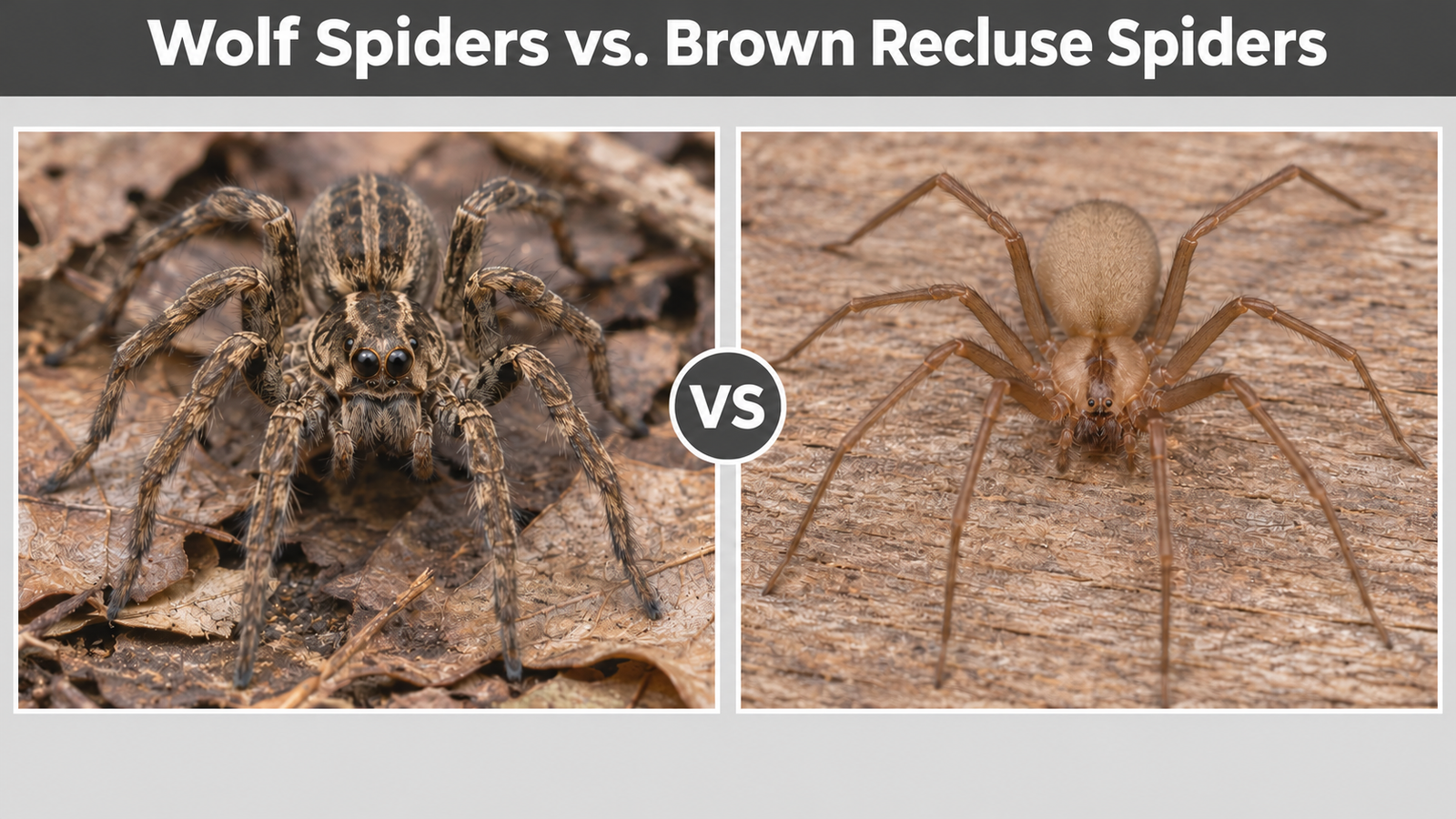
Wolf spiders are usually sturdier and hairier than brown recluse spiders. Many have stripes or mottled markings, while a brown recluse has a plain oval abdomen and slender, evenly colored legs. The eyes offer the clearest distinction in a sharp close-up. A wolf spider has eight eyes, including two noticeably large ones, while a brown recluse has six small eyes arranged in three pairs. If you found a brown spider indoors and only had a quick look, start with its body shape and markings, then consider where you live.
Wolf Spider vs. Brown Recluse at a Glance
“Wolf spider” refers to a family with many species, so their size and markings vary. The brown recluse is a single species, Loxosceles reclusa. Compare several features before settling on an identification, especially if the spider is small or the photo is blurry.
| Feature | Wolf Spider | Brown Recluse Spider |
|---|---|---|
| Eyes | Eight eyes in three rows, with two large eyes facing forward | Six small eyes in three separated pairs |
| Front body | Often striped or mottled | Adults often have a darker violin-shaped mark |
| Abdomen | Frequently patterned with stripes, spots, or chevrons | Plain and oval, with fine hairs |
| Legs | Often sturdier and visibly hairy, sometimes with dark bands | Slender and evenly colored, with fine hairs |
| Adult body size | Varies widely by species | Typically ¼ to ½ inch, excluding the legs |
| Egg sac | Female carries it attached to the rear of her abdomen | Female leaves it in a sheltered silk retreat |
How to Tell a Wolf Spider From a Brown Recluse
A top-down view is usually enough to compare the abdomen, legs, and overall build. Use the eye pattern when you have a clear view of the front of the spider. If you’re looking at a photo, zoom in before deciding which marks are part of the spider and which are shadows or reflections.
Compare the Eyes
Wolf spiders typically have a bottom row of four small eyes, two much larger eyes above that row, and two more eyes farther back. In a photo taken from the front, the large pair often stands out first. You may still have trouble seeing all eight from a single angle.
A brown recluse has three pairs of small, similarly sized eyes. One pair sits near the front center, and the other two pairs are spaced apart on either side, slightly farther back. A blurry photo can hide one or more pairs, so only use the eye count if you can see the individual eyes clearly.
Check the Abdomen and Violin Mark
Many wolf spiders have a stripe, mottling, or a series of darker markings on the abdomen, the rear section of the body. Similar patterns may continue onto the front body. The exact arrangement varies by species, and some wolf spiders are much less patterned than others.
A brown recluse has an evenly colored abdomen. Its darker violin-shaped mark, when visible, sits on the front body, where the legs attach. The narrow end points toward the abdomen. A dark patch that resembles a violin can be misleading on its own. Check for a plain abdomen and evenly colored legs before giving the mark much weight.
Look at the Legs and Overall Build
Many wolf spiders have a stocky build, thicker legs, and visible hairs. Some have dark bands on their legs, while others look more uniformly brown. A large, hairy spider with a striped body fits the typical wolf spider appearance, though other ground-hunting spiders share those traits.
Brown recluse legs are long and slender, with fine hairs and no prominent spines or contrasting bands. The body itself is relatively small. When comparing sizes, estimate the length from the front of the spider to the tip of its abdomen. The full leg span can make a brown recluse appear much larger than its body length suggests.
Habitat and Behavior Differences
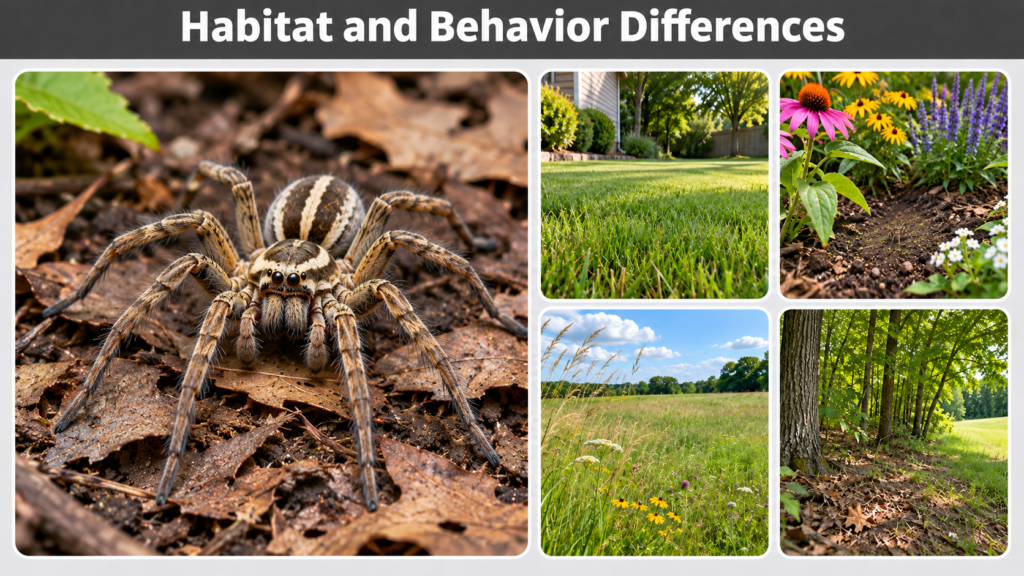
Both spiders can turn up indoors, but where you find one and what it’s doing can help narrow the possibilities. A spider running across a garage floor could belong to either group in areas where brown recluses live. A female carrying spiderlings on her back gives you a much stronger clue.
| Observation | What it suggests |
|---|---|
| Spider runs across a lawn, garden path, or garage floor | A wolf spider is plausible, especially if the body is sturdy and patterned |
| Female carries a round egg sac attached to the tip of her abdomen | A strong clue for a wolf spider |
| Female carries many tiny spiderlings on her back | A characteristic wolf spider behavior |
| Plain brown spider shelters behind a box in a dry storage area | A brown recluse is possible within its established range |
| Spider sits in the middle of a large circular web | An orb-weaver is a better match |
Where Wolf Spiders Live
Wolf spiders occur across much of North America. Depending on the species, they live in lawns, gardens, fields, woodland edges, and other habitats. Many hide under leaves, stones, or pieces of wood. Some use burrows. They hunt on foot and can move quickly when disturbed.
Indoors, you may see one crossing a basement, garage, or ground-floor room. The clearest behavioral clue is how females carry their young. A female attaches her egg sac to the spinnerets at the rear of her body. After hatching, the spiderlings climb onto her back and ride there for a time.
Where Brown Recluse Spiders Live
Brown recluses are established mainly in the central and south-central United States, including Missouri, Arkansas, Oklahoma, and portions of surrounding states. Wolf spiders have a much broader distribution. Other recluse species occur in parts of the Southwest, so a spider resembling a recluse may belong to a different species there.
Within their range, brown recluses can shelter in dry, undisturbed places such as closets, cardboard boxes, gaps behind furniture, and sheltered woodpiles. They use silk in their retreats and may leave those spaces to hunt. A spider crossing an open floor can still be a brown recluse, so check its physical features even if you saw it moving quickly.
Wolf Spider Bite vs. Brown Recluse Bite
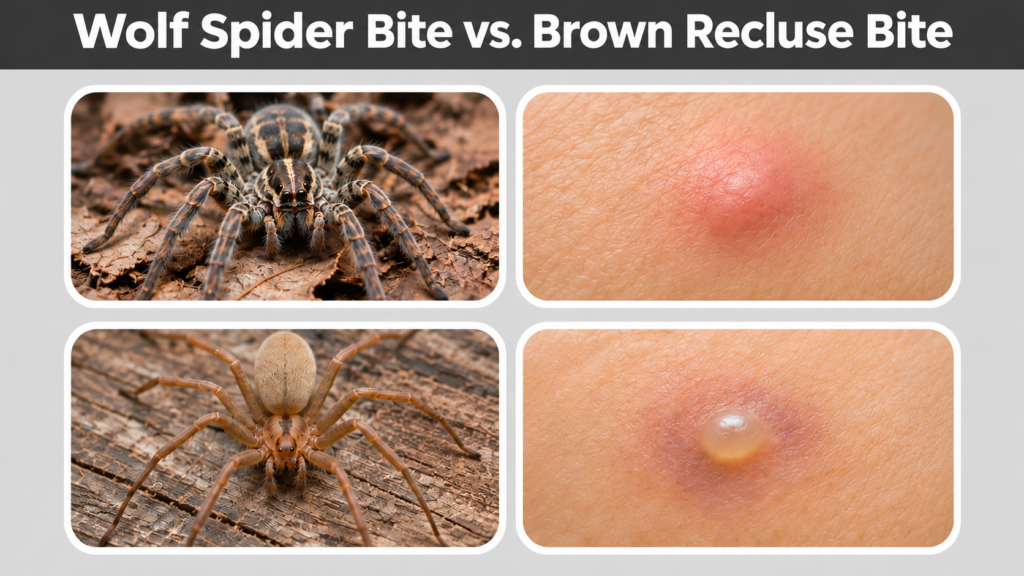
Wolf spider bites usually cause local discomfort. Brown recluse bites deserve more attention because some can cause a worsening skin injury or, less commonly, symptoms affecting the rest of the body. Skin appearance alone can’t tell you which spider was responsible. Other conditions, including infections, can produce similar redness, swelling, or sores.
| Bite question | Wolf Spider | Brown Recluse Spider |
|---|---|---|
| What might a bite feel like? | Often noticed as local pain or irritation | May be mild or go unnoticed at first |
| What can happen afterward? | Local pain, redness, or swelling | Local pain and redness can develop, and some bites cause blistering or skin breakdown |
| Can the skin mark identify the spider? | A skin mark alone is insufficient | A skin mark alone is insufficient |
If you suspect a brown recluse bite or symptoms are getting worse, contact a clinician or poison control center promptly. If you saw the spider, a photo taken from a safe distance can help with identification. Avoid handling it to get a closer look.
How to Identify the Spider You Found Indoors
Start by noting where you found it and taking a photo from above. Look at the abdomen first. Clear stripes or mottling make a brown recluse unlikely. Next, check the legs for bands and compare how heavy or slender they look. If the spider has a fuzzy build, sturdy legs, and a large pair of forward-facing eyes, a wolf spider is a strong possibility.
If the spider has a plain oval abdomen and thin, evenly colored legs, see whether a sharp photo shows the three separated pairs of eyes. Your location matters at this point because several other brown house spiders share those general features. If the details are unclear, keep the identification tentative and share the photo and your location with a local extension office or qualified pest professional.
Frequently Asked Questions
Is a wolf spider bigger than a brown recluse?
Some wolf spiders are considerably bigger and bulkier than an adult brown recluse. Others are small enough for their sizes to overlap. A brown recluse typically measures about ¼ to ½ inch in body length.
Compare the body rather than the distance between the leg tips. Overall build, eye arrangement, and markings are more reliable than size alone.
Can a wolf spider have a violin-shaped marking?
Dark stripes or patches on a wolf spider’s front body can look vaguely like a violin. The perceived shape can change with the lighting, viewing angle, or quality of the photo.
If you see a possible violin mark, look for other clues. A patterned abdomen, stout legs, or two conspicuously large eyes points away from a brown recluse.
Do wolf spiders and brown recluses both run fast?
Both can move quickly, especially when disturbed. Wolf spiders regularly run across open ground as they hunt, and brown recluses sometimes cross floors while moving between hiding places.
Speed alone can’t separate them. If the spider pauses long enough for a photo, focus on the body pattern, leg coloring, and eyes.
What is the brown spider carrying babies on its back?
A brown spider carrying a cluster of tiny spiderlings directly on its back is very likely a wolf spider. Females carry their young this way for a period after the eggs hatch.
Before the eggs hatch, the female usually carries a rounded silk egg sac attached to the rear of her abdomen. Either behavior offers a useful clue if you can see it clearly.
Can wolf spiders and brown recluses live in the same house?
Both can occur in the same area and may turn up in the same building where brown recluses are established. A wolf spider may wander into a basement or garage, while a brown recluse may shelter in a quiet storage space.
Identify each spider using its own features. Finding one wolf spider indoors tells you little about the identity of another brown spider elsewhere in the house.
