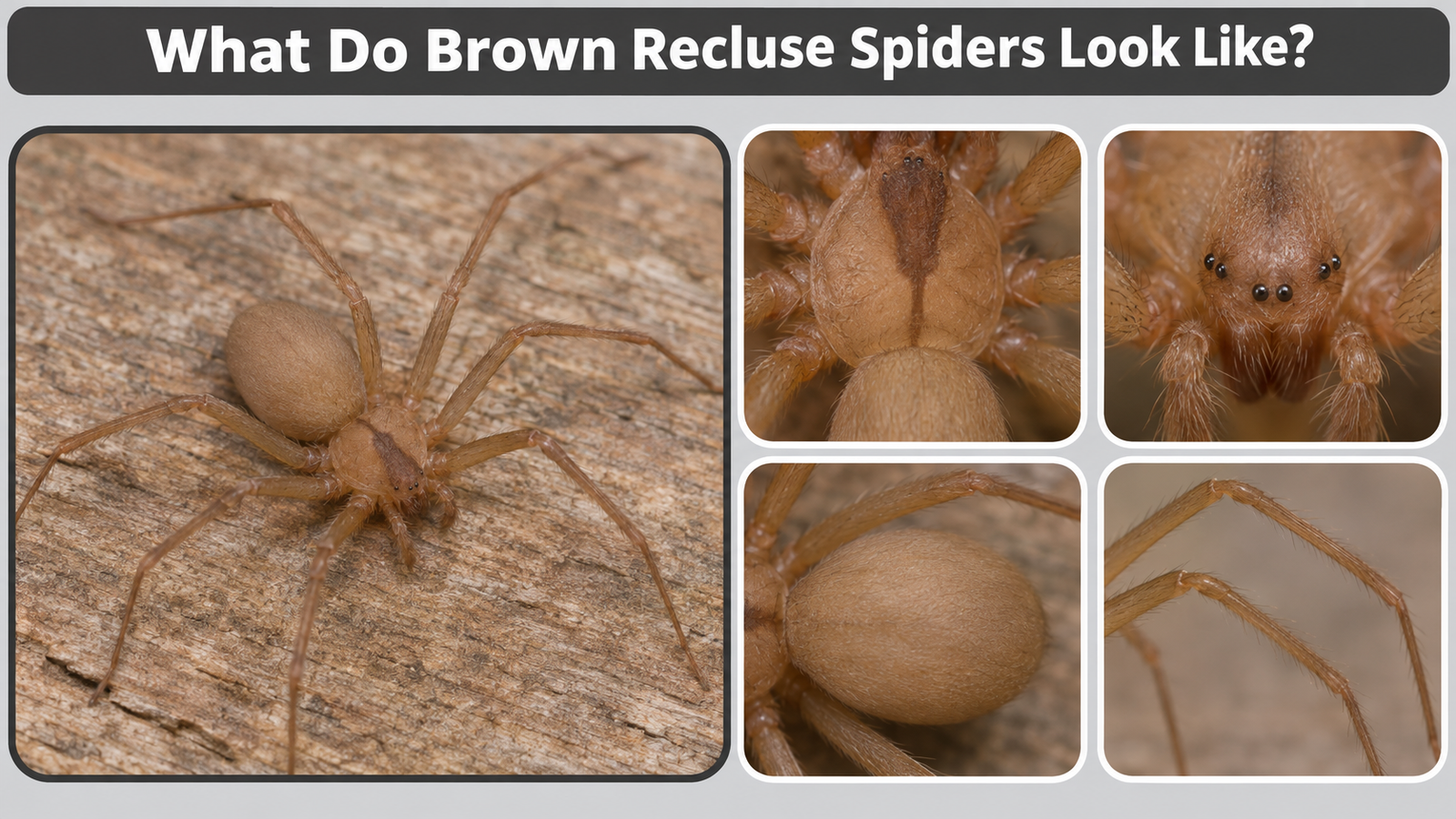
A brown recluse spider is usually tan to medium brown, with long, slender legs and a plain oval abdomen. Adults often have a darker, violin-shaped mark on the front body. The clearest clue is its six small eyes arranged in three pairs, though they’re difficult to count without a sharp close-up. Several common house spiders look similar at first glance. To narrow down the identification, check the eyes, leg markings, and abdomen together, then consider whether the brown recluse is established in your area.
How to Identify a Brown Recluse Spider
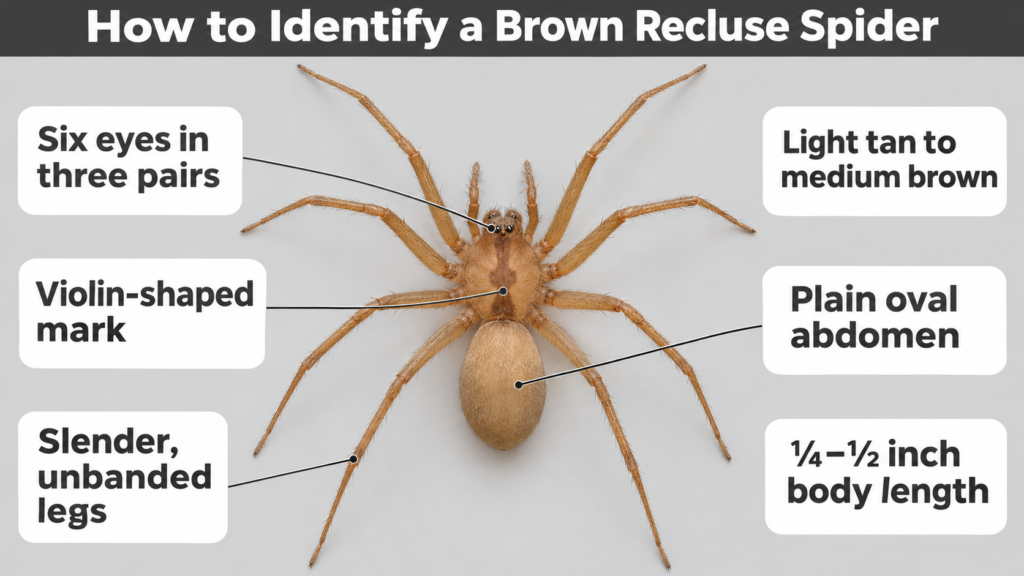
The brown recluse (Loxosceles reclusa) has a fairly plain appearance. Its legs and abdomen each have an even color, while the front body may carry the darker violin mark. Start with features you can see from a comfortable distance, such as the overall size and any obvious stripes or spots. A close, well-lit photo can help you check finer details later.
| Feature | What to look for |
|---|---|
| Eyes | Six small eyes in three separated pairs |
| Violin mark | A darker mark on the front body with its narrow end pointing toward the abdomen |
| Abdomen | Plain, oval, and covered with fine hairs |
| Legs | Long, slender, and evenly colored, with fine hairs and no prominent spines |
| Adult body length | Roughly ¼ to ½ inch, excluding the legs |
| Overall color | Commonly light tan to medium brown |
1. Six Eyes Arranged in Three Pairs
A brown recluse has one pair of eyes at the front center of its head region and one pair on either side, slightly farther back. The eyes are small and similar in size. The spaces between the pairs help distinguish the pattern from the rows or clusters of eyes found on many other spiders.
Check the arrangement as well as the count. A spitting spider can also have six eyes in three pairs, and other recluse species share the same eye pattern. If a photo shows only a few dark specks, leave the eye count open. Glare, shadows, and a side angle can hide an entire pair.
2. A Dark Violin-Shaped Mark on the Front Body
The violin mark sits on top of the cephalothorax, the front section where the legs attach. The broad part of the mark is closer to the eyes, and the narrow part points backward toward the abdomen. In some adults it looks distinctly like a fiddle. In others it appears as a less defined patch of darker brown.
Young brown recluses may have a faint mark, and lighting can make it look lighter or darker in photos. Many other spiders also have dark markings on the front body. If you see what looks like a violin, check whether the spider also has plain legs, an unpatterned abdomen, and the characteristic eye arrangement.
3. A Plain, Oval Abdomen
The abdomen is the rear section of the spider. On a brown recluse, it’s oval and evenly colored, typically ranging from beige to grayish brown or darker brown. Fine hairs can give it a soft, matte appearance. A faint shadow along one side is normal when light comes from a window or flashlight.
Look for markings that stay visible as the viewing angle changes. White dots, cream triangles, a dark stripe down the middle, or a series of chevrons point toward another spider. For instance, a small brown spider with a rounded abdomen and repeated cream triangles is more consistent with a triangulate cobweb spider.
4. Long, Slender Legs With Even Coloring
Brown recluse legs are thin and usually look tan to brown. Each leg is evenly colored along its length and lacks prominent bands, rings, or spots. The legs have short, fine hairs that may be hard to see in a regular photo. From across a room, they can appear smooth.
A side view can help you tell leg markings from shadows at the joints. Distinct light and dark bands across several legs are a clue to another species. Thick, bristle-like spines projecting from the legs are another clue. Long legs alone tell you very little because many indoor spiders share that shape.
5. A Small Body Compared With the Leg Span
An adult brown recluse typically measures about ¼ to ½ inch in body length. Measure from the front of the body to the tip of the abdomen. A spider with its legs stretched out looks considerably larger, so an estimate based on the full spread can be misleading.
Young brown recluses have smaller bodies and may look paler. For a photo that gives a sense of scale, include a floorboard seam, screw head, or another nearby object already in the scene. An accurate body-length estimate helps when you’re comparing the spider with a larger wolf spider or a very small cobweb spider.
6. Tan to Brown Coloring Across the Body
Most brown recluses look light tan to medium brown at a glance. The abdomen and front body can be different shades, even though each section looks relatively plain. A spider with a tan front body and a grayish-brown abdomen can still fit the general description.
Color is most useful for ruling out obvious mismatches. A spider with bright white abdominal patches, bold leg bands, or strongly contrasting stripes has features that point elsewhere. Indoor light can also cast a yellow or orange tint, so rely on the placement of markings and the shape of the spider before judging its shade.
Brown Recluse Look-Alikes
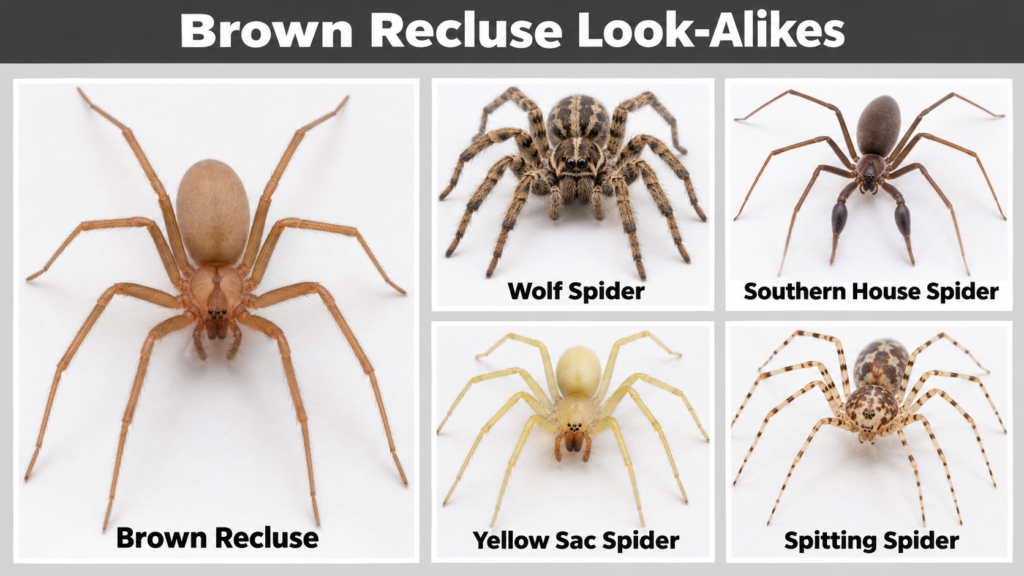
Wolf spiders, southern house spiders, and several other species account for many brown recluse look-alikes. The easiest difference to spot depends on the spider. Check the body pattern on a wolf spider, the front appendages on a male southern house spider, and the abdomen shape and markings on a cobweb spider.
| Look-alike | How to tell it apart |
|---|---|
| Wolf spider | Often sturdier and hairier, with patterned coloring and two notably large eyes |
| Male southern house spider | Has elongated, leglike appendages near the mouth that extend forward |
| Yellow sac spider | Often pale yellow or cream and has eight eyes |
| Spitting spider | May have six eyes in pairs, but typically has a domed front body and patterned coloring |
| Triangulate cobweb spider | Has a rounded abdomen with cream or yellowish triangles and thin legs that may darken at the joints |
Where Are Brown Recluse Spiders Found?
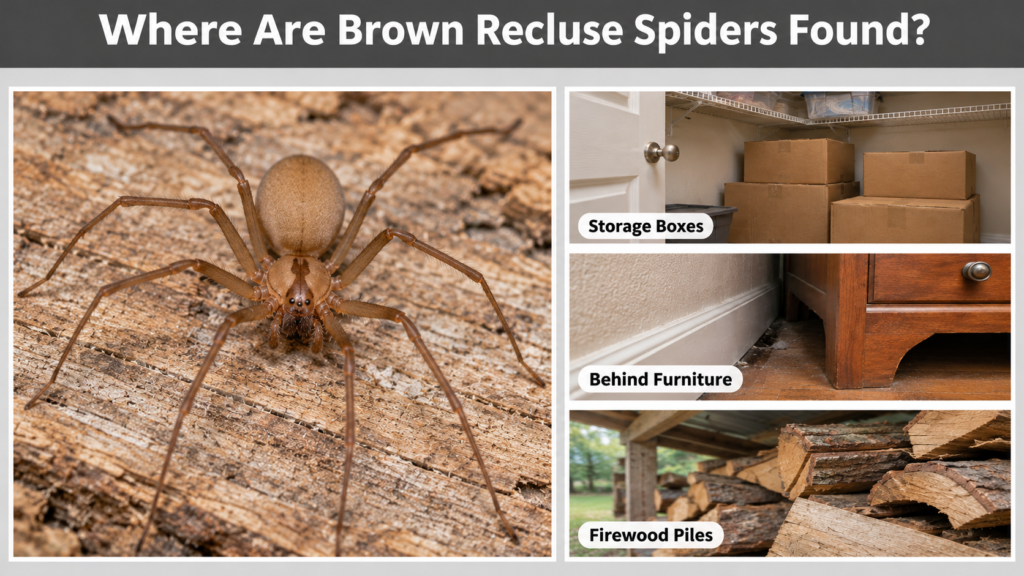
The brown recluse is established mainly in the central and south-central United States, including states such as Missouri, Arkansas, Kansas, and Oklahoma, with its range extending into parts of neighboring regions. Other recluse species occur in parts of the Southwest. A spider can occasionally travel outside its usual range in boxes or belongings, but local distribution is a useful clue when weighing an identification. Within its established range, brown recluses can shelter in dry, undisturbed spaces such as closets, storage boxes, and gaps behind furniture. Finding a brown spider in one of those places gives you a location clue. Its physical features still guide the identification.
How to Photograph a Suspected Brown Recluse
Take a clear photo from above to show the front body, abdomen, and all the legs. If you can get another shot from the front without disturbing the spider, use your camera’s zoom to capture the eyes. Keep the original full-resolution photo so the small details stay visible when someone enlarges it. Record your city or state, where you found the spider, and its approximate body length. Leave it in place while taking pictures. If the markings and eyes are hard to make out, a local university extension office or pest professional can review the photo and tell you whether it’s clear enough for identification.
Frequently Asked Questions
What does a baby brown recluse look like?
A young brown recluse usually looks like a smaller, sometimes paler adult. It has a plain abdomen, slender legs, and the same three pairs of eyes.
The violin marking can be faint on a juvenile. A clear photo of the eyes and body is more useful than trying to make out a dark shape on its back.
Do all brown recluse spiders have a violin mark?
Adult brown recluses typically have a darker violin-shaped mark, but its intensity varies. Young spiders may show little contrast in that area.
The mark belongs on the front body, where the legs attach. A dark shape on the abdomen is a different marking and points toward another identification.
Can a brown recluse have white spots or striped legs?
A brown recluse has an unpatterned abdomen and evenly colored legs. True white spots, repeated pale triangles, and distinct leg bands are useful clues that you’re looking at another spider.
A light reflection can resemble a white dot in a blurry photo. Try another angle to see whether the spot stays in the same place.
What is the easiest way to tell a brown recluse from a wolf spider?
Start with the build and markings. A wolf spider often has a sturdier, hairier body with stripes or other patterns. A brown recluse has slender legs and a plain oval abdomen.
A sharp front photo can settle many comparisons. Wolf spiders have eight eyes, including two noticeably large ones. Brown recluses have six small eyes in three pairs.
Can you identify a brown recluse from a photo?
A sharp photo can show enough details for identification, especially if it includes the eyes, front body, abdomen, and legs. Knowing where the spider was found helps distinguish the brown recluse from similar species.
A blurry photo can still help rule out a recluse if it clearly shows bold leg bands or abdominal spots. When the main features are obscured, keep the identification tentative.
