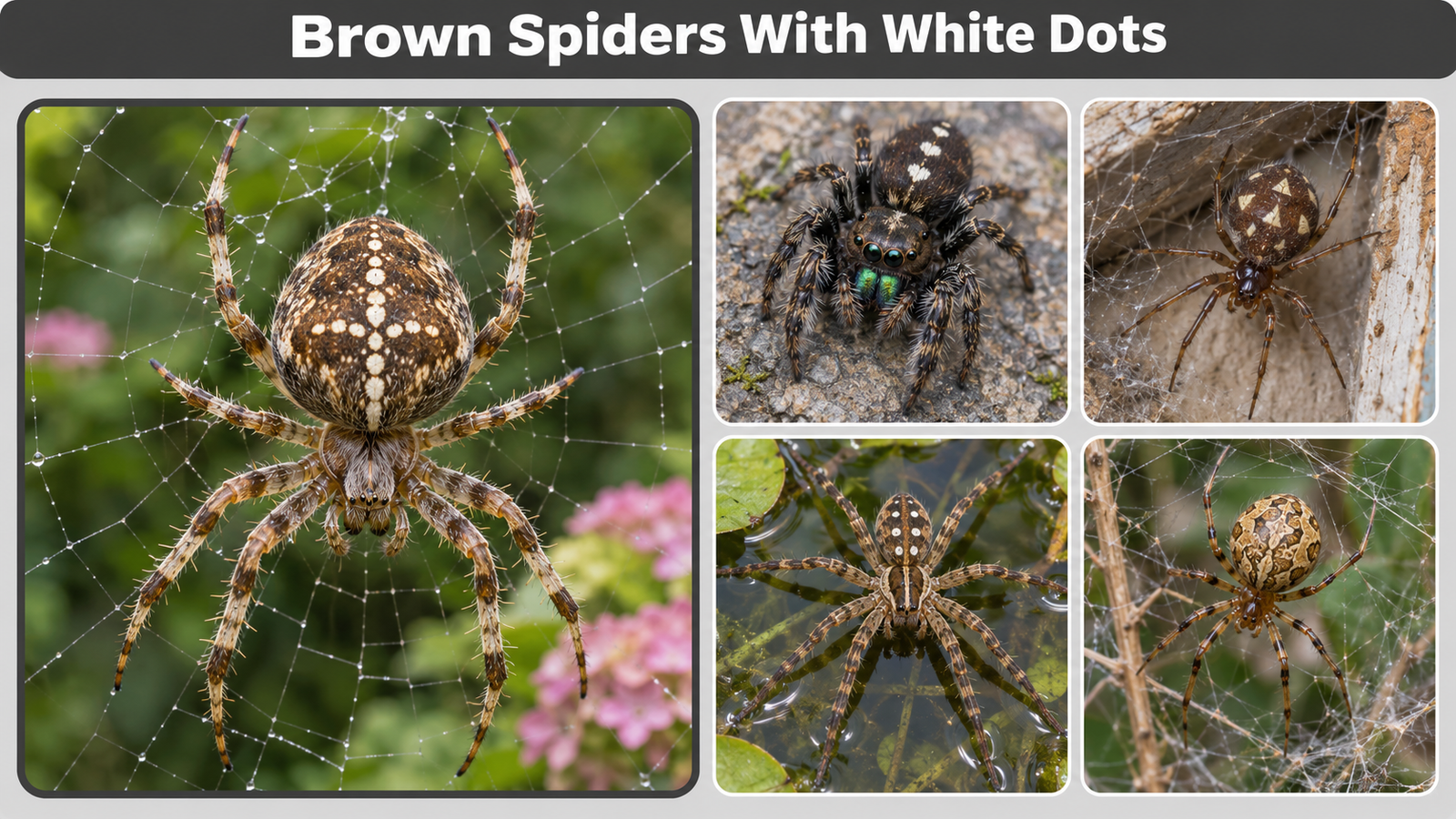
A brown spider with white dots could be a jumping spider on your windowsill, a cobweb spider behind a cabinet, or an orb-weaver in your garden. The most useful clue is the pattern the dots make. Three pale spots on a fuzzy spider point toward a bold jumping spider, while a white cross on a rounded abdomen suggests a cross orb-weaver. A row of cream triangles in a messy indoor web fits a triangulate cobweb spider. Start with where you found the spider, then compare its markings, body shape, and behavior.
How to Identify a Brown Spider With White Dots
Look at the abdomen, the rear section of the spider’s body, and note whether the markings are on the top, sides, or underside. Then look at the spider’s surroundings. A spider sitting in a round web offers a different set of clues from one darting across a wall. This guide focuses on spiders you may encounter in North America. Your location matters because similar-looking spiders occur in different regions.
| Marking and body shape | Where or how you saw it | Possible identification |
|---|---|---|
| Several pale spots, usually with a larger central spot, on a compact, fuzzy body | Hopping along a windowsill, railing, or wall | Bold jumping spider |
| White dots or short marks forming a cross on a rounded abdomen | Sitting in a large, circular outdoor web | Cross orb-weaver |
| Repeated cream or yellowish triangles on a small, rounded abdomen | Hanging in an irregular web in a quiet corner | Triangulate cobweb spider |
| Tiny pale dots in paired rows on a dark brown abdomen | Moving along the edge of a pond or marsh | Six-spotted fishing spider |
| Variable pale markings, slender legs, and a rounded abdomen | In a sheltered web with pale, spiky egg sacs | Brown widow |
1. Bold Jumping Spider (Phidippus audax)
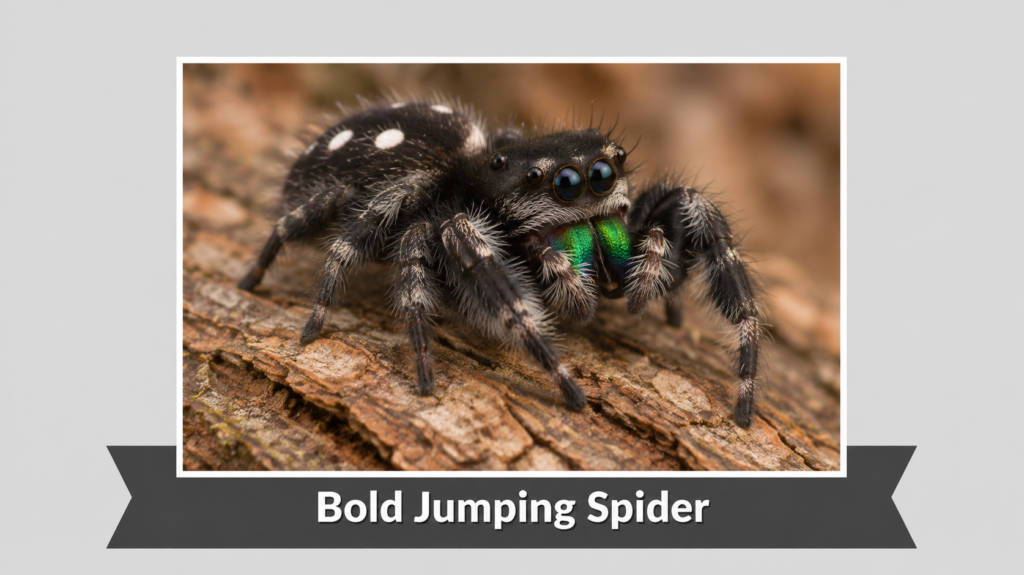
The bold jumping spider is worth comparing if you saw a small, fuzzy spider with three pale marks on its back. Many individuals look black, but some have reddish-brown coloring on the front body. The largest spot typically sits near the center of the abdomen, with two smaller spots farther back. Individual markings vary, so you may see a broken patch or short dash where you expected a round dot.
Identification and Behavior
Look for a compact body, thick-looking legs, and two prominent forward-facing eyes. Young bold jumpers may have orange or reddish markings that become white as they mature. Some individuals also show a metallic green sheen around the mouthparts, especially when light hits them from the front.
Bold jumpers pause, turn toward movement, and make quick leaps. You might find one on a sunny fence, an exterior wall, or an indoor window frame. If the spider hopped between surfaces and had a fuzzy, stocky build, a jumping spider is a strong possibility.
2. Cross Orb-Weaver (Araneus diadematus)
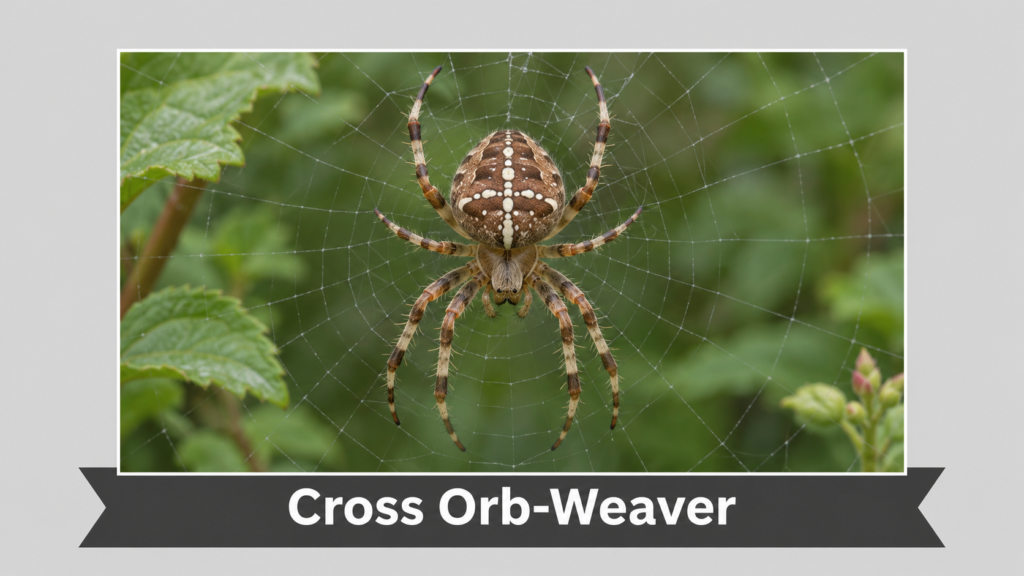
A brown garden spider with white dots arranged in a cross may be a cross orb-weaver. The abdomen can vary in color, and the pale pattern may look like a short row of dots with an extra spot or dash on each side. The cross is easiest to see from above because it sits on the upper surface of the abdomen.
Identification and Web Shape
Look for a rounded abdomen and a broad, wheel-shaped web. The web typically has silk strands radiating from the center with a spiral running between them. Garden paths, shrubs, and porch openings offer enough space for a web to stretch between two supports.
The pattern can look incomplete when the spider is partly hidden or facing away from you. If you only see a few pale dots, watch from a different angle and look at the web structure. A clear cross on top of the abdomen paired with a circular web gives you two clues to work with.
3. Triangulate Cobweb Spider (Steatoda triangulosa)
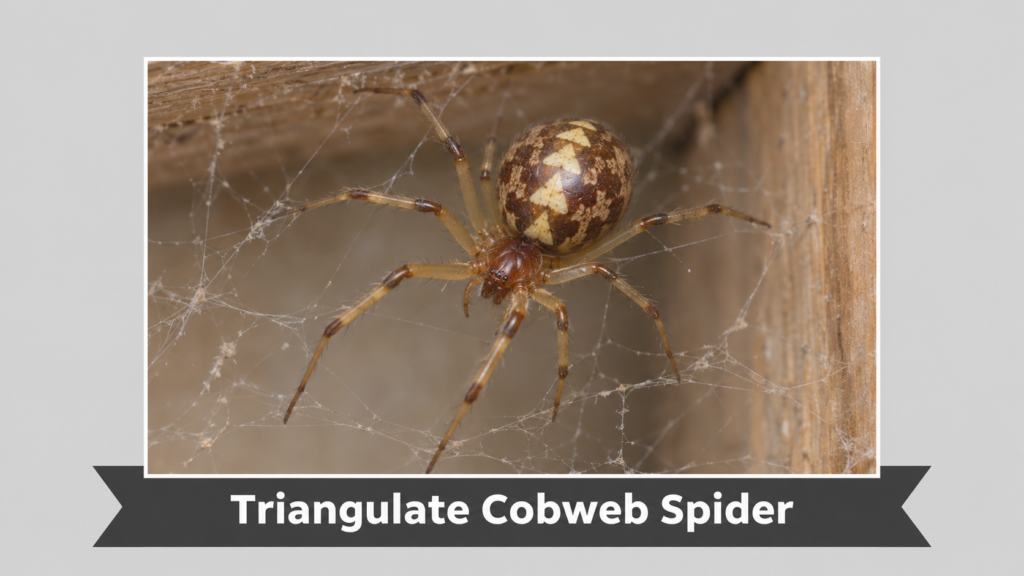
This small house spider has white or yellowish markings that can look like dots from across a room. Up close, the markings are usually rough triangles or zigzags down the top of its brown abdomen. Irregular pale patches may also appear along the sides. Its small size makes it easy to overlook in dark corners.
Identification and Indoor Habitat
Check the body shape and legs. The abdomen is rounded, the front body is often orange-brown, and the thin yellowish legs may darken near the ends of their segments. The body is typically about ⅛ to ¼ inch long, excluding the legs.
Look for its tangled web along baseboards, in basements, behind furniture, or in outbuildings. If a tiny brown spider stays in a messy web and has a row of pale triangular marks, compare it with the triangulate cobweb spider first.
4. Six-Spotted Fishing Spider (Dolomedes triton)
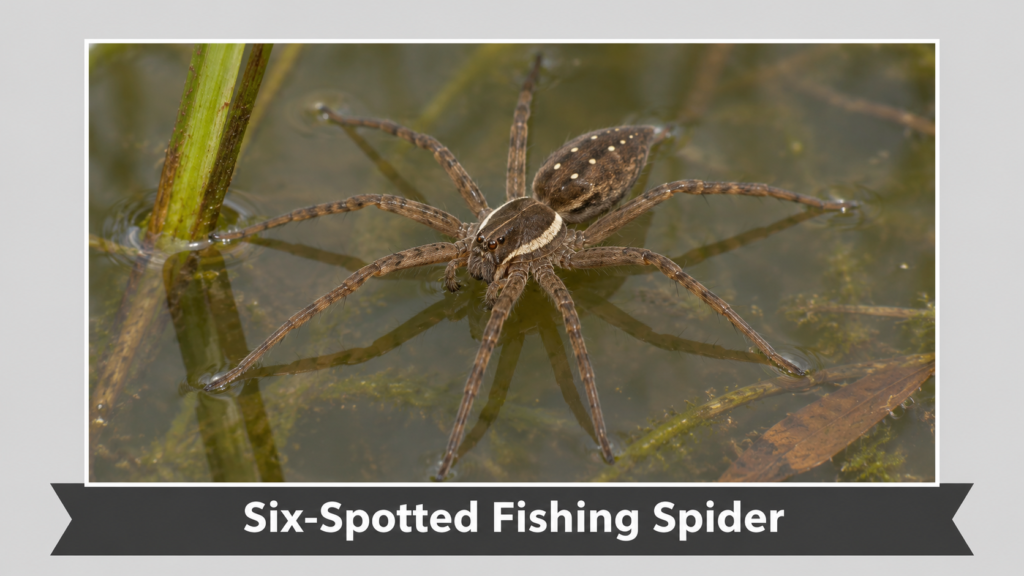
If you saw a long-legged brown spider with tiny white dots near a pond or marsh, consider the six-spotted fishing spider. It can have several pairs of small pale spots running down the top of its dark abdomen. A longer whitish or yellowish stripe can also border the front body and sometimes continue along the abdomen.
Identification Near Water
Look for an elongated body and legs that spread widely when the spider rests. The pale edge stripe can be easier to see than the dots, especially when the spider is sitting among reeds or against dark, wet wood. From above, the paired dots may resemble two narrow rows.
You may see one resting on plants at the water’s edge or running across the surface. A long-legged spider on a dry garage wall could have similar coloring, so use the water habitat together with the paired spots and pale edge stripe.
5. Brown Widow (Latrodectus geometricus)
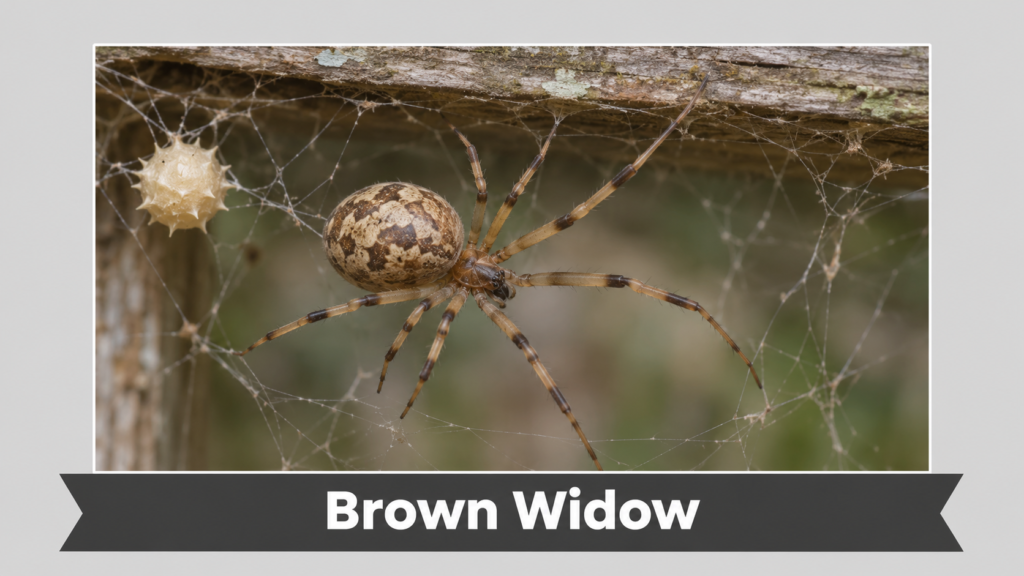
Brown widows can have light and dark geometric markings that look like dots or patches from a distance. Overall color varies, so two individuals can look quite different. Adult females usually have an orange hourglass on the underside of the abdomen, and the egg sacs have distinctive pointed projections.
Identification From a Distance
Look for a rounded abdomen, slender legs, and a sheltered, irregular web. If you can see the egg sacs, check whether they resemble small, pale, spiky balls. You may spot them beneath patio furniture or tucked into a protected corner. Their shape is more distinctive than pale dots on the adult spider.
Use a zoomed photo to document the spider and its web, and leave the spider and egg sacs undisturbed. If the only visible clue is a light marking on top of the abdomen, keep the identification provisional. Several other cobweb spiders have rounded abdomens and pale patterns.
What If You Found the Spider in Your House?
A fuzzy spider that crosses an open wall in quick bursts is a good candidate for a jumping spider. A small, rounded spider that stays suspended in a tangled web behind a shelf is more consistent with a cobweb spider. For a clearer identification, photograph the spider from above and from the side if you can do so without disturbing it. Include the web in a wider shot and estimate the body length separately from the leg span. Record your state or country and note whether the spider was jumping, running, or resting in silk. Those details help when a blurry photo makes triangles, dashes, and dots look alike.
Frequently Asked Questions
What kind of brown spider has three white dots on its back?
A bold jumping spider is a likely match when the spider is fuzzy and compact, with one larger pale spot and smaller spots behind it. Quick hops and prominent forward-facing eyes strengthen the identification.
Other jumping spiders can have pale markings. Look at the position and size of each spot alongside the spider’s body shape and movement.
Can a brown recluse have white dots on its abdomen?
A brown recluse typically has a plain abdomen. A clear pattern of white dots or triangles makes a brown recluse identification unlikely.
If you suspect one, use your location and a clear photo for confirmation. A dark mark that vaguely resembles a violin is an unreliable clue by itself.
What is the tiny brown spider with white spots in my bathroom?
If it lives in a messy web near the ceiling, behind the toilet, or under the sink, a triangulate cobweb spider is one possibility. Look closely at the abdomen for repeated cream-colored triangles.
A spider that moves in quick hops along the wall fits a jumping spider better. Look for a compact body and large eyes facing forward.
What brown spider has white dots in the shape of a cross?
The cross orb-weaver often has white dots or short marks that form a cross on top of its abdomen. You can usually see the arrangement most clearly from above.
Finding the spider in a large, wheel-shaped web outdoors adds another clue. Look for straight strands radiating from the middle of the web.
Do white dots tell you whether a spider is dangerous?
White dots alone cannot tell you whether a spider poses a health risk. Jumping spiders, orb-weavers, and cobweb spiders can all have pale markings.
For a suspected widow, the underside marking and the appearance of any egg sacs offer more useful clues. Observe the spider from a distance and use your camera’s zoom for a closer look.
