
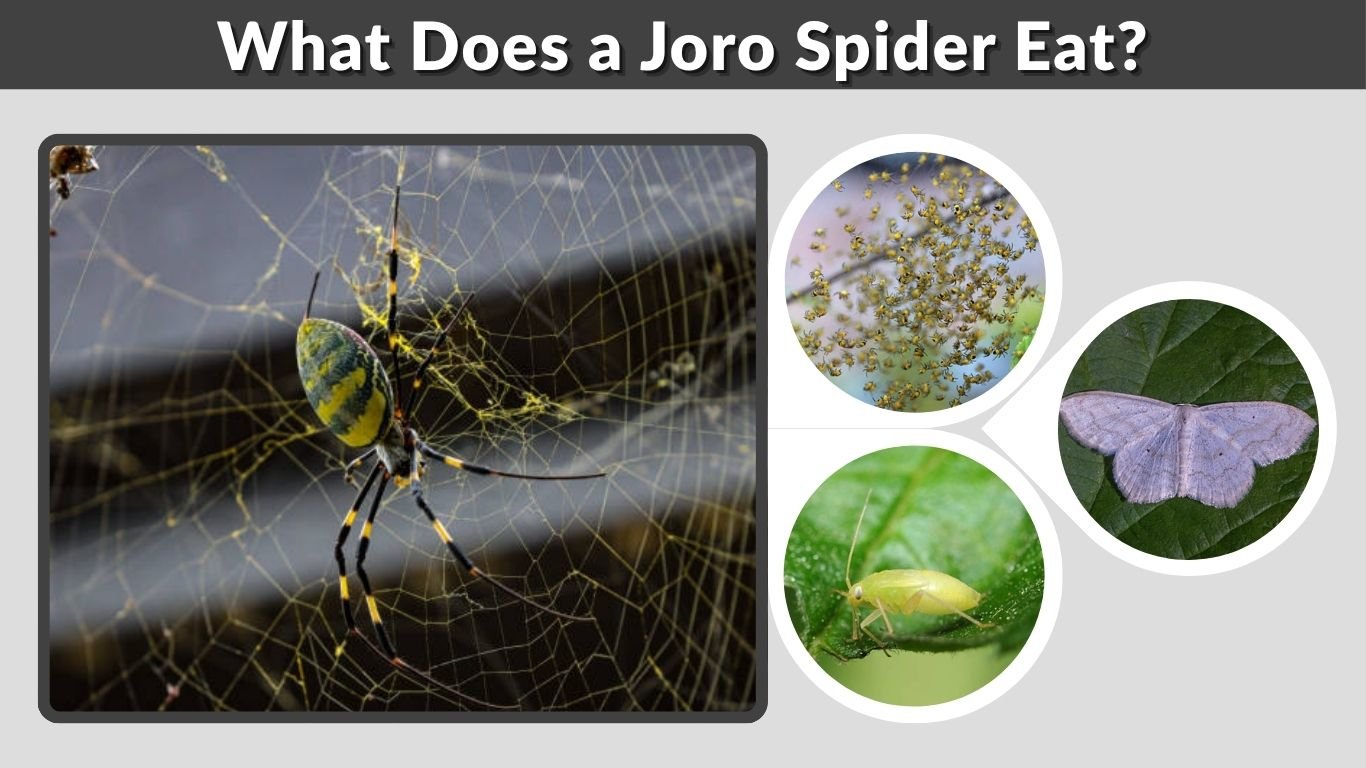
Joro spiders are large orb-weaving spiders that depend mainly on flying insects for food. Their enormous golden webs act as effective traps for mosquitoes, flies, moths, beetles, and many other insects moving through gardens and wooded areas. Despite their intimidating appearance, Joro spiders do not hunt people or pets. Instead, they spend much of their time waiting for prey to become tangled in silk. So, what does a Joro spider eat? Here are 10 of the most common foods found in a Joro spider’s diet.
What Do Joro Spiders Eat?
Joro spiders (Trichonephila clavata) are primarily insect-eating predators. They capture prey with large orb-shaped webs rather than actively chasing insects.
Their diet can vary depending on location, season, prey availability, and the size of the spider.
Common Joro spider foods include:
- Mosquitoes
- Flies
- Moths
- Beetles
- Wasps
- Bees
- Stink bugs
- Cicadas
- Grasshoppers
- Other spiders
Large adult females can handle significantly larger prey than young Joro spiders.
10 Common Foods in a Joro Spider’s Diet
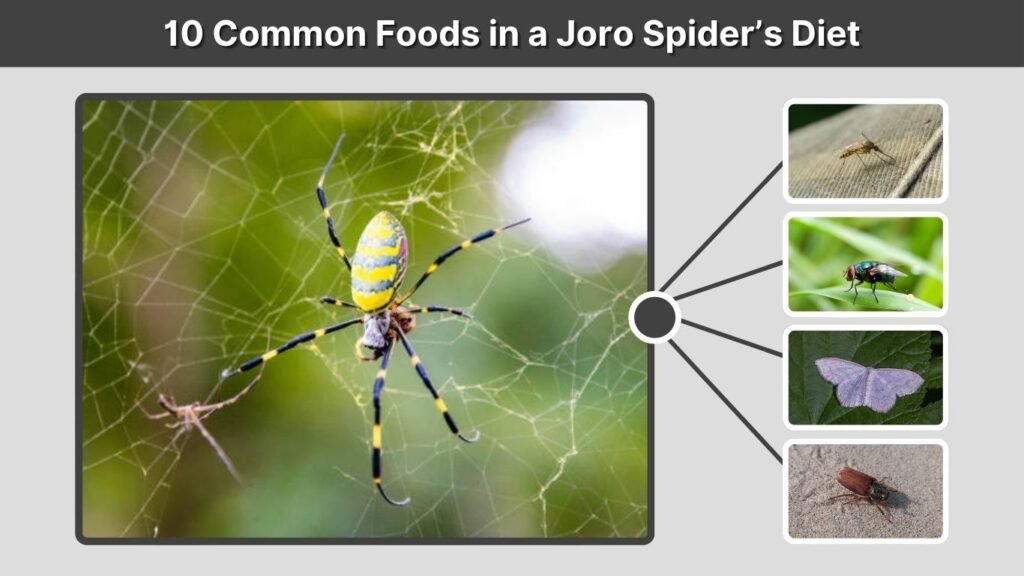
Joro spiders are opportunistic hunters that mainly eat insects trapped in their large, sticky orb webs. Their diet depends on what is available in the surrounding habitat, so they may feed on everything from tiny mosquitoes to larger moths and beetles. They do not actively chase prey over long distances; instead, they rely on web vibrations to detect captured insects. Below are 10 common foods Joro spiders eat in the wild.
1. Mosquitoes
Mosquitoes are among the numerous small flying insects that may become trapped in Joro spider webs.
Joro spiders do not specifically seek out mosquitoes. Instead, mosquitoes flying through an occupied area may accidentally hit the spider’s sticky web.
Once prey becomes trapped, the spider detects vibrations traveling through the silk. It approaches the insect, immobilizes it, and eventually consumes it.
Because Joro webs can be quite large, they may capture many different insects rather than specializing in one particular prey species.
2. Flies
Flies are another common food source for Joro spiders.
Houseflies, blowflies, crane flies, and various small wild flies can become entangled in orb webs.
Flying insects provide Joro spiders with protein and nutrients needed for growth, molting, reproduction, and egg production.
A mature female requires considerably more food than a small male or juvenile, making medium-sized flies useful prey when they are abundant.
3. Moths
Moths frequently fly at night and may accidentally enter large spider webs.
Joro spiders can capture both small and moderately sized moths. Once a moth becomes trapped, its movements create strong vibrations that alert the spider.
How Joro Spiders Handle Moths
The spider may:
- Approach the struggling moth
- Bite and immobilize it
- Wrap it with silk
- Wait until movement decreases
- Feed on the captured prey
Larger insects may be wrapped particularly thoroughly to prevent escape or injury to the spider.
4. Beetles
Flying beetles can also become food for Joro spiders.
The Joro spider’s strong web gives it an opportunity to capture insects that might escape from weaker webs.
Small and medium-sized beetles are generally easier prey than large beetles with hard protective shells.
If an insect is too large or potentially dangerous, a Joro spider may avoid it rather than risk injury.
5. Wasps
Although wasps can defend themselves with powerful stings, some become trapped in Joro webs and are eaten.
The spider generally approaches dangerous prey carefully.
Rather than immediately wrestling with a wasp, the spider may use silk to reduce its movement before feeding.
However, catching a wasp can be risky. Large or aggressive wasps may sometimes escape or damage the web.
6. Bees
Bees can occasionally become caught in Joro spider webs while flying between flowers and nesting areas.
A trapped bee may become prey if the Joro spider successfully immobilizes it.
However, Joro spiders are opportunistic predators rather than bee specialists. They consume whatever manageable insects happen to enter their webs.
Their diets therefore reflect which insects are most abundant around the web.
7. Stink Bugs
One particularly interesting part of the Joro spider diet is stink bugs.
Stink bugs can become trapped in their large webs and may be eaten just like other insects.
This includes invasive stink bug species living in areas where Joro spiders have established populations.
The ability to eat stink bugs has attracted attention because these insects can damage crops and garden plants.
However, Joro spiders should not be considered a complete biological control solution for stink bug populations.
8. Cicadas
Adult female Joro spiders can sometimes capture relatively large insects, including cicadas.
A cicada is much larger and stronger than a mosquito or fly, so capturing one requires a sturdy web.
Large Joro webs contain strong silk capable of slowing surprisingly substantial insects.
Still, not every cicada entering a web becomes food. Strong individuals may tear through the silk and escape before the spider can immobilize them.
9. Grasshoppers
Grasshoppers are primarily associated with vegetation and the ground, but they can jump or fly into Joro spider webs.
Smaller grasshoppers may become suitable prey.
Because grasshoppers have powerful legs, the spider needs to immobilize them quickly. Silk wrapping helps prevent struggling prey from escaping or damaging the web.
Juvenile Joro spiders generally target much smaller insects because large grasshoppers would be difficult for them to handle.
10. Other Spiders
Joro spiders may occasionally eat other spiders.
Spider-on-spider predation can happen when a smaller spider enters another spider’s web or becomes trapped.
However, other spiders do not necessarily make up a major portion of the Joro spider’s normal diet.
Joro spiders mainly depend on insects that accidentally fly into their webs.
Interactions between spiders can also involve competition rather than predation, particularly when several orb-weaving species occupy the same habitat.
How Does a Joro Spider Catch Its Food?
Joro spiders are orb-web hunters.
Rather than running after prey, an adult female normally waits on or near her web.
When an insect strikes the web, vibrations travel through the silk and tell the spider that something has been captured.
Typical Hunting Process
The process usually involves:
- An insect flying or jumping into the web.
- Sticky silk restricting the insect’s movement.
- The spider detecting vibrations.
- The spider approaching the prey.
- Venom helping immobilize the insect.
- Silk sometimes being wrapped around it.
- The spider feeding on the prey.
Spiders cannot chew solid food in the way humans do. Digestive fluids help liquefy tissues, which the spider then consumes.
What Do Baby Joro Spiders Eat?
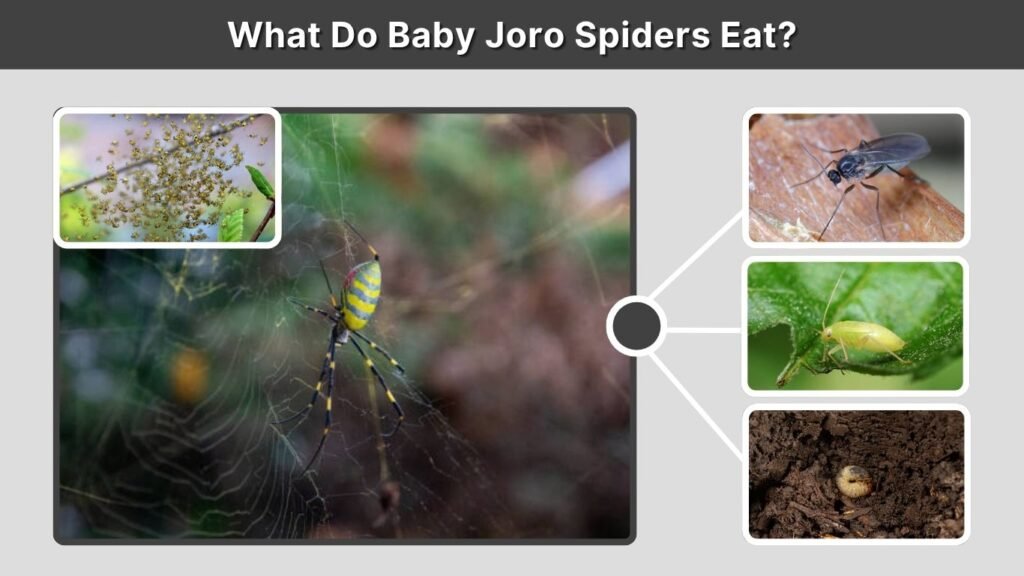
Baby Joro spiders, or spiderlings, eat much smaller prey than adults.
Their diet may include:
- Gnats
- Tiny flies
- Small mosquitoes
- Aphids
- Midges
- Other very small insects
As a Joro spider grows and molts, it becomes capable of constructing larger webs and capturing larger prey.
This explains why mature females may consume relatively large insects while newly hatched spiderlings depend on tiny prey.
Do Joro Spiders Eat Every Insect in Their Web?
No. Not every insect that enters a Joro spider web becomes food.
The spider may ignore prey when it is:
- Too large
- Potentially dangerous
- Difficult to immobilize
- Too small to be worth handling
- Already dead or unsuitable
Some insects also escape by breaking silk strands before the spider reaches them.
Joro spiders therefore balance the nutritional benefit of prey against the effort and danger involved in capturing it.
How Much Do Joro Spiders Eat?
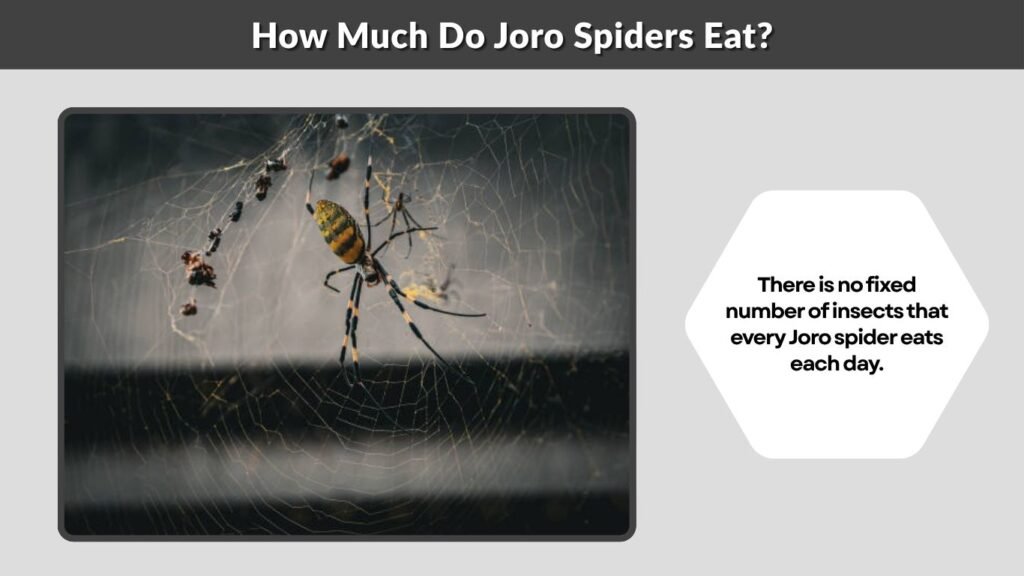
There is no fixed number of insects that every Joro spider eats each day.
Their food intake depends on prey availability, spider size, temperature, reproductive condition, and environmental factors.
Adult females require energy to maintain their bodies and eventually produce egg sacs. When prey is abundant, they may capture insects regularly.
They can also survive periods when fewer insects enter their webs.
Are Joro Spiders Helpful for Controlling Insects?
Joro spiders naturally remove some flying insects from their surroundings.
Their prey can include mosquitoes, flies, stink bugs, moths, and other insects that people sometimes consider pests.
However, Joro spiders are generalist predators. They may also capture pollinators and other beneficial insects.
For that reason, they should be viewed as one part of a larger food web rather than a targeted form of pest control.
Do Joro Spiders Eat Humans or Pets?
No. Humans and pets are not food for Joro spiders.
Joro spiders feed mainly on insects and occasionally other small arthropods.
Their venom is designed to immobilize relatively small prey. These spiders normally remain in their webs and have little reason to interact aggressively with humans.
Their large size and bright colors can make them look intimidating, but their feeding behavior is focused on creatures small enough to become trapped in their webs.
FAQs
What is a Joro spider’s favorite food?
Joro spiders do not appear to have one specific favorite food. They are opportunistic predators that mainly eat flying insects caught in their webs, including flies, mosquitoes, moths, beetles, wasps, stink bugs, and other insects available in their habitat.
Do Joro spiders eat mosquitoes?
Yes. Mosquitoes can become trapped in Joro spider webs and may be eaten. However, Joro spiders are not specialized mosquito predators. Their webs catch many types of flying insects, so mosquitoes represent only one possible part of their diet.
Do Joro spiders eat stink bugs?
Yes, Joro spiders can capture and eat stink bugs, including some invasive species. Their strong orb webs can hold these relatively large insects long enough for the spider to immobilize and feed on them.
Do Joro spiders eat other spiders?
Joro spiders may occasionally eat smaller spiders, especially if another spider becomes trapped in their web. However, insects make up most of their typical prey, and other spiders are not necessarily a primary food source.
What do baby Joro spiders eat?
Baby Joro spiders eat tiny insects such as gnats, midges, aphids, mosquitoes, and small flies. As they grow through repeated molts, they become capable of building larger webs and capturing progressively larger insects.
