
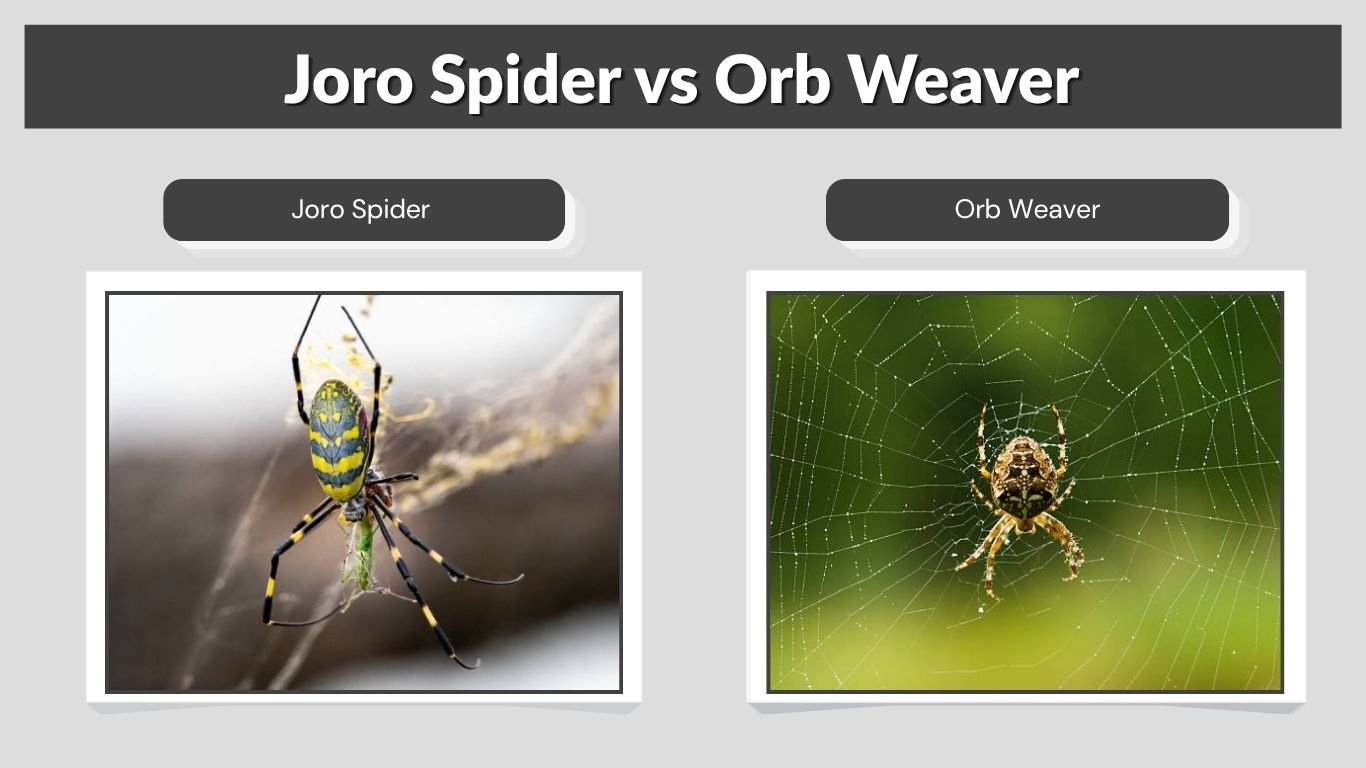
Comparing a Joro spider with an orb-weaver is slightly misleading because the Joro spider is itself a type of orb-weaver. “Orb-weaver” describes a large group of spiders that build wheel-shaped webs, while “Joro spider” refers to one particular species, Trichonephila clavata. To identify an unfamiliar spider, compare the Joro with specific orb-weaver species such as the golden silk orb-weaver, yellow garden spider, spotted orb-weaver, or marbled orb-weaver.
Joro Spider vs Orb Weaver: Quick Comparison
| Feature | Joro spider | Other orb-weavers |
| Classification | One specific orb-weaver species | A broad group containing many species |
| Scientific name | Trichonephila clavata | Varies by species |
| Female color | Yellow with blue-gray bands | Yellow, orange, brown, red, white, or black |
| Leg pattern | Black with yellow bands | Highly variable |
| Web | Golden and often multilayered | Usually wheel-shaped; color and structure vary |
| Native range | East Asia | Worldwide |
| Status in the U.S. | Introduced | Many species are native; some are introduced |
| Danger to people | Low | Usually low |
The Joro belongs to the orb-weaver family Araneidae. Therefore, every Joro spider is an orb-weaver, but most orb-weavers are not Joro spiders.
What Is a Joro Spider?
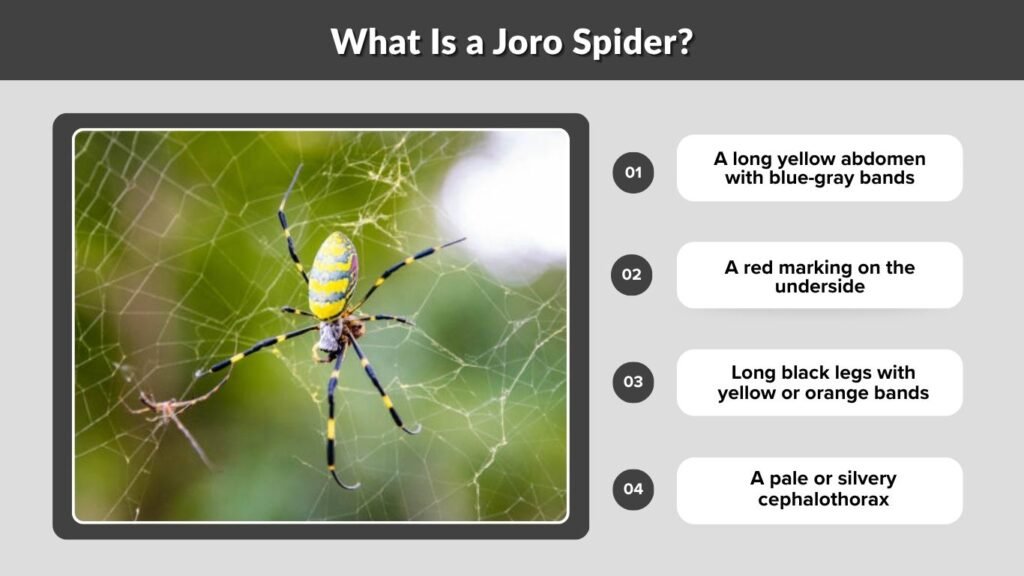
The Joro spider is a large, colorful web-building spider native to East Asia, including Japan, Korea, and China. It was documented in northeastern Georgia around 2014 and has since spread through parts of Georgia, South Carolina, Tennessee, and western North Carolina.
Adult females are much larger and more colorful than males. A mature female has a long yellow abdomen crossed by blue-gray or bluish-green bands. Its underside displays black, yellow, and red markings.
Joro Spider Identification
Look for these characteristics:
- A long yellow abdomen with blue-gray bands
- A red marking on the underside
- Long black legs with yellow or orange bands
- A pale or silvery cephalothorax
- No obvious black hair brushes around the leg joints
- A large web made from yellow or golden silk
- Several supporting layers around the central orb
Mature female Joros can reach approximately 17–30 millimetres in body length. Their long legs may produce a total span approaching four inches, making the spider appear palm-sized.
What Is an Orb-Weaver Spider?
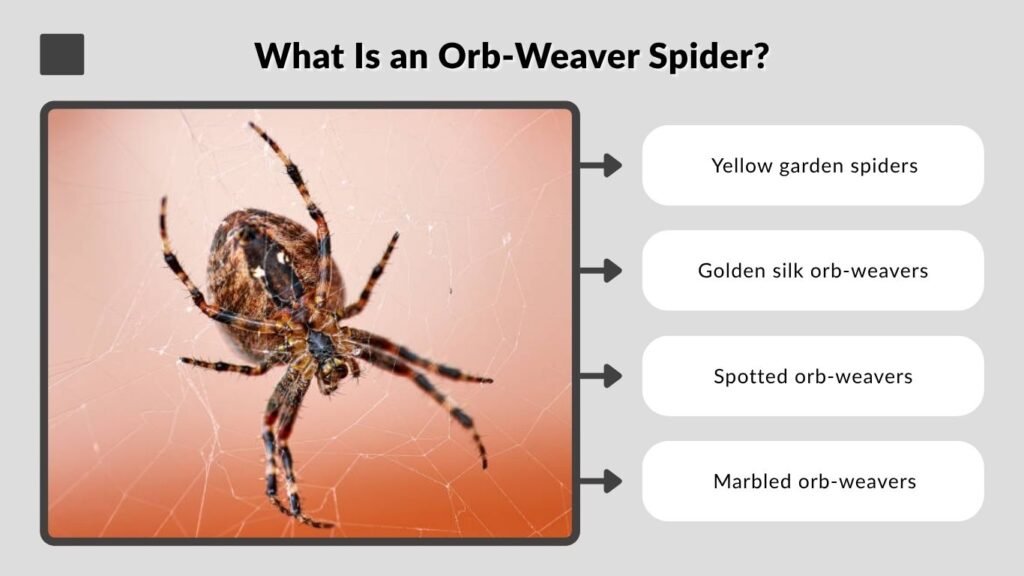
Orb-weavers are spiders that usually construct circular webs with spokes radiating from a central point. These webs resemble wheels or targets and are designed to intercept flying insects.
Orb-weavers occur in numerous colors, shapes, and sizes. Some have smooth round abdomens, while others are elongated, spiny, or covered with unusual markings.
Common orb-weavers found in Georgia and North Carolina include:
- Yellow garden spiders
- Golden silk orb-weavers
- Spotted orb-weavers
- Marbled orb-weavers
- Banded garden spiders
- Spiny-backed orb-weavers
- Basilica orb-weavers
Most are beneficial predators that capture moths, flies, mosquitoes, beetles, and other insects. Nearly all possess venom for subduing prey, but common orb-weavers are not considered dangerous to people.
Joro Spider vs Golden Silk Orb-Weaver
The golden silk orb-weaver, Trichonephila clavipes, is the species most frequently confused with the Joro. It is also commonly called the banana spider.
Both belong to the genus Trichonephila, produce golden silk, and have extremely large females. However, their markings are noticeably different.
| Feature | Joro spider | Golden silk orb-weaver |
| Abdomen | Yellow with blue-gray bands | Orange or golden with pale spots |
| Main leg color | Black | Yellow-orange |
| Leg bands | Yellow or orange | Dark brown |
| Hair near leg joints | No obvious tufts | Noticeable black brushes |
| Native status | Introduced from Asia | Native to the Americas |
| Web | Golden and strongly multilayered | Golden with a more defined central orb |
The black hair brushes around the golden silk orb-weaver’s leg joints are among the most useful identification features. Joro legs appear smoother and are predominantly black with yellow bands.
Joro Spider vs Yellow Garden Spider
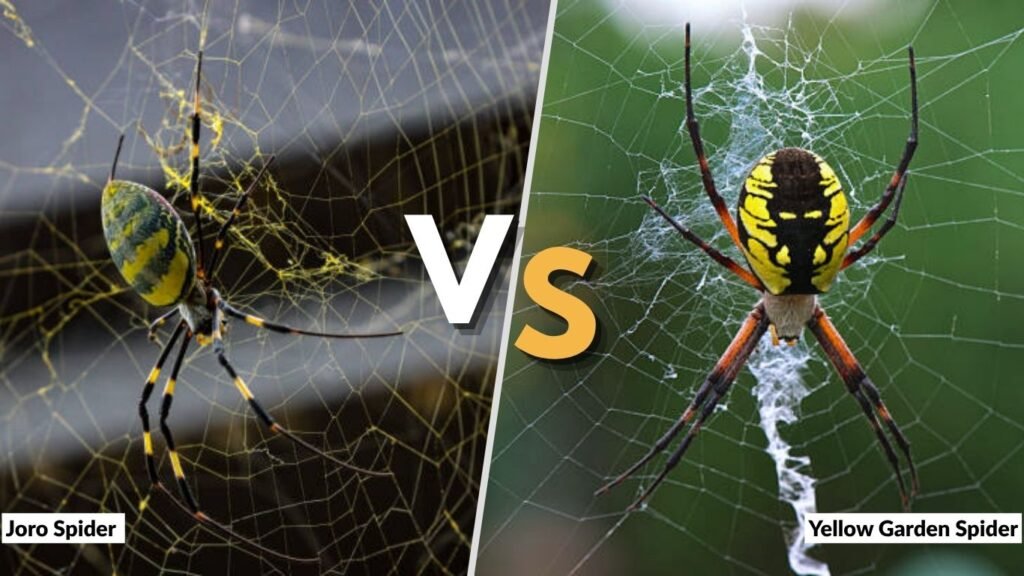
The yellow garden spider, Argiope aurantia, is also called the writing spider, zipper spider, or black-and-yellow garden spider. It is native to North America and commonly appears in gardens and sunny areas during late summer.
Key Differences
A yellow garden spider has a broad black abdomen decorated with bright yellow patches. It typically holds its legs in pairs, creating an X-shaped posture in the center of its web.
Its most recognizable feature is the thick white zigzag woven through the web’s center. This structure is known as a stabilimentum.
A Joro has a longer abdomen with horizontal blue-gray and yellow bands. Its web is golden and multilayered, and mature females do not produce the prominent white zipper associated with yellow garden spiders.
| Feature | Joro spider | Yellow garden spider |
| Body shape | Long and cylindrical | Broad and oval |
| Pattern | Yellow with blue-gray bands | Black with yellow patches |
| Web color | Golden yellow | Usually white or silvery |
| Central zigzag | Absent in adult webs | Usually prominent |
| Resting posture | Legs spread separately | Legs often paired in an X |
| Origin | East Asia | North America |
Joro Spider vs Spotted and Marbled Orb-Weavers
Spotted and marbled orb-weavers may be mistaken for juvenile Joros, especially when their colors include yellow, orange, red, or black.
Spotted Orb-Weavers
Spotted orb-weavers in the genus Neoscona generally have rounded abdomens with brown, reddish, orange, or gray patterns. Many hide during daylight and move to the center of their webs after dark.
They lack the long, strongly banded yellow-and-blue abdomen of an adult female Joro.
Marbled Orb-Weavers
The marbled orb-weaver has a large rounded abdomen that may be orange, yellow, cream, or white with dark marbled markings. Adult females measure approximately 9–20 millimetres in body length.
A marbled orb-weaver looks short and rounded, while a Joro appears longer, flatter, and much more elongated.
What Is the Red Orb-Weaver in Florida?
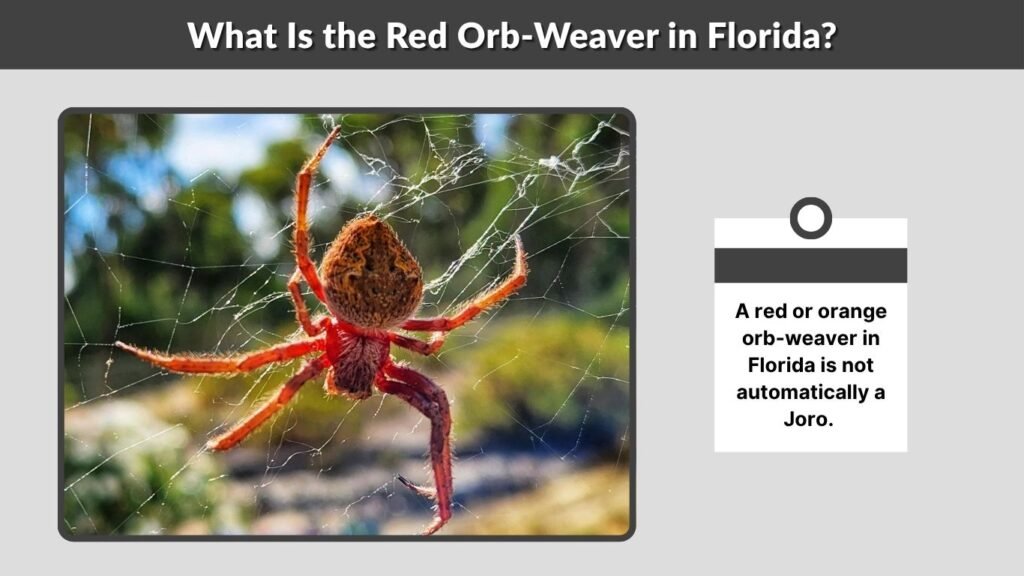
A red or orange orb-weaver in Florida is not automatically a Joro. Several native or established species may display red coloration, including tropical orb-weavers, marbled orb-weavers, spotted orb-weavers, and spiny-backed orb-weavers.
The tropical orb-weaver, Eriophora ravilla, may appear reddish, orange, brown, or gray. It generally has a rounded abdomen and builds its web after dark. Florida also supports the distinctive spiny-backed orb-weaver, which has a flattened abdomen with projecting spines.
Joro Spiders in Georgia and North Carolina
Georgia has been the center of the established U.S. Joro population since the species was first documented there. The spider is now widespread in parts of northern Georgia and continues to appear in surrounding states.
Joros have also been confirmed in western North Carolina. NC State Extension reported sightings in several communities around Henderson County and noted that western North Carolina records have increased since the species was first detected in the state.
The Joro is non-native and spreading, but researchers are still evaluating its long-term ecological effects. Native orb-weavers remain common throughout the region, so a large web-building spider should not be identified as a Joro based on size alone.
Are Joro Spiders More Dangerous Than Orb-Weavers?
No. Joro spiders are not considered more dangerous than common native orb-weavers. They possess venom for immobilizing insects, but they are reluctant to bite humans.
A bite would be most likely if the spider were trapped against the skin or deliberately handled. Expected symptoms may include temporary pain, redness, or mild swelling.
Neither Joros nor common garden orb-weavers normally chase, jump at, or attack people. Their large size and webs make them conspicuous, but their appearance greatly exaggerates the actual risk.
How to Identify the Spider Quickly
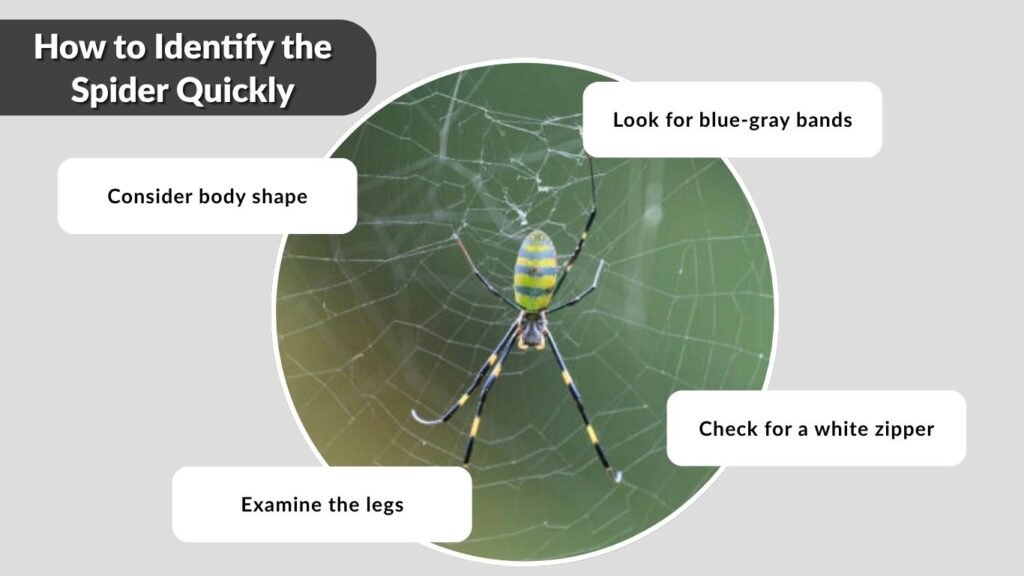
Follow these simple checks:
- Look for blue-gray bands. A yellow abdomen crossed by blue-gray bands strongly indicates a female Joro.
- Check for a white zipper. A thick zigzag in the web suggests a yellow garden spider.
- Examine the legs. Black hair brushes around yellow-orange legs indicate a golden silk orb-weaver.
- Consider body shape. A round orange abdomen may belong to a marbled or spotted orb-weaver.
- Inspect the web. Large golden multilayered webs are characteristic of mature female Joros.
- Consider the location. Joros are increasingly reported in Georgia and western North Carolina but are not yet equally common everywhere.
FAQs
Is a Joro spider an orb-weaver?
Yes. The Joro is one particular orb-weaver species named Trichonephila clavata. Orb-weaver is a broad classification that includes numerous native and introduced spiders.
What is the main difference between a Joro and an orb-weaver?
There is no true either-or difference because Joros belong to the orb-weaver group. Identification requires comparing a Joro with a specific species, such as a golden silk orb-weaver or yellow garden spider.
Is a Japanese orb-weaver the same as a Joro?
The Joro spider is native to Japan and is sometimes informally called a Japanese orb-weaver. However, Japan contains many other orb-weaver species, so that name is not uniquely precise.
Are all orb-weavers invasive?
No. Many orb-weavers are native to North America and form an important part of local ecosystems. The Joro is introduced from Asia, while yellow garden spiders and American golden silk orb-weavers are native.
Should I kill a Joro spider?
A Joro usually does not require control unless its web blocks a doorway, path, or frequently used space. The web can be removed with a broom or long stick. Direct handling and unnecessary pesticide use should be avoided.
