
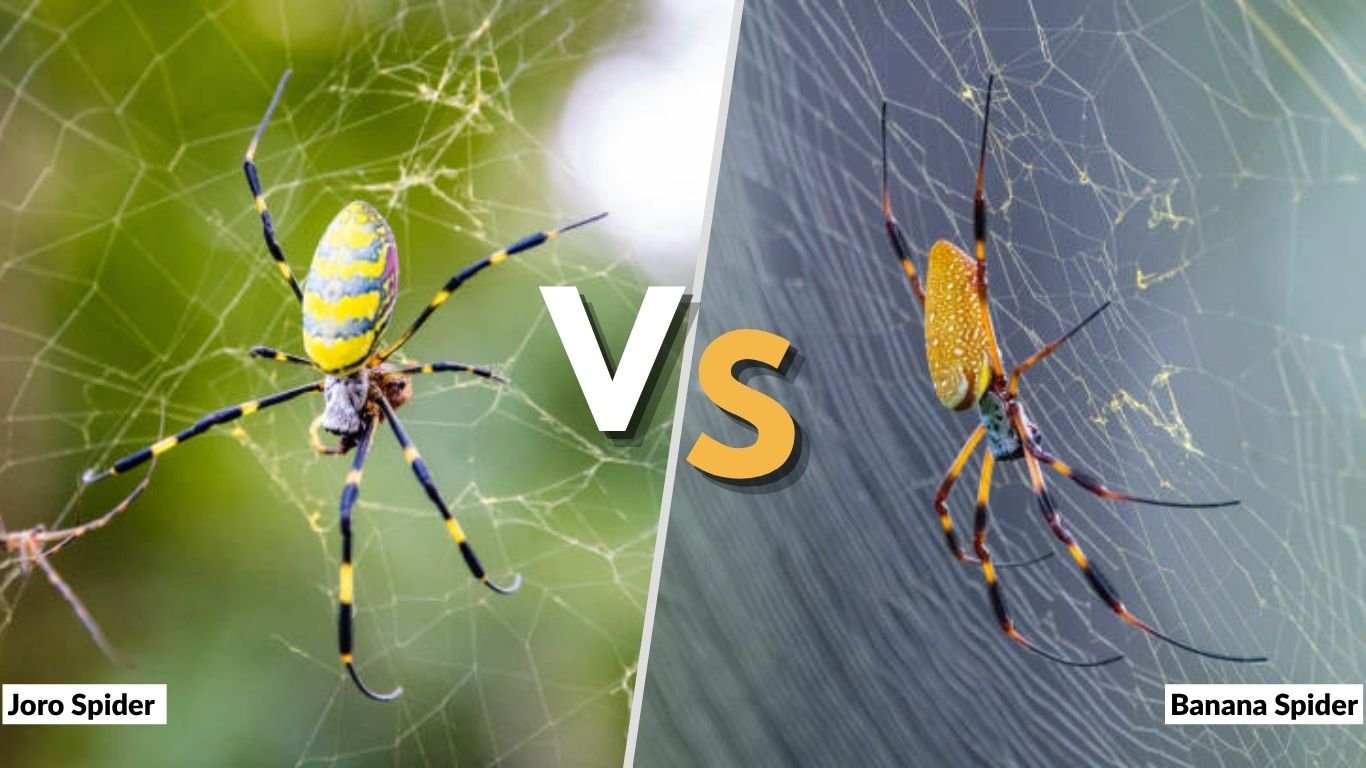
Joro spiders and banana spiders are large orb-weavers with long legs, colorful bodies, and strong golden webs. Their similar appearance often causes confusion, particularly in the southeastern United States. However, they differ in abdominal markings, leg structure, native range, web design, and seasonal activity. The name “banana spider” can describe several spiders, but in this comparison it refers to the golden silk orb-weaver, the species most commonly confused with the Joro spider.
Joro Spider vs Banana Spider: Quick Comparison
| Feature | Joro spider | Banana spider |
| Scientific name | Trichonephila clavata | Trichonephila clavipes |
| Other name | Jorō spider | Golden silk orb-weaver |
| Native range | East Asia | North and South America |
| Female abdomen | Yellow with blue-gray bands | Golden-orange with pale spots |
| Legs | Black with yellow bands | Yellow-orange with dark bands |
| Hair tufts on legs | Absent | Present near several joints |
| Web | Large, golden, multilayered | Large, golden, more organized |
| Risk to humans | Low | Low |
Both belong to the golden orb-weaver genus Trichonephila. The Joro is an introduced East Asian species in North America, while the golden silk orb-weaver is native to the Americas.
What Is a Joro Spider?
The Joro spider, Trichonephila clavata, is a colorful orb-weaver native to Japan, China, Korea, and nearby parts of East Asia. It was first confirmed in North America in northeastern Georgia in 2014 and has since established populations in parts of the eastern United States.
Adult females are large and conspicuous. Their bodies can reach about 1.2 inches long, while the legs may span approximately four inches. They have cylindrical yellow abdomens crossed by broad blue-gray or bluish-green bands. The underside includes black, yellow, and red markings.
Joro legs are predominantly black with yellow or orange bands. They lack the noticeable black hair tufts found on a golden silk orb-weaver’s legs.
What Is a Banana Spider?
“Banana spider” is an imprecise common name applied to several unrelated spiders. In the southeastern United States, it usually refers to the golden silk orb-weaver, Trichonephila clavipes.
Female golden silk orb-weavers have elongated golden, orange, or yellowish abdomens decorated with pale or silvery spots. Their legs are yellow-orange with brown bands and noticeable black brushes of hair around several joints.
Because “banana spider” may also be used for certain wandering spiders and other tropical species, identification should be based on appearance, location, and web type rather than the common name alone.
Appearance and Identification
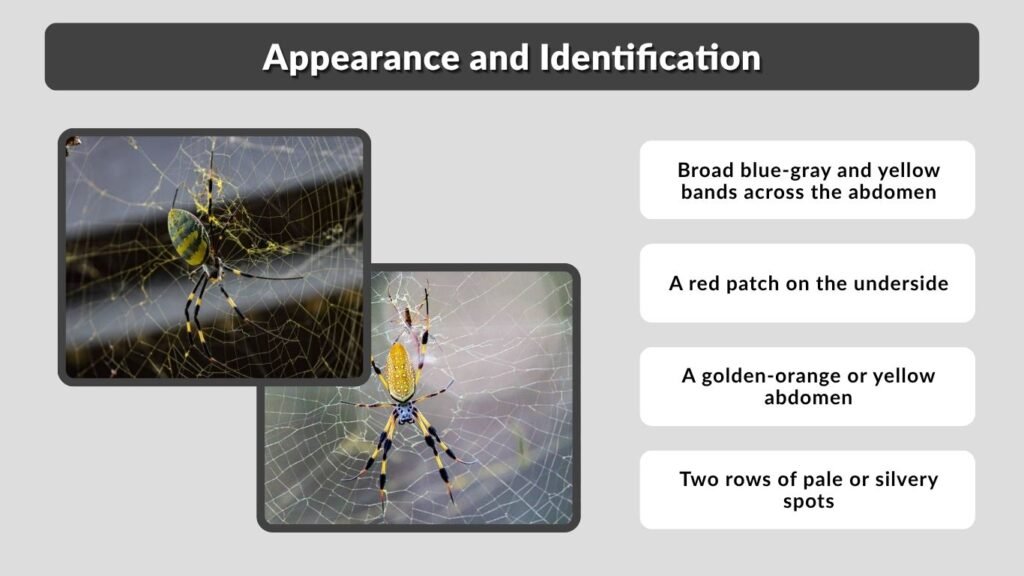
The easiest way to separate the two is to examine their abdominal patterns and legs.
Joro Spider Identification
Look for:
- Broad blue-gray and yellow bands across the abdomen
- A red patch on the underside
- Long black legs with yellow bands
- No thick hair brushes around the leg joints
- A pale or silvery cephalothorax
- A large, somewhat three-dimensional golden web
Banana Spider Identification
Look for:
- A golden-orange or yellow abdomen
- Two rows of pale or silvery spots
- Yellow-orange legs with brown bands
- Black hair tufts near several leg joints
- A darker cephalothorax
- A large golden orb web in warm, wooded areas
University of Georgia identification guidance considers the leg tufts and abdominal markings among the most dependable differences.
| Body feature | Joro spider | Golden silk “banana” spider |
| Main abdominal pattern | Horizontal bands | Rows of pale spots |
| Abdomen colors | Yellow, blue-gray, black, and red | Yellow, orange, silver, and dark brown |
| Main leg color | Black | Yellow-orange |
| Leg bands | Yellow or orange | Brown or dark |
| Joint hair | No obvious tufts | Distinct black tufts |
| Female body shape | Long and cylindrical | Long and cylindrical |
Size Comparison
Both species show extreme sexual dimorphism, meaning adult females are dramatically larger and more colorful than males.
Female Joro spiders measure approximately 0.67–1.2 inches in body length and may have a leg span approaching four inches. Adult males are only about 0.16–0.31 inches long and have muted brown coloration.
Female golden silk orb-weavers may reach roughly 1.5–2 inches in body length, although measurements vary. Their long legs make them appear considerably larger. Males are small, slender, and reddish brown.
Therefore, a female banana spider may have a larger body, but both species can appear hand-sized when their legs are included.
Web Differences
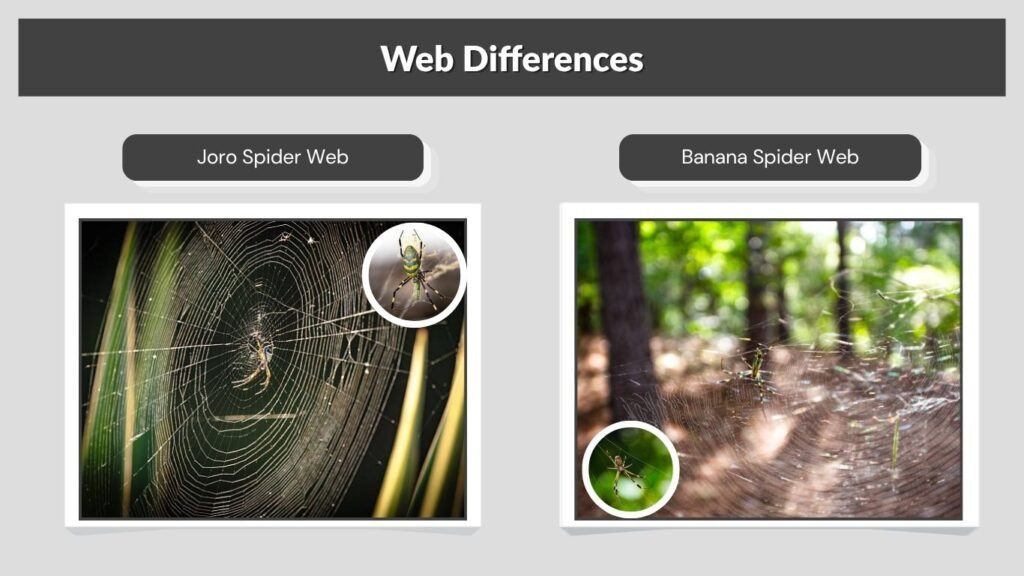
Both spiders produce silk with a noticeable golden or yellow tint. Their webs may stretch several feet between trees, buildings, utility lines, shrubs, and other supports.
Joro Spider Web
A mature Joro web is often:
- Large and exceptionally strong
- Golden or yellow in sunlight
- Multilayered or three-dimensional
- Surrounded by irregular support threads
- Built between widely separated objects
Some mature webs can span ten feet or more, with supporting strands extending beyond 20 feet. Multiple Joro webs may also be positioned close together.
Banana Spider Web
The golden silk orb-weaver produces a broad, well-defined orb surrounded by support lines. Its semi-permanent web commonly appears along woodland trails, forest openings, gardens, and edges of clearings. The spider repairs the structure instead of rebuilding the entire web every day.
| Web feature | Joro spider | Banana spider |
| Silk color | Golden yellow | Golden yellow |
| Basic design | Orb within multilayered support web | Large, organized orb |
| Appearance | May look tangled or disorganized | Usually more clearly defined |
| Common position | Trees, buildings, porches, and open spaces | Forest edges, trails, and clearings |
| Nearby spiders | Several females may occur close together | Females may also occur in groups |
Joro Spider vs Garden or Writing Spider
The yellow garden spider, Argiope aurantia, is another common Joro look-alike. It is also called the writing spider, zipper spider, or black-and-yellow garden spider.
A yellow garden spider has a broad black abdomen marked with bright yellow patches. Its web typically contains a thick white zigzag called a stabilimentum. Joro webs lack this bold central zipper and are usually larger, golden, and more multilayered.
Garden spiders also hold their legs in paired groups, often forming an X-shaped posture at the center of the web. Joros usually spread their long legs more independently.
Male vs Female Joro Spider
Female and male Joro spiders look so different that they may be mistaken for separate species.
| Feature | Female Joro | Male Joro |
| Body length | Up to about 1.2 inches | Up to about 0.31 inches |
| Color | Bright yellow, blue-gray, black, and red | Brown, tan, and muted yellow |
| Legs | Very long and strongly banded | Shorter and darker |
| Web behavior | Constructs the main web | Lives around a female’s web |
| Visibility | Highly noticeable | Easy to overlook |
One female web may contain one or more small males. Females can be hundreds of times heavier than males, creating one of the most striking size differences among familiar garden spiders.
Are Joro and Banana Spiders Dangerous?
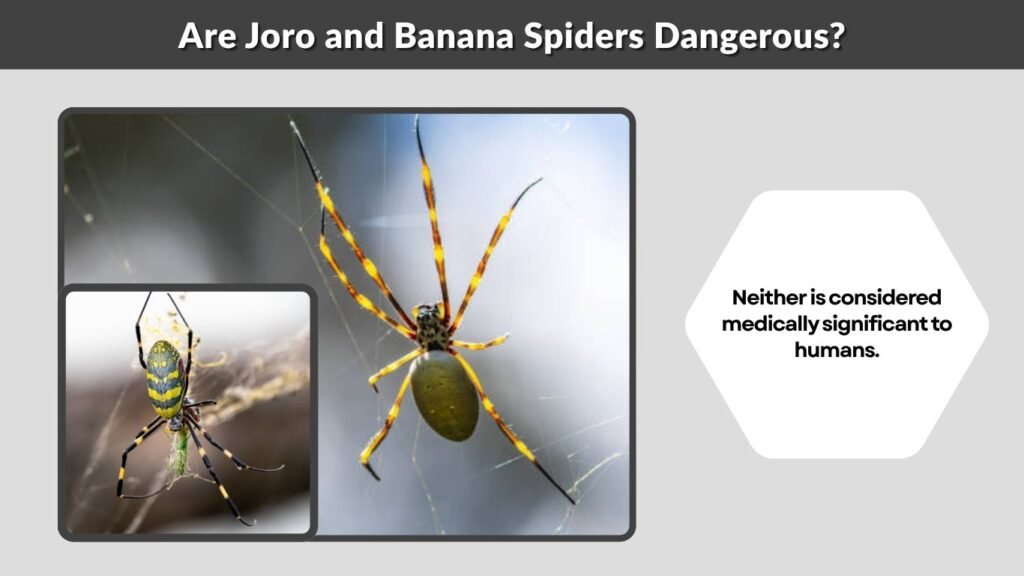
Neither is considered medically significant to humans. Both possess venom because they use it to subdue insect prey, but they are reluctant to bite and are not naturally aggressive toward people.
Penn State Extension describes Joro spiders as harmless and notes that their venom is weak and not medically important. University of Georgia sources similarly describe both Joros and golden silk orb-weavers as harmless to people and pets.
A bite could cause temporary pain, redness, or irritation, but bites are uncommon. People with serious swelling, breathing difficulty, or signs of an allergic reaction should seek medical care.
Which Spider Should You Remove?
Neither species generally requires control when its web is away from doors, paths, playgrounds, or frequently used areas. Both capture flies, moths, mosquitoes, wasps, and other insects.
An inconvenient web can usually be removed with a broom or long stick while wearing gloves. The spider often relocates after repeated disturbance. Avoid handling either species directly, and do not use pesticides unless there is a genuine need.
FAQs
Is a Joro spider a type of banana spider?
Both are golden orb-weavers in the genus Trichonephila, but they are different species. Joros are T. clavata, while the American golden silk orb-weaver commonly called a banana spider is T. clavipes.
Which is bigger, a Joro or banana spider?
The female golden silk orb-weaver generally has a larger body. However, both have extremely long legs and may appear similarly large when resting in their webs.
How can I identify a Joro quickly?
Look for broad blue-gray and yellow bands on the abdomen, black legs with yellow bands, and a red marking underneath. Joro legs do not have the obvious black hair tufts seen on golden silk orb-weavers.
Is a writing spider the same as a Joro?
No. The writing spider is usually the native yellow garden spider, Argiope aurantia. Its web has a bold white zigzag, while a Joro makes a large, golden, multilayered web.
Can Joro spiders bite humans?
They are physically capable of biting, but they are timid and rarely do so. Their bites are not considered medically important under ordinary circumstances.
