
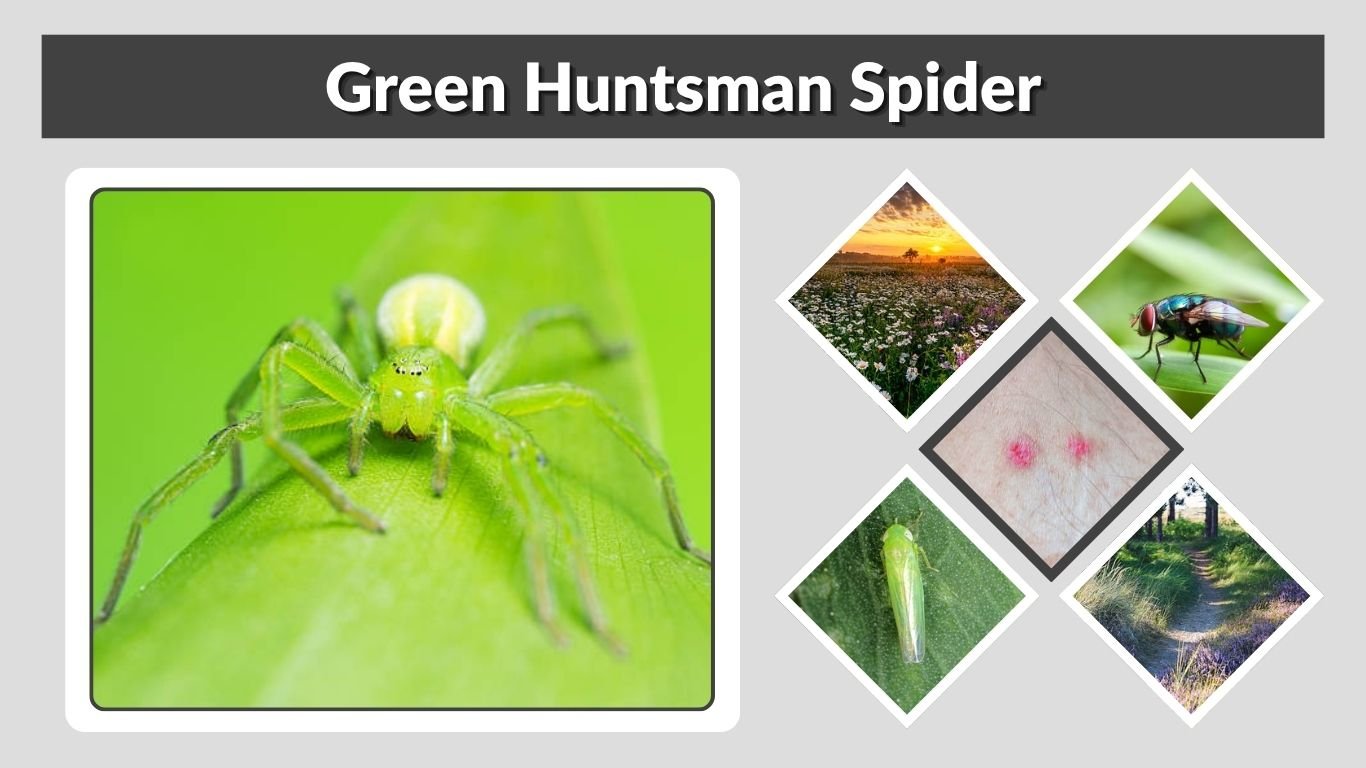
The green huntsman spider is a vivid, leaf-colored hunting spider best known from Europe and parts of Asia. Unlike web-building spiders, it moves through grass, shrubs, and low vegetation searching for insects. Its bright color provides excellent camouflage, making it surprisingly difficult to notice among fresh leaves. The name usually refers to Micrommata virescens, but it is sometimes confused with Australia’s much larger green-bellied huntsman spider. This guide explains how to identify the green huntsman, where it lives, what it eats, whether it is dangerous, and how males, females, and young spiders differ.
What Is a Green Huntsman Spider?
The green huntsman spider, Micrommata virescens, belongs to the huntsman spider family Sparassidae. It is also sometimes called the emerald spider. Despite belonging to a family famous for very large tropical spiders, this European species is relatively small.
The World Spider Catalog recognizes Micrommata virescens as an accepted species with a broad range extending across Europe and parts of temperate Asia.
Quick Facts
| Feature | Details |
| Scientific name | Micrommata virescens |
| Family | Sparassidae |
| Main color | Bright grass green |
| Body length | Approximately 7–13 mm |
| Habitat | Meadows, grasslands, shrubs and woodland edges |
| Diet | Insects and other small invertebrates |
| Web | Does not build a prey-catching web |
| Danger to humans | Not considered medically dangerous |
| Main range | Europe and temperate Asia |
British Arachnological Society material describes the species as a striking green huntsman measuring approximately 7–13 millimeters in body length.
Green Huntsman Spider Identification
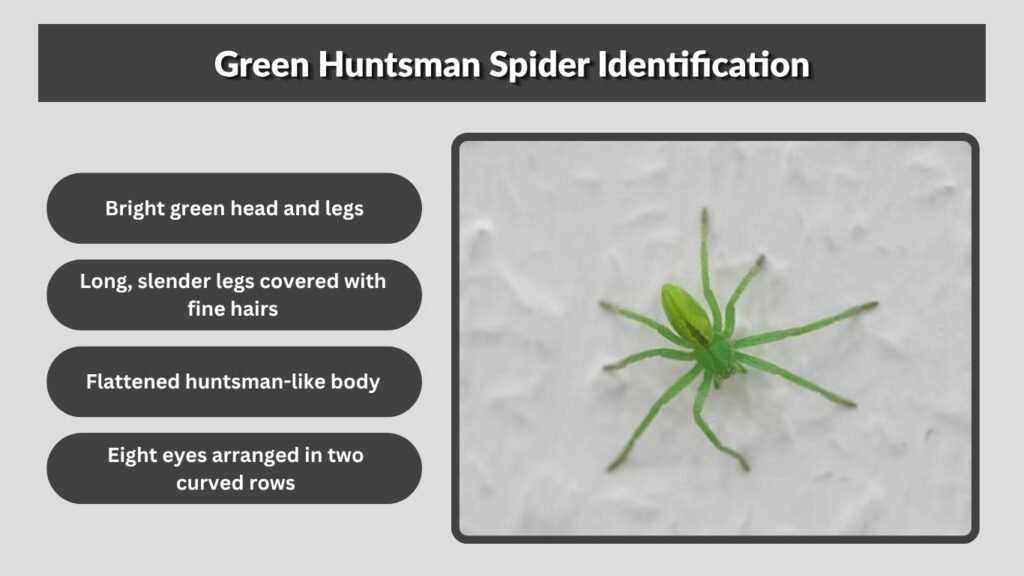
Adult green huntsman spiders have flattened bodies and long legs that spread slightly sideways. Their shape allows them to move quickly between leaves, stems, and blades of grass.
Identification Features
- Bright green head and legs
- Long, slender legs covered with fine hairs
- Flattened huntsman-like body
- Eight eyes arranged in two curved rows
- Pale hairs surrounding parts of the eye region
- Female with a broad green abdomen
- Male with red and yellow abdominal markings
- No large prey-catching web
The legs have dense gripping hairs called scopulae near their ends. These structures help the spider move securely across vegetation. European identification resources also note its long legs and distinctive eye arrangement.
Male vs. Female Green Huntsman Spider
Adult females are generally larger and more uniformly green than males. A female has a grass-green abdomen, sometimes with a slightly darker central marking bordered by yellowish color.
Males have green legs and a green front body, but their abdomen is more colorful. A mature male commonly displays a bright red longitudinal stripe bordered by yellow, with additional red along the sides. These adult colors develop after the final molt, while juveniles can vary considerably in appearance.
| Feature | Female | Male |
| Body | Broader and heavier | Slimmer |
| Abdomen | Mainly green | Yellow-green with red markings |
| Size | Usually larger | Usually smaller |
| Behavior | Guards eggs | Searches actively for females |
Green Huntsman Spider Size
The green huntsman is not a giant spider. Its body is normally between 7 and 13 millimeters long, although the extended legs make it appear considerably wider.
A large female may look impressive when resting with her legs spread across a leaf, but she remains much smaller than the large huntsman spiders associated with Australia, Southeast Asia, and tropical Africa.
Green Huntsman Spider Habitat and Natural Range
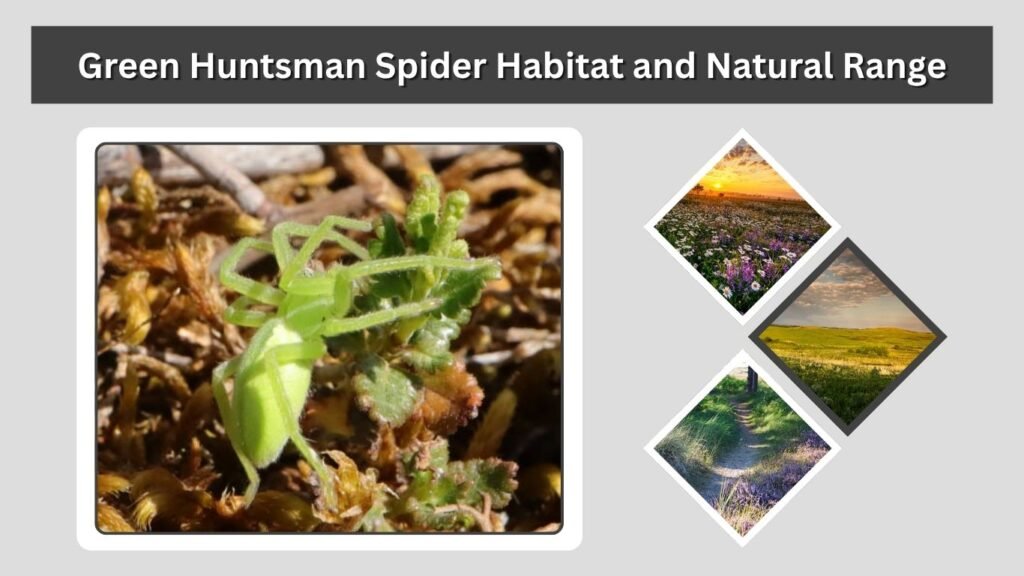
Green huntsman spiders live mainly in vegetation rather than under household furniture or tree bark. They favor warm, sunny places containing tall grass, broad leaves, shrubs, or low tree growth.
Common habitats include:
- Meadows
- Grasslands
- Forest clearings
- Sunny woodland edges
- Roadside vegetation
- Unmanaged field margins
- Gardens with dense plants
- Low shrubs and young trees
The species is active during the day and is particularly associated with warm habitats. Its green coloration blends with vegetation, protecting it from birds while also helping it approach prey without being detected.
Green Huntsman Spider in the UK
Micrommata virescens is Britain’s only native huntsman species. It is primarily recorded in southern England and is much less familiar than ordinary house spiders. Its scarcity and strong camouflage mean that even people living within its range may never see one.
France, Portugal, Cyprus, and Ireland
The species has documented records across numerous European countries, including France, Portugal, Cyprus, and Ireland. However, it is uncommon in some parts of its range; Irish conservation records describe it as rare and historically known from only a small number of counties.
Is It Found in America?
The true Micrommata virescens is not regarded as a native American spider. A green huntsman-like spider photographed in the United States may be a different huntsman, crab spider, running crab spider, or another green hunting species. Location should therefore be considered before identifying a specimen from color alone. Its accepted natural distribution lies across Europe and temperate parts of Asia.
Does the Green Huntsman Build a Web?
The green huntsman does not build an orb, funnel, or sheet web for trapping prey. Instead, it waits among leaves and grasses before quickly grabbing insects that approach.
It can pursue escaping prey and may use a short jump during an attack. Silk is still important, however. Females use it to join leaves together when constructing a protected chamber for their eggs.
What Does a Green Huntsman Spider Eat?
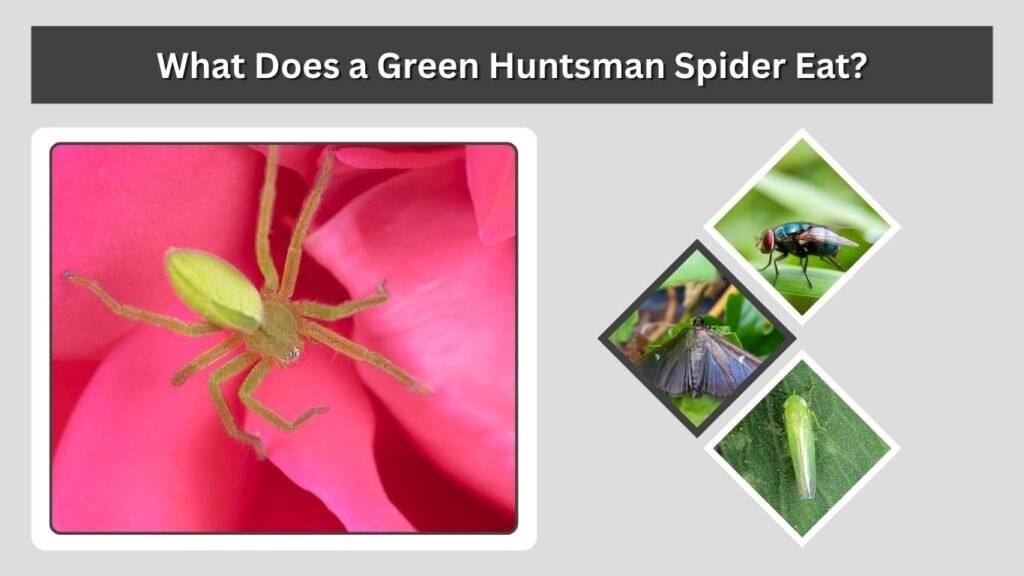
This spider hunts insects and other small invertebrates living among vegetation. Likely prey includes flies, moths, leafhoppers, small beetles, bugs, and other appropriately sized arthropods.
The spider remains still until prey moves within reach. It then seizes the animal with its front legs and delivers venom through its fangs. Because it naturally reduces insect populations, the green huntsman is a beneficial garden predator rather than a plant pest. Its documented hunting method involves ambushing and, when necessary, briefly pursuing prey.
Is the Green Huntsman Spider Poisonous?
The green huntsman is venomous rather than poisonous. It uses venom to immobilize prey, but it is not considered dangerous to humans.
A poisonous animal causes harm when touched or swallowed, whereas a venomous animal injects venom through a bite or sting. Like most spiders, the green huntsman possesses venom, but its small size and nonaggressive behavior make a significant human bite unlikely.
European arachnological information indicates that even females protecting eggs are unlikely to penetrate human skin effectively. Nevertheless, any wild spider should be left alone rather than handled.
Green Huntsman Spider Bite
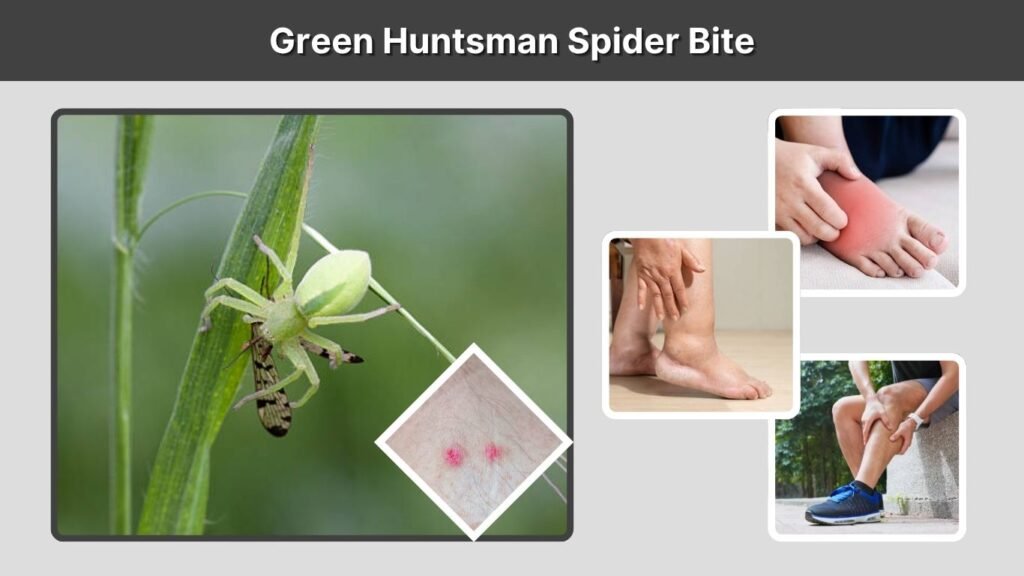
Bites are rarely reported and would most likely occur if the spider were squeezed, trapped against the skin, or handled roughly. It normally relies on camouflage and rapid escape rather than confrontation.
A possible minor bite could produce:
- Brief pain or pinching
- Local redness
- Mild itching
- Temporary tenderness
- Minor swelling
Wash a suspected bite with soap and water and apply a wrapped cold pack for discomfort. Seek medical care if pain or swelling becomes severe, symptoms spread beyond the bite area, or breathing difficulty, facial swelling, dizziness, or widespread hives develop.
Reproduction and Egg Protection
Males become especially active during spring and early summer while searching for females. A male approaches cautiously and taps the female with his front legs before mating.
The female later joins several leaves with silk to create a protective chamber. She places her green eggs inside and guards them until the spiderlings hatch. She may remain with the young briefly before they disperse into nearby vegetation.
Green Huntsman vs. Green-Bellied Huntsman
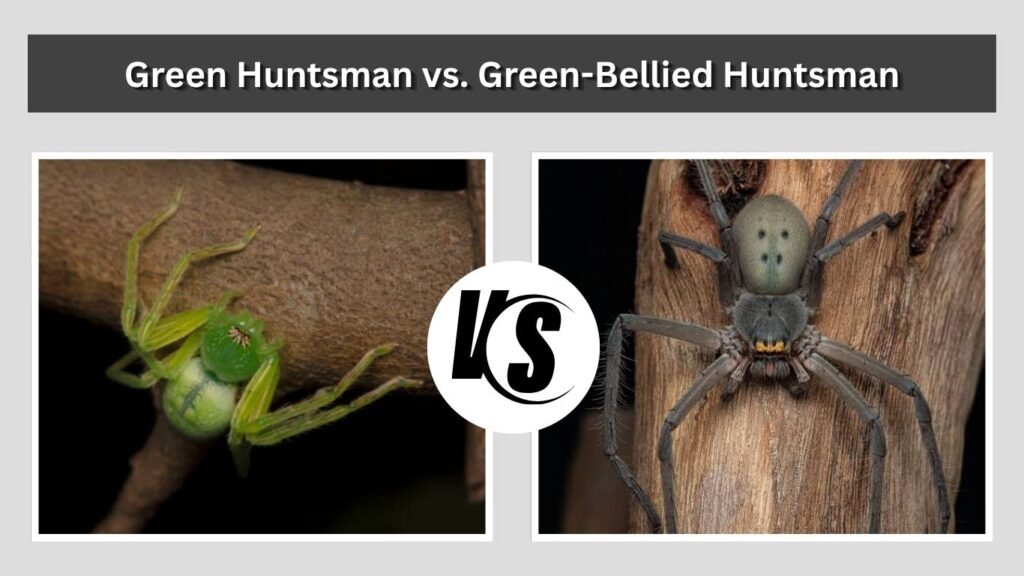
The European green huntsman and Australian green-bellied huntsman are different species.
| Feature | Green Huntsman | Green-Bellied Huntsman |
| Scientific name | Micrommata virescens | Typostola barbata |
| Main range | Europe and temperate Asia | Eastern Australia |
| Body size | About 7–13 mm | Can exceed 40 mm |
| Leg span | Relatively modest | May exceed 150 mm |
| Color | Bright leaf green | Brown-green or fawn |
| Overall build | Slender | Large and heavy |
The green-bellied huntsman is among Australia’s largest spiders by leg span and occurs along the eastern side of the country. It may have greenish areas, dark abdominal spots, and orange hairs near the mouth. It should not be confused with the smaller, vividly green European species.
Are Green Huntsman Spiders Good to Have Around?
Green huntsman spiders are beneficial predators. They do not eat plants, damage buildings, infest food, or create messy prey-catching webs. Their presence usually indicates suitable vegetation and an available supply of small insects.
When one appears inside accidentally, place a container over it, slide stiff paper underneath, and release it into dense vegetation. Direct handling is unnecessary.
FAQs
Are green huntsman spiders dangerous?
No. The European green huntsman is not considered medically dangerous. It avoids people and bites are extremely unusual. Its venom is primarily used against small insect prey.
How large does a green huntsman spider grow?
The body normally measures approximately 7–13 millimeters. Females are usually larger and broader than males, although the long legs can make both sexes appear larger.
Do green huntsman spiders live in Australia?
The European species Micrommata virescens is not the famous Australian green huntsman. Australia has other green or greenish huntsman spiders, including the much larger green-bellied huntsman, Typostola barbata.
Why is the green huntsman bright green?
Its color provides camouflage among leaves, grasses, and low shrubs. This helps the spider hide from predators and remain unnoticed while waiting for insects.
Can a green huntsman spider live in a house?
It may enter accidentally, but it is primarily an outdoor vegetation-dwelling spider. It is more likely to survive in meadows, woodland edges, shrubs, and gardens than inside a house.
