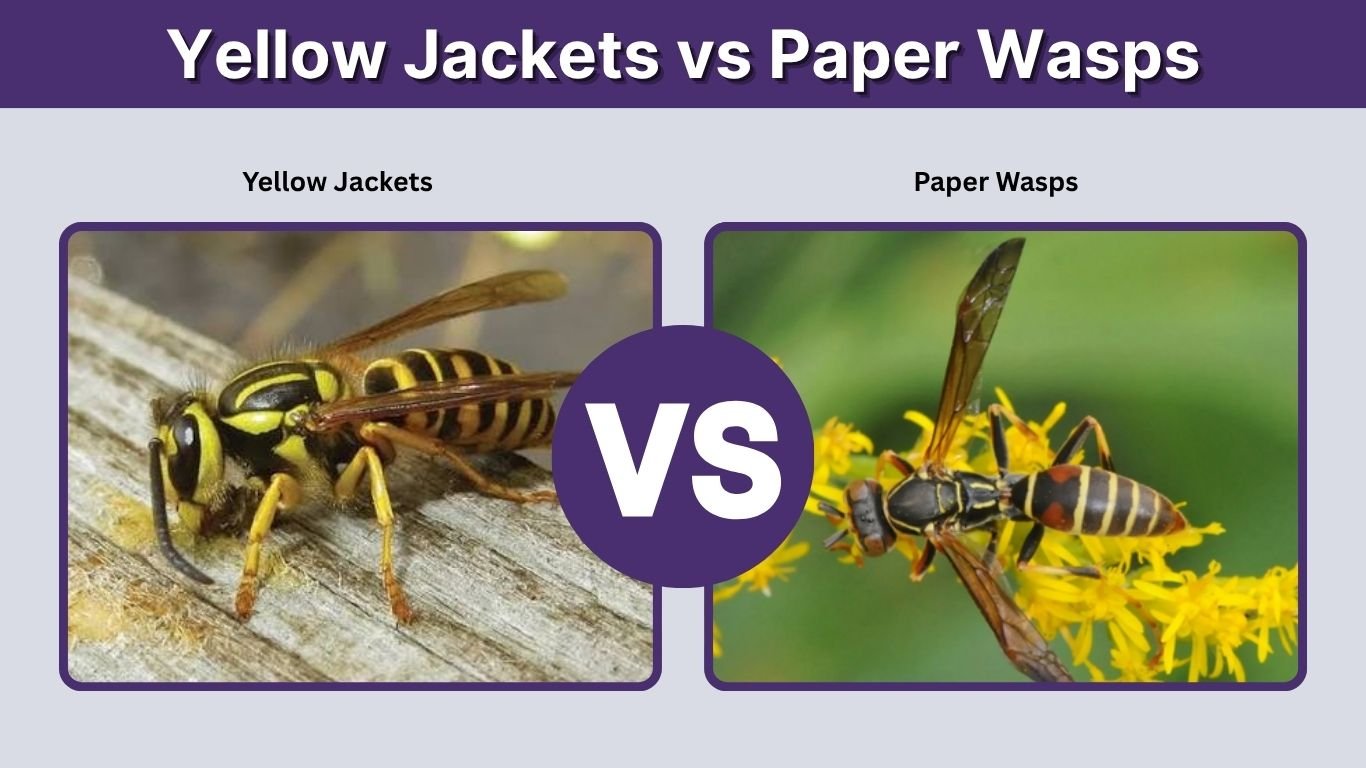
Yellow jackets and paper wasps are social wasps that may appear around yards, gardens, porches, and buildings. Although both can have black-and-yellow markings, they differ noticeably in body shape, behavior, food preferences, and nest construction. Yellow jackets are compact scavengers that commonly build enclosed nests underground or inside cavities. Paper wasps have slender bodies, long dangling legs, and exposed umbrella-shaped nests. Both can sting repeatedly, but yellow jackets generally create more conflicts around people and food.
Yellow Jackets vs Paper Wasps at a Glance
The easiest way to distinguish these wasps is to examine their body shape, antennae, flight posture, and nest. Paper wasps are usually longer and slimmer, whereas yellow jackets have shorter legs and compact bodies.
| Feature | Yellow jacket | Paper wasp |
| Body shape | Short and stocky | Long and slender |
| Waist | Less noticeable | Narrow and clearly defined |
| Legs in flight | Held closer to the body | Often hang visibly downward |
| Antennae | Usually entirely dark | May have orange tips, depending on species |
| Nest | Enclosed and hidden | Open comb without an envelope |
| Typical location | Ground, walls, attics, or cavities | Eaves, railings, branches, and sheltered structures |
| Food behavior | Hunts insects and scavenges sweets or meat | Primarily hunts caterpillars and visits flowers |
| Nest defense | Often intense | Usually less defensive unless the nest is approached |
How to Identify Yellow Jackets
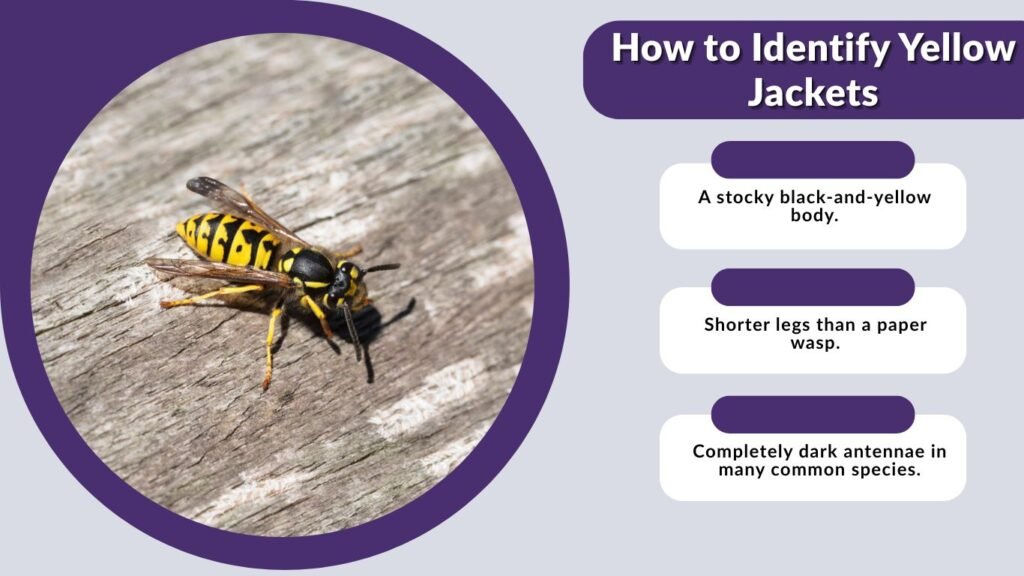
Yellow jackets are smooth-bodied social wasps with sharply defined black-and-yellow or black-and-white patterns. Different species have slightly different abdominal markings, but most have a compact shape, short legs, and relatively broad abdomen.
Main Yellow Jacket Features
Look for:
- A stocky black-and-yellow body
- Shorter legs than a paper wasp
- Completely dark antennae in many common species
- Wings held close to the body while resting
- Fast, direct flight
- Frequent activity around garbage, meat, fruit, and sweet drinks
- Numerous workers entering a small hole in the ground or building
Some yellow jacket species become persistent scavengers during late summer and fall. They may investigate picnic tables, open drink containers, trash cans, pet food, and outdoor cooking areas. Colony populations peak late in the season and may contain thousands of workers.
How to Identify Paper Wasps
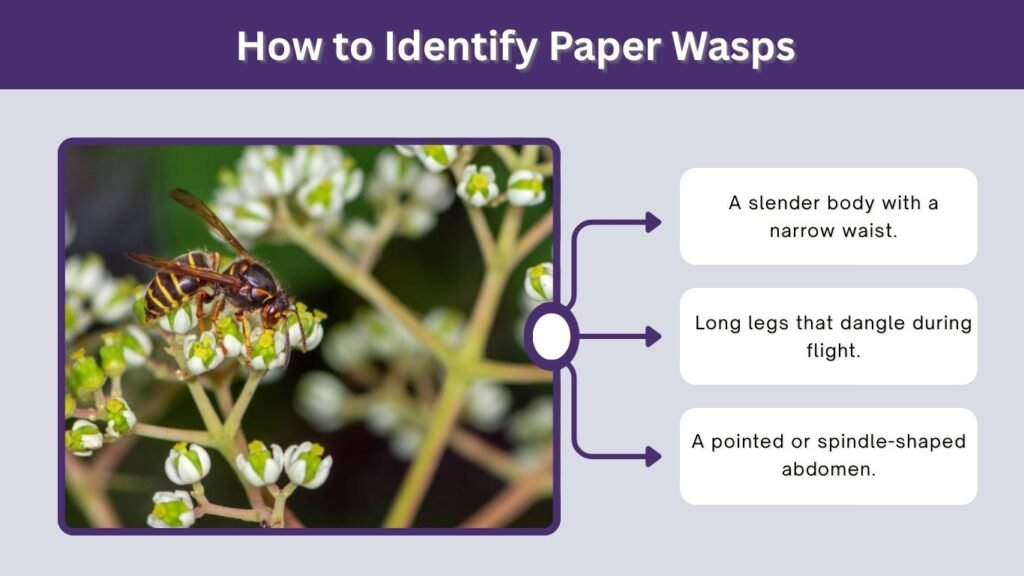
Paper wasps in the genus Polistes have elongated bodies, narrow waists, and noticeably long legs. Their colors vary among species and may include yellow, black, reddish brown, orange, or combinations of these colors.
Main Paper Wasp Features
Look for:
- A slender body with a narrow waist
- Long legs that dangle during flight
- A pointed or spindle-shaped abdomen
- Brown, reddish, black, or yellow coloring
- Slow flight around rooflines and vegetation
- An exposed nest with visible hexagonal cells
- Smaller colonies than those of most yellow jackets
Paper wasps frequently hunt caterpillars and other soft-bodied insects, which they chew and carry back to their developing larvae. Away from the nest, they are generally more interested in hunting or feeding than confronting people.
Yellow Jacket Nest vs Paper Wasp Nest
Nest structure provides the most dependable identification clue. Both wasps make paper by chewing weathered wood fibers and mixing them with saliva, but they use that material differently.
| Nest feature | Yellow jacket nest | Paper wasp nest |
| Outer covering | Enclosed by a paper envelope | No outer envelope |
| Internal structure | Several comb layers | Usually one exposed comb |
| Shape | Rounded or irregular inside a cavity | Umbrella-shaped |
| Entrance | Small opening leading to a hidden colony | All cells remain visible |
| Colony size | Potentially thousands | Usually much smaller |
| Visibility | Often mostly concealed | Normally easy to see |
Paper Wasp Nest
A paper wasp nest resembles an upside-down umbrella attached by a narrow stalk. Its open cells can be seen from below, and adult wasps commonly rest across the surface.
Typical locations include:
- Roof eaves
- Porch ceilings
- Window frames
- Deck railings
- Fence posts
- Mailboxes
- Tree branches
- Inside sheds or garages
Paper wasp nests remain exposed throughout their development. They do not become enclosed in a round paper shell.
Yellow Jacket Nest
Most yellow jackets build enclosed, multilayered paper nests inside protected spaces. Underground colonies may use abandoned rodent burrows, while structural colonies can occupy walls, attics, soffits, and other cavities.
Common signs include a steady stream of wasps entering and leaving:
- A hole in the soil
- A gap beneath siding
- A crack around a roofline
- An opening in a stone wall
- A space around a utility pipe
- A hollow tree or log
The visible hole may be several feet from the main nest chamber. Disturbing the entrance can trigger many workers to defend the colony.
Yellow Jacket Nest vs Paper Wasp Nest in Siding
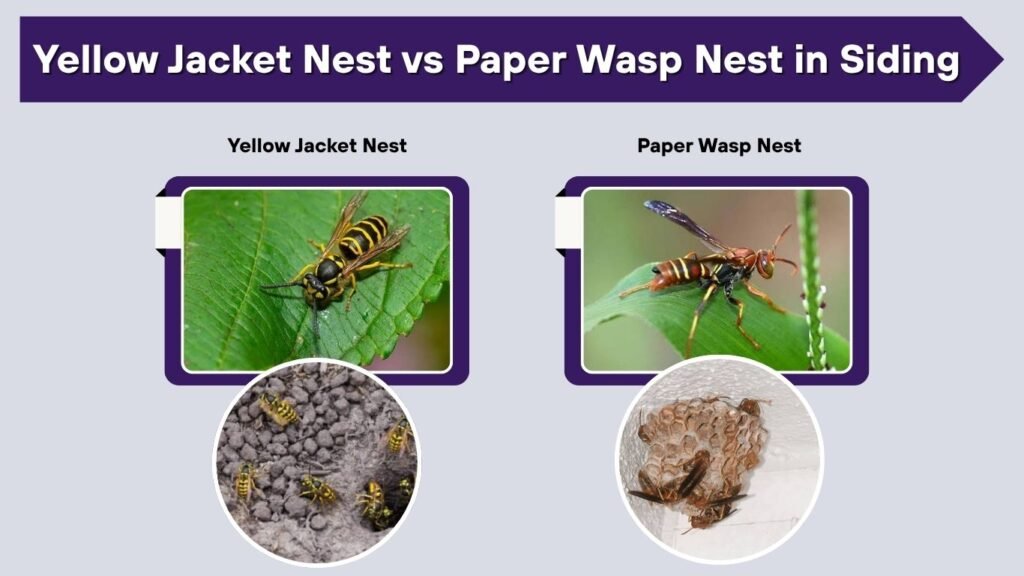
Wasps repeatedly entering siding are more likely to be yellow jackets than paper wasps. Yellow jackets readily build concealed nests inside wall voids, whereas paper wasps usually attach exposed combs beneath an overhang or behind a shutter.
Do not seal an active yellow jacket entrance immediately. Trapped workers may search for another exit and enter the home through walls, vents, lighting fixtures, or ceiling openings. A hidden structural nest is safer to assess and treat with help from a qualified pest-control professional.
European Paper Wasp vs Yellow Jacket
The European paper wasp can look especially similar to a yellow jacket because both have bright black-and-yellow patterns. However, European paper wasps are generally slimmer, have longer legs, and possess orange-tipped antennae. Yellow jackets usually have shorter legs and completely dark antennae.
The nest remains another reliable clue. European paper wasps produce exposed umbrella-shaped combs, while yellow jackets usually construct enclosed nests underground or inside protected cavities.
| Feature | European paper wasp | Yellow jacket |
| Antennae | Orange at the tips | Usually entirely dark |
| Body | Long and slender | Compact and stocky |
| Legs | Long and dangling | Shorter and tucked closer |
| Nest | Open and exposed | Enclosed and usually hidden |
| Food around people | Less likely to scavenge aggressively | Commonly attracted to food and drinks |
Paper Wasp Sting vs Yellow Jacket Sting
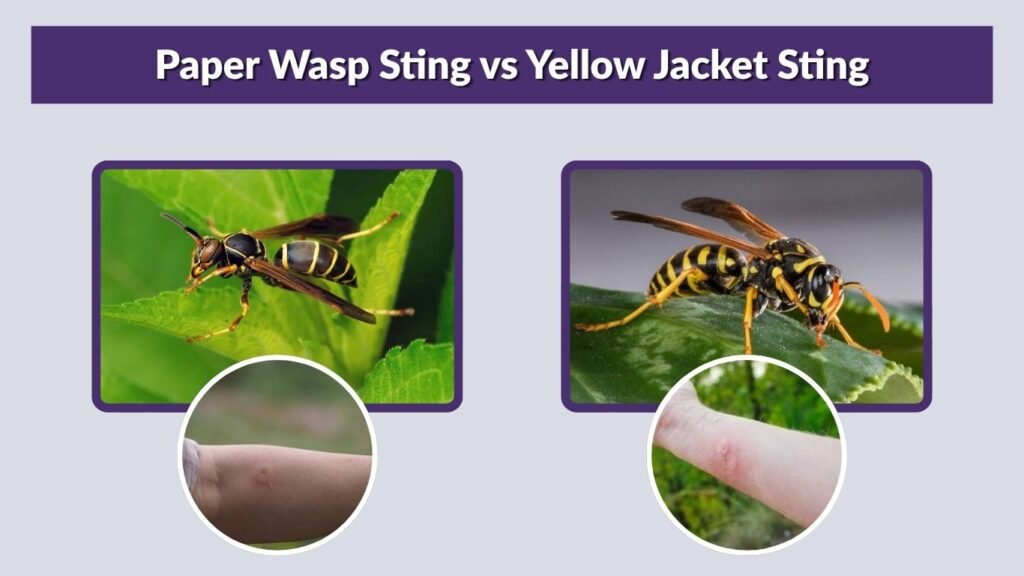
Both yellow jackets and paper wasps have smooth stingers and can sting more than once. Neither routinely leaves its stinger behind in the skin.
It is difficult to say that one sting always hurts more. Pain depends on the species, sting location, amount of venom, number of stings, and the individual’s sensitivity. A single sting from either insect may cause immediate pain, redness, itching, and swelling.
The practical difference is behavioral. Paper wasps are most likely to sting when someone approaches, shakes, or touches their exposed nest. Yellow jackets can defend concealed colonies in large numbers and may also sting when trapped against the skin or disturbed around food.
What to Do After a Sting
Move calmly away from the area to avoid additional stings. Wash the skin with soap and water, and apply a cold pack wrapped in cloth to reduce pain and swelling.
Seek urgent medical assistance for:
- Difficulty breathing or swallowing
- Swelling of the tongue, throat, or face
- Severe dizziness, weakness, or fainting
- Widespread hives
- Vomiting or rapidly worsening symptoms
- Numerous stings, especially in a child
Most localized reactions improve without emergency treatment, but swelling and itching may last for several days.
Paper Wasps vs Yellow Jackets vs Hornets
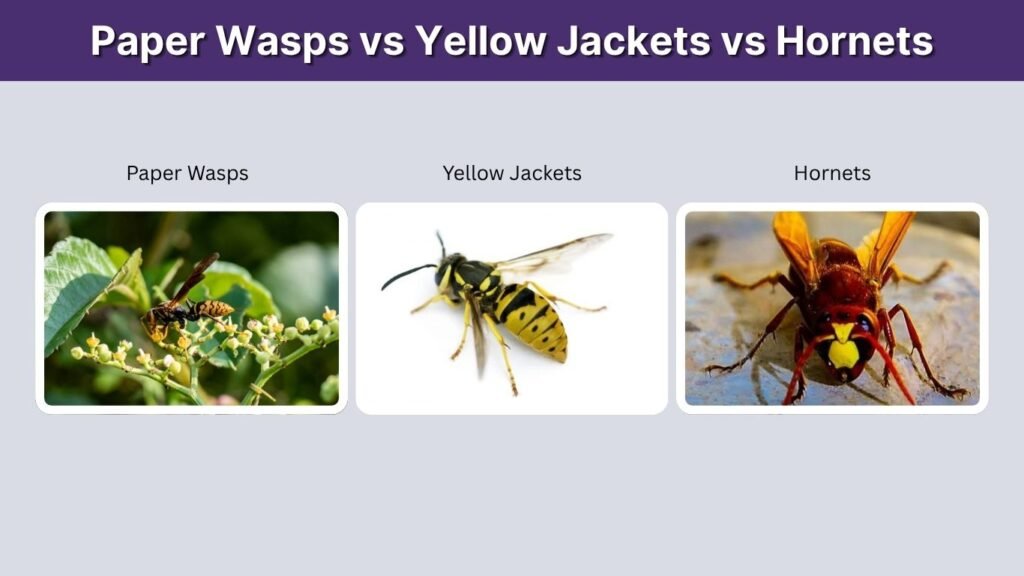
Hornets are closely related social wasps. In North America, the bald-faced hornet is technically an aerial yellow jacket rather than a true hornet. It has a black-and-white body and builds a large enclosed paper nest above ground.
| Wasp type | Body | Typical nest |
| Paper wasp | Slender with long legs | Open umbrella-shaped comb |
| Yellow jacket | Compact and brightly banded | Enclosed underground or cavity nest |
| Bald-faced hornet | Larger, black and white | Enclosed aerial nest |
| European hornet | Large, reddish brown and yellow | Enclosed nest in a cavity |
Paper wasps are usually the least disruptive around food. Yellow jackets are the most likely to become picnic and garbage nuisances, while hornets are mainly dangerous when their nests are approached.
Should You Remove the Nest?
A nest in a remote section of the yard may be left until freezing weather naturally ends the colony. Paper wasps and yellow jackets also provide ecological benefits by feeding their larvae caterpillars, flies, and other insects. Their annual nests are not normally reused the following year.
Removal may be appropriate when a nest is near:
- A doorway or busy walkway
- A children’s play area
- Outdoor seating or dining areas
- A person with a known sting allergy
- A frequently used shed or garage
- A wall opening connected to living space
Large underground or structural yellow jacket colonies are particularly risky to handle without professional equipment. Never pour gasoline into a nest, use fire, block an active entrance, or stand directly in the insects’ flight path.
FAQs
Which is more aggressive, a paper wasp or a yellow jacket?
Yellow jackets generally cause more conflicts because some species aggressively defend large colonies and scavenge around human food. Paper wasps can also defend their nests, but workers encountered away from the nest are usually less confrontational.
How can I quickly tell a yellow jacket from a paper wasp?
Look at the body and legs. Yellow jackets are compact with short legs, while paper wasps are slender with long legs that often dangle during flight. An exposed umbrella-shaped nest confirms paper wasps.
Do yellow jackets and paper wasps reuse old nests?
No. Their colonies normally die after freezing weather, while newly produced queens survive in protected places. Each surviving queen begins a new colony and constructs a new nest when warm weather returns.
Can paper wasps and yellow jackets sting repeatedly?
Yes. Both have smooth stingers that can normally be withdrawn after a sting, allowing them to sting again. This differs from worker honey bees, which usually leave a barbed stinger behind.
Which nest is more dangerous to remove?
A large yellow jacket nest is generally more hazardous because it may contain thousands of workers and is often concealed underground or inside a structure. Exposed paper wasp nests are easier to locate, but disturbing one can still cause multiple stings.